Poetry for Young People: Langston Hughes by David Roessel

Summary: Gr. 6-9. Hughes' stirring poetry continues to have enormous appeal for young people. In this illustrated collection of 26 poems, Andrews' beautiful collage-and-watercolor illustrations extend the rhythm, exuberance, and longing of the words--not with literal images, but with tall, angular figures that express a strong sense of African American music, dreams, and daily life--while leaving lots of space for the words to "sing America." The picture-book format makes Hughes' work accessible to some grade-school children, especially for reading aloud and sharing, but the main audience will be older readers, who can appreciate the insightful, detailed introduction and biography, as well as the brief notes accompanying each poem, contributed by Hughes scholars Roessel and Rampersol. Their comments, together with the quotes from the poet himself, will encourage readers to return to the book to see how Hughes made poetry of his personal life, black oral and musical traditions, urban experience, and the speech of ordinary people. Whether the focus is the Harlem Renaissance, the political struggle, Hughes' African heritage, or the weary blues, this book will find great use in many libraries. Hazel Rochman
Copyright © American Library Association. All rights reserved

Classroom Implications:

A WORK TO TREASURE
, November 5, 2006
Reviewer:D. Blankenship (The Ozarks) -
I cannot think of a better way to introduce the poetry of Langston Hughes than this small volume. The selection is excellent and of interest you the young reader. The commentary is quite relevant as are the pictures which accompany it. I find that often now, our young people go all the way through the early grades in school and many of them have never heard of Hughes,much less read his poetry. This was the sort of stuff my generation and the generation before it grew up on and cut our teeth on. I do not feel I am any worse for the wear. I am fearful that we are bringing up an entire generation (rightfully or wrong, although I feel it is the later) of young folks who will have no appreciation to this great art form and will miss a lot. This book helps. This entire series helps, as a matter of fact and I certainly recommend you add this one and the others to your library. Actually, it is rather fun reading these with the young folk and then talking about them. Not only do you get to enjoy the work your self and perhaps bring back some great memories, but you have the opportunity to interact with your child or student. It is actually rather surprising what some of the kids come up with. I read these to my grandchildren and to the kids in my classes at school. For the most part, when I really get to discussing the work with them, they enjoy it. Recommend this one highly.

Purchase

Poetry Speaks to Children by Elise Paschen


Summary: Grade 3-8–A fine, basic collection. Approximately half of the 97 selections are read or performed on the accompanying CD. The book provides a mix of adult writers (Rita Dove, Seamus Heaney, and Billy Collins, among others) and those whose work is specifically for children, such as X. J. Kennedy and Mary Ann Hoberman. Topics include childhood, animals, nonsense poems, and humor. The three illustrators have captured the different tones of the selections, from a comic portrait of the Jabberwock slayer wearing a colander and wielding a plunger and the wailing children in William Stafford's First Grade, to the moving paintings of a girl with flowers echoing the natural images of James Berry's Okay, Brown Girl, Okay. The CD gives children the opportunity to hear several of the poets, such as Robert Frost reading Stopping by Woods on a Snowy Evening and Langston Hughes reading The Negro Speaks of Rivers. They hear a variety of accents and dialects–an Irish lilt, New England inflections, or James Berry's lilting Jamaican-British voice. Readers of Roald Dahl's books will enjoy hearing him read The Dentist and the Crocodile, and fans of The Lord of the Rings books and movies will appreciate hearing Tolkien read Frodo's Song in Bree. Joy Harjo frames her Eagle Poem with a haunting vocalization that echoes its serious tone.–Barbara Chatton, College of Education, University of Wyoming, Laramie
Copyright © Reed Business Information, a division of Reed Elsevier Inc. All rights reserved.

Classroom Implications: This diverse and appealing collection of poems for children includes poets contemporary (Nikki Giovanni, Billy Collins) and, thanks to archival recordings, not so contemporary (Robert Frost, J.R.R. Tolkien) reading their own work. There are also performances of well-known poems such as "Jabberwocky" and "Casey at the Bat." Some tracks feature the welcome bonus of the poet talking briefly about the background or genesis of a poem. The narrated poems are often unidentified and unattributed, and there are no page-turn signals, so listeners must follow along carefully with the book to keep track of poems and authors. Older children will certainly have a deeper understanding of the poems, but the illustrated picture-book format and lively soundtrack are sure to help hook even the youngest listeners on poetry at an early age. J.M.D. © AudioFile 2006, Portland, Maine-- Copyright © AudioFile, Portland, Maine

Purchase

Owen & Mzee: Language Of Friendship by Isabelle Hatkoff

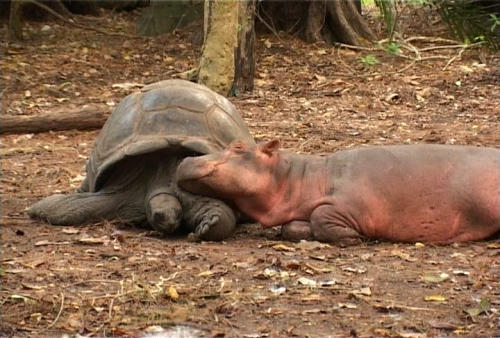
Summary: For somewhat older readers than Marion Dane Bauer's A Mama for Owen (2007), this book updates children on its famous subjects through crisp, immediate photos taken at the Kenyan refuge they call home. The same complicated supporting cast is featured in this book, including a father-daughter team; a naturalist from the refuge; and photojournalist Greste, whose photos here are more varied, abundant, and consistent in quality than before. Along with assuring children that the bond between Owen and Mzee is "stronger than ever," the authors chronicle the animals' system of communication, involving nudges, nips, and even a special kind of call. Libraries that own the first title will certainly want to add this title; those that don't may wish to purchase just this one, which gives the necessary context and duplicates some elements from the earlier book, while extending the information--through references to naturalists' concerns about Owen's need to interact with other hippos, and about Mzee's safety as his companion grows to his 7,000-pound size--in a way that moves beyond the pat, heartwarming aspects of the incident to ask fascinating questions about animal behavior. Jennifer Mattson
Copyright © American Library Association. All rights reserved

Classroom Implications: Kids will be begging for a sequel if they read the original book about Owen and Mzee. This is a great book to have on hand for follow up readings kids may want to do during independent reading. It also makes a great book to read aloud to children if the level of text is too difficult for the readers. It is a nonfiction picture book that adds depth and emotional feeling to the nonfiction genre.

Purchase

Owen & Mzee: The True Story Of A Remarkable Friendship by Isabella Hatkoff

Summary: Kindergarten-Grade 5 When the six-year-old contributor to this book saw the photograph documenting the extraordinary friendship between a baby hippo (Owen) and a 130-year-old giant tortoise (Mzee), she persuaded her father to help tell their story. Originally an e-book, the hardcover version begins with images of the duo, whetting readers' appetite and providing reassurance as the potentially disturbing plot unfolds. After a scene depicting a pod of hippos near the Sabuki River in Kenya, the text describes the 600-pound baby's displacement and separation from the group during the 2004 tsunami. Children witness the challenging rescue and meet the knowledgeable staff at an animal sanctuary. From Owen's first approach for protection to Mzee's unexpected tolerance, the photographs, mostly by BBC photojournalist Greste, capture the pair eating, swimming, snuggling, and playing together. Their contentment and peace are palpable. Because it is sensitively structured, with careful choices about what is emphasized and illustrated, the situation does not overwhelm readers. The text and the back matter are brimming with information about the animals, their caregivers, and the locale. This touching story of the power of a surprising friendship to mitigate the experience of loss is full of heart and hope. A worthy complement is Ann Morris and Heidi Larson's glimpse at a human family's loss and recovery in Tsunami: Helping Each Other (Millbrook, 2005). Wendy Lukehart, Washington DC Public LibraryCopyright © Reed Business Information, a division of Reed Elsevier Inc. All rights reserved.

Additional Illustrations:

This is how Owen appeared on the morning of Dec. 27, 2004 before any attempts were made to catch him. Picture taken by Uncle Joe before putting camera down and entering ocean with two French volunteers (one was named Owen) and one KWS Ranger named Said.

Purchase

Hachiko: The True Story of a Loyal Dog by Pamela Turner

Summary: Gr. 1-4. This small, square picture book pays tribute to one of the world's lesser-known animal heroes: Hachiko, a dog who kept vigil for nearly 10 years at a Tokyo train station, waiting for his deceased master to return from work. Turner unfolds this poignant true story in the natural, unaffected voice of Kentaro, a fictional little boy, who wonders at the dog's unswerving devotion. Unobtrusive details evoke a sense of place ("Ladies in kimonos walked carefully, trying to keep their white tabi socks away from the grime of the streets"), as does Nascimbene's spare line-and-watercolor artwork, reminiscent of Japanese woodblock prints. American children will find the scenes of kimono-clad women bustling alongside men in Western suits especially intriguing. Though Hachiko's eventual death may be upsetting to some (he dies at the station, "still waiting for Mr. Ueno"), the sad news is leavened by an ending that emphasizes his status as a furry folk hero in Tokyo, further elaborated in an afterword. This will resonate with any child who has loved a dog and been loved in return; for reading aloud to groups of older kids, pair the story with The Mightiest Heart (2003), a Welsh legend about another selfless hound. Jennifer Mattson Copyright © American Library Association. All rights reserved

Classroom Implications: A true story taking place in the early 1900's in Japan, students will relate with the resounding message of trust, faithfulness and heroic animals found in this story! It is another nonfiction picture book that captures the warm-hearted animals at their most loyal.

Here is a link to a chapter book about Hachiko that older kids may be inspired to read after they read this picture book. The book is called, Hachiko Waits by Leslie Newman.

Purchase

Remember: The Journey to School Integration by Toni Morrison

Summary: Grade 3-8–This unusual blend of archival photographs, historical background, and fictional narrative brings to life the experiences and emotions of the African-American students who made the tumultuous journey to school integration. Dramatic, mostly full-page, black-and-white photographs make up the bulk of the book. An introduction sets the scene, and factual pages, consisting of several sentences, are scattered throughout. They explain the significance of the events, the trauma of racial conflict, the courage and determination of African Americans and their supporters, and the importance of remembering and understanding. With poignant simplicity and insight, Morrison imagines the thoughts and feelings of some of the people in the pictures. The wrenching, inspiring autobiographical school integration memoirs of first-grader Ruby Bridges (Through My Eyes [Scholastic, 1999]) and Little Rock Nine high school junior Melba Pettillo Beals (Warriors Don't Cry [Washington Square, 1995]) offer greater immediacy and convey a powerful message for future generations about the need for understanding, self-awareness, and self-respect. However, Morrison's reflective interpretation presents a gentler guide for younger readers. Appended are a chronology of "Key Events in Civil Rights and School Integration History"; "Photo Notes" that describe the actual date, location, and content of each picture; and a dedication that recalls the four young girls killed in the bombing of their Birmingham, AL, church in 1963. The provocative, candid images and conversational text should spark questions and discussion, a respect for past sacrifices, and inspiration for facing future challenges.–Gerry Larson, Durham School of the Arts, NC
Copyright © Reed Business Information, a division of Reed Elsevier Inc. All rights reserved.

Classroom Implications: This text is "a gentle guide" for younger, less-experienced or highly sensitive readers. It is an interpretive text that straddles the lines between fiction and nonfiction (Morrison inserts thoughts/feelings to certain photographs in the text). This is a text that recounts AND reflects on the school desegration that the nation faced during the civil rights movement. Would be a nice pair with The Forbidden Schoolhouse: The True and Dramatic Story of Prudence Crandall and Her Students.


Purchase

The Forbidden Schoolhouse: The True and Dramatic Story of Prudence Crandall and Her Students by Suzanne Jurmain

Summary: Gr. 5-8. Jurmain has plucked an almost forgotten incident from history and has shaped a compelling, highly readable book around it. In 1831, Prudence Crandall opened a school for young white ladies. When asked by an African American teenager if she might join the class, Crandall, whose sympathies were with the abolitionists, agreed. So begins a jolting episode in which Crandall turned her school into one for girls of color, and is both tormented and sued by the citizenry of Canterbury, Connecticut, who wanted no part of African Americans in their town. Writing with a sense of drama that propels readers forward (and quoting the language of the day, which includes the word nigger), Jurmain makes painfully clear what Crandall and her students faced, while showing their courage as they stood up to those who tried to deter them. Printed on thick, snowy stock and including a number of sepia-toned and color photographs as well as historical engravings, the book's look will draw in readers. Children will be especially pleased by the appended material, which includes an epilogue that tells what became of the principals, as well as source notes for the many quotes. Ilene CooperCopyright © American Library Association. All rights reserved

Classroom Implications: What's great about this nonfiction text is that it's about desegregation but takes place in a northern setting! Students often read about desegregating schools in the South during the civil rights movement. But this book takes readers back to the 1800's in New England. This book is a nice transition from nonfiction picture books and nonfiction reading students engage in during high school. Therefore, this books is a perfect nonfiction read for the middle grades.

Purchase