Showing posts with label point of view. Show all posts

The Sweetest Fig by Chris Van Allsberg


Summary: Grade 3 Up-Another quietly bizarre and stunning picture book from Van Allsburg. In this modern fairy tale, a Parisian dentist (a prissy and sadistic man who even hates his own dog) is given two magic figs by an old woman who tells him, "'They can make your dreams come true.'" Bibot scoffs. However, after the first fig proves to do exactly that (in a scene in which the dentist walks down the street in his underwear, and then the Eiffel Tower droops over), he realizes how precious they are. Night after night, he hypnotizes himself into dreaming that he is the richest man on earth. Finally, he prepares to eat the second fig. But his dog, Marcel, beats him to it, and the following morning, the dentist wakes up as the helpless pup under a bed, with his own face calling to him, "'Time for your walk. Come to Marcel.'" The Sweetest Fig is a superb blend of theme, language, and illustration, with a very grabbing plot as well. The writing is formal yet direct, using simple, deliberate vocabulary to match the elegant setting and mood. The shades of gray, cream, and brown and the calm, stable design enhance this mood. The angle at which readers view scenes is always intriguing and heightens their involvement. Most children old enough to read this complex book on their own will be fascinated and will return to it again and again. Van Allsburg at his best.
Lauralyn Persson, Wilmette Public Library, IL
Copyright 1993 Reed Business Information, Inc.

Classroom Implications: This text is great to teach point of view and perspective due to the sudden shift at the end of the book. It also lends itself well to characterization and cause and effect concepts.

Purchase

Zoom by Istvan Banyai

Summary: From Booklist:Grades 3-8. Beginning with a close-up of a rooster's comb, each picture zooms out to give a more distant perspective; for example, the "camera" zooms out to show increasingly distant figures of children watching the rooster. Then, a large hand appears, showing that the scene was not depicting a real farm, but a toy farm set. But zoom out a few more times, and the scene reveals that the picture of the girl playing with the farm set is really on the magazine held by a boy, who's sleeping in a chair, which is by a pool, which is on an ocean liner, which is out at sea--no, wait--that picture is on a cruise-line poster on the side of a city bus, but that picture is on a television screen in the Arizona desert . . . and so on until the earth is shown from above, growing smaller with each turn of the page. The final scene is one white dot on a black page. Clear-cut paintings outlined in ink appear on each right-hand page; the left-hand pages are black. Not a story, but an "idea" book, it makes the viewer ask, "What am I really seeing here?" This clever picture book could be intriguing..., depending on the viewer's frame of mind, but children will find it worth a look. Once, anyway. Carolyn Phelan

Sequel Information: Re-Zoom
Summary: From Publishers Weekly:Re-Zoom resumes, or more accurately, reprises, the layout and nothing-is-as-it-seems perspective of last season's Zoom. Featuring detailed drawings backpainted on animation cels, this text-free volume opens with a red-on-blue cave painting that, with the turn of a page, becomes a detail on a wristwatch. The next spread reveals that the watch belongs to a young man doing a rubbing of carved hieroglyphs... and so on. To surprise his audience, which may already expect the sequence of pictures to expand to infinity, as in Zoom, Banyai toys not only with spatial relations but with time and with cultural referents: people in 19th-century garb, admiring an image of Napoleon, turn out to be on a movie set; a woman in traditional Japanese dress sports a yellow Walkman. There are nods to the arts as well. A black-and-white Alfred Hitchcock and a blue bodhisattva sit astride a thundering elephant, and a dejected-looking Picasso rides the New York City subway. The finale-which leaves readers in a subway tunnel as the train's red taillights recede-may not be as mindbending as Zoom's outer-space flight, but is nonetheless a clever solution. All ages. Copyright 1995 Reed Business Information, Inc. --This text refers to an out of print or unavailable edition of this title.

Purchase

The Other Side by Istvan Banyai

Summary: Grade 6 and Up–There's nothing mundane or predictable about Banyai's wordless picture book. As in Zoom and Re-Zoom (both Viking, 1995), the illustrator takes his audience on a visual journey that begins with a nearly blank page that, when turned, reveals instructions for folding a paper airplane. On the next page, a girl in her high-rise apartment practices her cello and a paper airplane can be seen outside her window. Readers flip the page to see the girl's building from the outside looking in. Paper airplanes are everywhere, thanks to a young neighbor one floor up who has been practicing his folding skills. Each pair of pages, front and back, presents inside and outside views, and although the scenes are not obviously linked to a larger plotline, they are connected through reoccurring images, colors, and themes. This is a challenging book, one that allows for creative speculation. The graphite-rendered artwork is quirky as well as infinitely interesting. Not everyone will get the sly humor, or be prepared to indulge in a book that demands such work. However, those who give it a try will be drawn into a thought-provoking, whimsical world. It's a book that begs to be talked about, and teachers will find it a useful tool for discussions about point-of-view and perspective.–Carol L. MacKay, Camrose Public Library, Alberta, Canada Copyright © Reed Business Information, a division of Reed Elsevier Inc. All rights reserved.

Notable Information: This text would be most efficiently used in an upper grade classroom. The way the story builds off of the perspective shifts is highly complex. It is a highly usable text to teach perspective, point of view and symbolism. The Other Side would also pair nicely with a writing activity based around the perspectives of the text. Students could also develop complex conceptual ideas that could become literary essays.

Text Excerpt:

Purchase

The Red Book by Barbara Lehman


Summary: Kindergarten and Up: In this wordless mind trip for tots, Lehman develops a satisfying fantasy in a series of panels framed with thick white borders. The effect is of peering through portals, an experience shared by the characters as they independently stumble across enchanted red books that provide them with a videophone-like connection. Though wordless picture books often seem to be the province of fine artists indulging in high-concept braggadocio (as in Istvan Banyai's 1995 Zoom), Lehman's effort ensures child appeal with an unaffected drawing style and a simple, easy-to-follow story line about a friendship forged between a city girl and a faraway island boy. The message about the transporting power of story will moisten the eyes of many adult readers, but children will most appreciate the thought-provoking visuals, in which characters' actions influence the course of their own storybook narratives--likewise affecting the larger "red book," cleverly packaged to mimic the shape and color of its fictional counterpart. Ideal for fueling creative-writing exercises. Jennifer Mattson Copyright © American Library Association. All rights reserved

Classroom Implications: This post-modern, book within a book, plays with perspective like Flotsam or Zoom. The Red Book deconstructs the common picture book motif, where the characters seem to affect and create the story as the pages turn. The wonderful teaching point this book carries is that character's actions influence the course of the story. This is an essential element of reading and writing to expose students to in the classroom. Kids in the upper grades can take advantage of this wordless text and use the pictures to create their own story.

Purchase

Homemade Love by bell hooks

Summary: PreSchool-K-Evans's wonderful illustrations raise this paean to parental love a notch above the ordinary. "My mama calls me girlpie. Her Sweet sweet. Daddy's honey bun chocolate Dew Drop. Homemade Love," says the small African-American narrator. The story line is minimal: her parents love her, even when she does something wrong, and their love supports her, even at night. The rhythm of the words, the smoothness of the text, and the positive message all combine to make a lovely read-aloud, despite a slightly treacly premise. Evans's folksy paintings, done in bright primary colors, are wonderful, with an appealing, dark-skinned, large-eyed little girl wearing dresses decorated with patterns that reflect the story. The artist fills up the pages so completely that readers only see the parents from the waist down for the first half of the book. When the child breaks something, her sorrow is evident, and after everything is all better, "kiss kiss," she goes outside and does cartwheels in the flowers, exuding happiness and a zest for life. An appealing addition for most collections. Amy Lilien-Harper, The Ferguson Library, Stamford, CT
Copyright 2002 Reed Business Information, Inc.

Classroom Implications: This book does not as strong of a story line as previous books by hooks, yet it still captures the love shared in a family. This story is about unconditional love, a subject that many students can identify or disidentify with based on their own experiences.

Purchase

There Is a Flower at the Tip of My Nose Smelling Me by Alice Walker

Summary: From Publishers Weekly
Walker (The Color Purple; Finding the Green Stone) praises the surroundings that fortify the human experience. In her vision, people do not work their will on the things around them, but rather the people and the universe influence each other: "There is a flower/ At the tip/ Of my nose/ Smelling/ Me./ There is a sky/ At the end/ Of my/ Eye/ Seeing/ Me." Vitale (When the Wind Stops) paints great swaths of sunset sky that glow from the horizon, illuminating the serene face of a dreaming girl who looks as if she would be at home anywhere. "There is a dance/ That lives/ In my bones/ Dancing/ Me," reads the text, as the heroine, charged from within by streams of incandescent energy, leaps and sways in swirls of sunlight that stream out from her fingertips. "There is a story/ At the end/ Of my arms," Walker concludes, "Telling/ Me!" Now a rainbow falls over the girl's face, and creation holds out marvelous possibilities. Smaller versions of herself surround the girl in a frieze: in these miniature images she flies, dives into the waves with a fish and climbs the leaves of an enormous white flower to kiss its face. It's less a story than an illuminated prayer"an expression of gratitude for one girl, all humans and the whole of the cosmos. All ages. (Apr.)
Copyright © Reed Business Information, a division of Reed Elsevier Inc. All rights reserved.

Classroom Implications: In the author's note in the back of the book, Alice Walker writes that this book began as a thank-you note. Students would really latch onto this concept. This text extends the idea of gratitude and shifts to a more universal way of looking at things. Middle school students may use this as a mentor text to inspire a new kind of writing that originates from a different, more universal perspective.

Text Excerpt:


Purchase

Finding Miracles by Julia Alvarez


Summary: Grade 6-9–In spite of her family's openness, Milly Kaufman has never wanted to talk about her adoption. However, during ninth grade, Pablo Bolívar, a refugee from an unnamed Central American country, joins her class and immediately identifies her as someone who might have come from his family's hometown. Then, her grandmother attempts to make a will that differentiates between her and her siblings. While her mother and father's angry reaction makes the woman back down, their increasingly close relationship with Pablo's family makes it impossible for Milly to stop thinking about the parents who gave her up and the war-torn nation she came from. When that country's dictator is deposed in a democratic election, the Bolívars go home to visit and invite Milly along. There she discovers a world quite different from her Vermont home, an extended family, a boyfriend in Pablo, and several possible sets of birth parents. She realizes, too, how much she loves her own family, and they join her for a grand reunion. The strength of this book lies in its description of adoption issues–Milly's feelings of abandonment and difference and her sister's fear that Milly's increased identification as Latina will destroy their close relationship. However, the plot is contrived to help Milly find her identity, and the characters never really come alive. The home country has been stripped of any identifying characteristics that might make the setting interesting. Still, readers interested in this subject will be pleased with the satisfying resolution.–Kathleen Isaacs, Edmund Burke School, Washington, DC Copyright © Reed Business Information, a division of Reed Elsevier Inc. All rights reserved.

Themes: Adoption, Family, Identity, Heritage, Abandonment, Belonging, Hybrid Identities

Classroom Implications: Becoming Naomi Leon iimmediately comes to mind when the character in this book struggles with a piece of her identity that lingers in her native country. Alvarez carefully explores relationships in this book--relationships between characters, countries and identities.

Purchase

Beauty: A Retelling of the Story of Beauty and the Beast by Robin McKinley

Summary: Ages 9-12 Amazon.com Review This much-loved retelling of the classic French tale Beauty and the Beast elicits the familiar magical charm, but is more believable and complex than the traditional story. In this version, Beauty is not as beautiful as her older sisters, who are both lovely and kind. Here, in fact, Beauty has no confidence in her appearance but takes pride in her own intelligence, her love of learning and books, and her talent in riding. She is the most competent of the three sisters, which proves essential when they are forced to retire to the country because of their father's financial ruin.

The plot follows that of the renowned legend: Beauty selflessly agrees to inhabit the Beast's castle to spare her father's life. Beauty's gradual acceptance of the Beast and the couple's deepening trust and affection are amplified in novel form. Robin McKinley's writing has the flavor of another century, and Beauty heightens the authenticity as a reliable and competent narrator.

This was McKinley's first book, written almost 20 years ago. Since that time she has been awarded the Newbery Medal for The Hero and the Crown and has delighted her fans with another retelling of the Beauty and the Beast fable, Rose Daughter. Still, McKinley's first novel has a special place in the hearts of her devoted readers, many of whom attest to relishing Beauty time and again.

Possible other texts:
Classroom Implications: McKinley's first book, Beauty, provides an excellent starting point for students to dive into a fantasy study. McKinley also chooses strong female narrators and points of view for her characters, an added plus in fantasy.

Purchase

The First Part Last by Angela Johnson

Summary: Ages 11+. Rarely do we see teen pregnancy from the father's perspective. Narrator Khalipa Oldjohn gives realistic insight into the consequences of unexpected parenthood on one teenaged father. Alternating between "then," when Nia told him on his sixteenth birthday that he was going to be a father, and "now," as he struggles to raise his daughter alone, we witness Bobby coming to grips with responsibility as he struggles to do the right thing. The back-and-forth between past and present requires close attention to the narration to understand why Bobby gave up the adoption option in favor of fatherhood. N.E.M. 2005 YALSA Selection © AudioFile 2005, Portland, Maine-- Copyright © AudioFile, Portland, Maine

Themes:
Responsibility, Parenting, Choices

Classroom Implications: This novel includes a crucial voice for the male YA audience. It positions the male in a position that is normally not documented and explored in YA literature. There is also an audio version available that may be helpful for lower level readers, sp.ed. and e.l.l. students.


Purchase

Witness by Karen Hesse

Summary--Ages 9-12 . It is 1924, and a small Vermont town finds itself under siege--by the Ku Klux Klan. Using free verse, Newbery Medal-winning author Karen Hesse (Out of the Dust) allows 11 unique and memorable voices to relate the story of the Klan's steady infiltration into the conscience of a small, Prohibition-era community. The Klan's "all-American" philosophy is at first embraced by several of the town's influential men, including Constable Parcelle Johnson and retailer Harvey Pettibone. But Harvey's sensible wife, Viola, and independent restaurant owner Iris Weaver suspect from the beginning that the Klan's arrival heralds trouble. As the only African Americans in town, 12-year old Leonora Sutter and her father try to escape Klan scrutiny, while 6-year-old, city-born Esther Hirsch remains blissfully unaware of the Klan's prejudice against Jews as she enjoys the Vermont countryside. And Sara Chickering, the lady farmer who has opened her home to Esther and her father, is torn between her own hidden biases and her growing love for Esther. All, however, are galvanized towards action when a shadowy figure shoots at Esther and her father right through Sara's front door. Who would commit such an evil act? And is it too late to remove the poison that has insidiously leaked into their once tight-knit community? Part mystery, part social commentary, Hesse's historically accurate chronicle is a riveting catalyst for discussion that thoughtfully explores race and identity from every possible point of view. The free verse format and distinct characterizations also make Witness a perfect choice for library or classroom reader's theater productions. --Jennifer Hubert

Themes:
Community, Justice, Fear, Prejudice

Classroom Implications: This book teaches
tough concepts and is written with the young or struggling reader in mind. It is an excellent historical fiction book for the struggling reader or younger reader. It also makes a nice transition between historical fiction and poetry/prose. Witness makes room to teach concepts such as, narrative voice, perspective, point of view, verse, and descriptive language.

Purchase

Fever 1793 by Laurie Halse Anderson

Summary: Ages 12 and up. On the heels of her acclaimed contemporary teen novel Speak, Laurie Halse Anderson surprises her fans with a riveting and well-researched historical fiction. Fever 1793 is based on an actual epidemic of yellow fever in Philadelphia that wiped out 5,000 people--or 10 percent of the city's population--in three months. At the close of the 18th century, Philadelphia was the bustling capital of the United States, with Washington and Jefferson in residence. During the hot mosquito-infested summer of 1793, the dreaded yellow fever spread like wildfire, killing people overnight. Like specters from the Middle Ages, gravediggers drew carts through the streets crying "Bring out your dead!" The rich fled to the country, abandoning the city to looters, forsaken corpses, and frightened survivors.
In the foreground of this story is 16-year-old Mattie Cook, whose mother and grandfather own a popular coffee house on High Street. Mattie's comfortable and interesting life is shattered by the epidemic, as her mother is felled and the girl and her grandfather must flee for their lives. Later, after much hardship and terror, they return to the deserted town to find their former cook, a freed slave, working with the African Free Society, an actual group who undertook to visit and assist the sick and saved many lives. As first frost arrives and the epidemic ends, Mattie's sufferings have changed her from a willful child to a strong, capable young woman able to manage her family's business on her own. --Patty Campbell

Themes:
Social Change, Transformation

Classroom Implications: If students read Speak in social issues book clubs, then they will be excited to read Fever 1793 in historical fiction book clubs. This book pairs nicely with
An American Plague: The True and Terrifying Story of the Yellow Fever Epidemic of 1793 by Jim Murphy. This novel carries strong characterization into a historical setting. This blend attracts readers to use their skills of characterization and bridge it into a genre that is typically difficult to spark immediate engagement.

Purchase

If You Come Softly by Jacqueline Woodson

Summary: Ages 10-up. Once again, Woodson (I Hadn't Meant to Tell You This) handles delicate, even explosive subject matter with exceptional clarity, surety and depth. In this contemporary story about an interracial romance, she seems to slip effortlessly into the skins of both her main characters, Ellie, an upper-middle-class white girl who has just transferred to Percy, an elite New York City prep school, and Jeremiah, one of her few African American classmates, whose parents (a movie producer and a famous writer) have just separated. A prologue intimates heartbreak to come; thereafter, sequences alternate between Ellie's first-person narration and a third-person telling that focuses on Jeremiah. Both voices convincingly describe the couple's love-at-first-sight meeting and the gradual building of their trust. The intensity of their emotions will make hearts flutter, then ache as evidence mounts that Ellie's and Jeremiah's "perfect" love exists in a deeply flawed society. Even as Woodson's lyrical prose draws the audience into the tenderness of young love, her perceptive comments about race and racism will strike a chord with black readers and open the eyes of white readers ("Thing about white people," Jeremiah's father tells him, "they know what everybody else is, but they don't know they're white"). Knowing from the beginning that tragedy lies just around the corner doesn't soften the sharp impact of this wrenching book. Copyright 1998 Reed Business Information, Inc.

Themes:
Inter-racial dating, Families, Membership, Prejudice

Classroom Implications:
If a classroom was focusing on author study book clubs, this would be an excellent book to start with in a J. Woodson group. There are several of her books posted on this blog. This book is great for teaching first- and third-person narration, membership, prejudice, and descriptive language.

Purchase

Define "Normal" by Julie Anne Peters

Summary: Grade 7-10-When Antonia is assigned to Jazz as a peer counselor, she figures there is no way she can help this tattooed, pierced, incorrigible girl. They are complete opposites. Antonia is a straight-A student whose parents are divorced and she is struggling to keep what's left of her family together as her mother battles depression. Jazz's family is wealthy and seemingly perfect. As they continue through the 15 hours of peer counseling, it becomes clear that both girls have issues they need to work through. They go from wary classmates to friends who support and help one another. As Antonia's mother is hospitalized for her depression, Jazz battles her own mother's need to control by quitting the one thing she loves most-playing classical piano. Both girls deal with their losses by finding new ways to look at their problems and to resume life as "normally" as possible. This believable book is well written and readers will feel that they know both Jazz and Antonia, and they will want to see them triumph over the frustrations in their lives. Kimberly A. Ault, Lewisburg Area High School, PA Copyright 2000 Reed Business Information, Inc

Themes:
Identity, Inclusion/Exclusion, Stereotypes, Membership

Classroom Implications:
This is a wonderful book to begin a conversation on what is considered "normal" in different communities. Middle school students can latch onto this tough subject using this novel. It is also a great novel to reach out to marginalized youth that sit on the peripheries of normalized school student bodies. Julie Anne Peters has a variety of books that touch on this issue and uses her literature to advocate for marginalized youth. In Luna, she features and advocates for a transgendered character. Another book that reaches out to LGBTQ youth is What Happened to Lani Garver? This text is recommended for high school and carries some controversial images, language and content, but can be used as an excellent tool to inspire students to question identity and labels.

Purchase

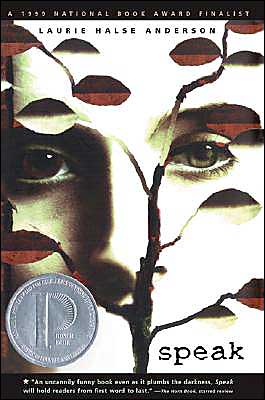
Speak by Laurie Halse Anderson

Summary: Ages 12-up. In a stunning first novel, Anderson uses keen observations and vivid imagery to pull readers into the head of an isolated teenager. Divided into the four marking periods of an academic year, the novel, narrated by Melinda Sordino, begins on her first day as a high school freshman. No one will sit with Melinda on the bus. At school, students call her names and harass her; her best friends from junior high scatter to different cliques and abandon her. Yet Anderson infuses the narrative with a wit that sustains the heroine through her pain and holds readers' empathy. A girl at a school pep rally offers an explanation of the heroine's pariah status when she confronts Melinda about calling the police at a summer party, resulting in several arrests. But readers do not learn why Melinda made the call until much later: a popular senior raped her that night and, because of her trauma, she barely speaks at all. Only through her work in art class, and with the support of a compassionate teacher there, does she begin to reach out to others and eventually find her voice. Through the first-person narration, the author makes Melinda's pain palpable: "I stand in the center aisle of the auditorium, a wounded zebra in a National Geographic special." Though the symbolism is sometimes heavy-handed, it is effective. The ending, in which her attacker comes after her once more, is the only part of the plot that feels forced. But the book's overall gritty realism and Melinda's hard-won metamorphosis will leave readers touched and inspired. Copyright 1999 Reed Business Information, Inc.

Themes:
Identity, Inclusion/Exclusion, Teenage/Female Violence

Classroom Implications: This novel pulls the reader into the world of an isolated teenager. This novel would be matched well with The Misfits, The Perks of Being a Wallflower, The Pinballs, The Outsiders, or Define Normal--all books that address identities and lives on the periphery. This is an excellent novel to study first person narration, symbolism, internal/external conflict and point of view.

Purchase

Show Way by Jacqueline Woodson

Kindergarten-5. A Show Way is a quilt with secret meanings, and the image works as both history and haunting metaphor in this exquisite picture book. Based on Woodson's own history, the unforgettable story tells of African American women across generations, from slavery and the civil rights movement to the present. The cut-out jacket design is impressive, as is Talbott's mixed-media artwork inside, which extends Woodson's clear poetic narrative with beautiful collages that make use of big triangles, squares, and curves to emphasize portraits and landscapes and show connections and courage. The first double-page spread is of anguished separation when Soonie's great-grandmother is sold "without her ma or pa." Growing up on a plantation in South Carolina, Soonie learns from Big Mama about children "growing up and getting themselves free," and also how to sew quilts with signs that show the way to freedom. Time passes: Soonie's granddaughter, Georgiana, has twin girls who march for freedom in the 1960s. The final glorious spread shows Georgiana's granddaughter, Jacqueline Woodson, laughing at home with her own beloved daughter, Toshi Georgiana, whose picture is embedded in a quilt, connecting her with those who came before. A must for the classroom, this story will move many readers to explore their own family roots; link to the Booklist interview with Woodson , in which she talks about what she owes to those who came before her. Hazel RochmanCopyright © American Library Association. All rights reserved

Classroom Implications: Woodson crafts a perfect text to introduce a study of family history in the classroom. This text inspires students to research their own family history. Tar Beach by Faith Ringold would make an excellent match with this text. This pairing opens the door to a parallel study on quilt making and community.

Skills and Strategies

  • Descriptive Language
  • Symbolism
  • Point of view
  • Characterization
  • Timelines of text

Purchase

Criss Cross by Lynne Rae Perkins

Grade 6-9–The author of the popular All Alone in the Universe (HarperCollins, 1999) returns with another character study involving those moments that occur in everyone's life–moments when a decision is made that sends a person along one path instead of another. Debbie, who wishes that something would happen so she'll be a different person, and Hector, who feels he is unfinished, narrate most of the novel. Both are 14 years old. Hector is a fabulous character with a wry humor and an appealing sense of self-awareness. A secondary story involving Debbie's locket that goes missing in the beginning of the tale and is passed around by a number of characters emphasizes the theme of the book. The descriptive, measured writing includes poems, prose, haiku, and question-and-answer formats. There is a great deal of humor in this gentle story about a group of childhood friends facing the crossroads of life and how they wish to live it. Young teens will certainly relate to the self-consciousnesses and uncertainty of all of the characters, each of whom is straining toward clarity and awareness. Allison Gray, John Jermain Library, Sag Harbor, NY Copyright © Reed Business Information, a division of Reed Elsevier Inc. All rights reserved.
Classroom Implications: Noted for its unique writing style and narrative voice, this text brings a welcome new energy to vitalize classroom libraries. It contains illustrations and photographs, as well as presents two narrators of the story. This book may take some scaffolding around the author's style, but once students get the hang of it, they won't want to stop reading this story on teenage life.
Skills and Strategies
  • Point of View
  • Characterization
  • Author's style

Knuffle Bunny: A Cautionary Tale by Mo Willems

PreS-Gr. 2. This comic gem proves that Caldecott Medal-winner Willems, the Dr. Spock and Robin Williams of the lap-sit crowd, has just as clear a bead on pre-verbal children as on silver-tongued preschoolers. On a father-daughter trip to the Laundromat, before toddler Trixie "could even speak words," Daddy distractedly tosses her favorite stuffed bunny into the wash. Unfortunately, Trixie's desperate cries ("aggle flaggle klabble") come across as meaningless baby talk, so she pitches a fit until perceptive Mommy and abashed Daddy sprint back to retrieve the toy. Willems chronicles this domestic drama with pitch-perfect text and illustrations that boldly depart from the spare formula of his previous books. Sepia-tone photographs of a Brooklyn neighborhood provide the backdrops for his hand-drawn artwork, intensifying the humor of the gleefully stylized characters--especially Trixie herself, who effectively registers all the universal signs of toddler distress, from the first quavery grimace to the uncooperative, "boneless" stage to the googly-eyed, gape-mouthed crisis point. Even children who can already talk a blue streak will come away satisfied that their own strong emotions have been mirrored and legitimized, and readers of all ages will recognize the agonizing frustration of a little girl who knows far more than she can articulate. Jennifer Mattson Copyright © American Library Association. All rights reserved

Excerpt:


Classroom Implications: Great for non-verbal children, this book is a welcomed addition to primary classroom libraries. Educators can focus on non-verbal communication strategies with non-verbal and verbal children. This text encompasses the genre of realistic fiction by the plot and the illustrations.

Skills and Strategies
  • Point of view
  • Verbal and non-verbal cues
  • Setting
Purchase

Flotsam by David Weisner


Summary: PreS-Gr. 2 (and beyond). As in his Caldecott Medal Book Tuesday (1991), Wiesner offers another exceptional, wordless picture book that finds wild magic in quiet, everyday settings. At the seaside, a boy holds a magnifying glass up to a flailing hermit crab; binoculars and a microscope lay nearby. The array of lenses signals the shifting viewpoints to come, and in the following panels, the boy discovers an old-fashioned camera, film intact. A trip to the photo store produces astonishing pictures: an octopus in an armchair holding story hour in a deep-sea parlor; tiny, green alien tourists peering at sea horses. There are portraits of children around the world and through the ages, each child holding another child's photo. After snapping his own image, the boy returns the camera to the sea, where it's carried on a journey to another child. Children may initially puzzle, along with the boy, over the mechanics of the camera and the connections between the photographed portraits. When closely observed, however, the masterful watercolors and ingeniously layered perspectives create a clear narrative, and viewers will eagerly fill in the story's wordless spaces with their own imagined story lines. Like Chris Van Allsburg's books and Wiesner's previous works, this visual wonder invites us to rethink how and what we see, out in the world and in our mind's eye. Gillian Engberg Copyright © American Library Association. All rights reserved

Classroom Implications: Never underestimate the power of words...or lack of words. This wordless picture book provides a fascinating narrative for children to explore without the constraints of a text written with words! This book allows children to dive into the complex concept of multiple perspectives by using an accessible visual text. In addition to the text being accessible, it is visually stimulating, imaginative and beautifully done. This text also lends itself well to English Language Learners in the classroom, as well as a mentor text for special education students in the upper grades.

Skills and Strategies
  • Point of View
  • Perspective
  • Storytelling
  • Narrative writing
Purchase