Summary: Grade 3-8–A fine, basic collection. Approximately half of the 97 selections are read or performed on the accompanying CD. The book provides a mix of adult writers (Rita Dove, Seamus Heaney, and Billy Collins, among others) and those whose work is specifically for children, such as X. J. Kennedy and Mary Ann Hoberman. Topics include childhood, animals, nonsense poems, and humor. The three illustrators have captured the different tones of the selections, from a comic portrait of the Jabberwock slayer wearing a colander and wielding a plunger and the wailing children in William Stafford's First Grade, to the moving paintings of a girl with flowers echoing the natural images of James Berry's Okay, Brown Girl, Okay. The CD gives children the opportunity to hear several of the poets, such as Robert Frost reading Stopping by Woods on a Snowy Evening and Langston Hughes reading The Negro Speaks of Rivers. They hear a variety of accents and dialects–an Irish lilt, New England inflections, or James Berry's lilting Jamaican-British voice. Readers of Roald Dahl's books will enjoy hearing him read The Dentist and the Crocodile, and fans of The Lord of the Rings books and movies will appreciate hearing Tolkien read Frodo's Song in Bree. Joy Harjo frames her Eagle Poem with a haunting vocalization that echoes its serious tone.–Barbara Chatton, College of Education, University of Wyoming, Laramie
Copyright © Reed Business Information, a division of Reed Elsevier Inc. All rights reserved.
Classroom Implications: This diverse and appealing collection of poems for children includes poets contemporary (Nikki Giovanni, Billy Collins) and, thanks to archival recordings, not so contemporary (Robert Frost, J.R.R. Tolkien) reading their own work. There are also performances of well-known poems such as "Jabberwocky" and "Casey at the Bat." Some tracks feature the welcome bonus of the poet talking briefly about the background or genesis of a poem. The narrated poems are often unidentified and unattributed, and there are no page-turn signals, so listeners must follow along carefully with the book to keep track of poems and authors. Older children will certainly have a deeper understanding of the poems, but the illustrated picture-book format and lively soundtrack are sure to help hook even the youngest listeners on poetry at an early age. J.M.D. © AudioFile 2006, Portland, Maine-- Copyright © AudioFile, Portland, Maine
Purchase
 Summary: PreS- Kindergarten. The bright, beautiful oil-wash illustrations for these 15 lullabies, nursery rhymes, and finger-play games reflect the diversity of the Latino experience. The settings vary-- from city streets to picking fields; from cozy bedroom to library, school, art gallery, and grocery store--and the caregivers who soothe the children in the pictures include mother, father, sibling, and grandparent. The bilingual text appears first in Spanish, with the English translation beneath or by its side, and most selections are accompanied by instructions for a finger-play. Musical notation and comments about the melodies are at the back. A native of Puerto Rico, editor Delacre lives in Maryland, and she draws the songs from 14 different countries to show and tell about children who grow up "learning and loving two cultures and two languages." Some of the verses don't rhyme in translation, but in the best of them, the rhythm and poetry travel with music and fun. Hazel Rochman Copyright © American Library Association. All rights reserved
Classroom Implications: This is a bilingual text and an important addition to the Pre-K or Kindergarten classroom. Students engage in song and play from a variety of countries.
Purchase
 Summary: Grade 4-8-The dramatic story of Chavez's 340-mile march to protest the working conditions of migrant farmworkers in California is the centerpiece of this well-told biography. Readers meet Chavez at his grandparents' home in Arizona where he lived happily amid a large extended family. His childhood was cut short when, due to financial difficulties, the family was forced to move to California to seek employment. After years of laboring in the fields, Chavez became increasingly disturbed by the inhuman living conditions imposed by the growers. The historic 1965 strike against grape growers and the subsequent march for "La Causa" are vividly recounted, and Chavez's victory-the agreement by the growers granting the workers better conditions and higher pay-is palpable. While sufficient background information is provided to support the story and encourage further research, focusing on one event makes the story appealing to younger readers. The text is largely limited to one side of a spread; beautifully rendered earth-toned illustrations flow out from behind the words and onto the facing page. A fine addition to any collection.Sue Morgan, Tom Kitayama Elementary School, Union City, CA Copyright 2003 Reed Business Information, Inc.
Themes: Activism, Peace, Social Activism, Hope, Prejudice, Perseverance
Classroom Implications: A must to match with Cesar: Si, Se Puede!/ Yes, We Can! by Carmen Bernier-Grand. This picture book is an excellent piece of nonfiction/biography that will reach and inspire students. Cesar's life is an accessible venue by which to teach fairness, activism, peace and perseverance.
Teacher's Guide to Book
Purchase
 Summary: Grade 2-6–The life and times of César Chávez are vividly re-created in this collection of poems. Where most biographies stick to the facts of what a person did, this one also touches on the man's character and values. Children will learn about Chávez, but, more importantly, they will learn the important lessons he taught, and they will be able to apply them to their own lives. The lyrical language describes events and paints evocative pictures to which children will relate. Diaz's stylized, computer-drawn, folk-art illustrations capture the subject's private and public life, from the images of picking fruit to peaceful demonstrations. A glossary and translation of the Spanish words used, a concise well-written biographical essay, and famous Chávez quotes are appended. An excellent choice for most libraries.–Scott La Counte, Anaheim Public Library, CA Copyright © Reed Business Information, a division of Reed Elsevier Inc. All rights reserved.
Themes: Activism, Peace, Social Activism, Hope, Prejudice,
Classroom Implications: This books makes a perfect compliment iwth Harvesting Hope: The Story of Cesar Chavez by Kathleen Krull. Whereas Krull's book is a biographical picture book, Bernier-Grand's book offers a more poetic, minimalistic tribute to Chavez's life's work.
Note: A glossary and translation of the Spanish words used, a concise well-written biographical essay, and famous Chávez quotes are appended. (amazon.com)
Purchase
 Summary: PreS-Gr. 3. The creators of Tomas and the Library Lady (1997) offer another glowing picture book set in the American Southwest, but this time, the story is a magical tall tale. In a cozy village, Dona Flor grows from an unusual child, who can speak the language of plants and animals, into a giant, whose heart is as large as her enormous hands and feet. After ferocious animal cries terrorize the villagers, Flor sets out to find their source. The culprit--a tiny, mischievous puma, who ingeniously amplifies his kittenish growl into a beastly roar--is an amusing surprise, and Flor soothes the cat in its own language, returning peace to her village. Mora strengthens her economical, poetic text with vivid, fanciful touches: the villagers use Flor's colossal homemade tortillas as roofs, for example. Colon's signature scratchboard art extends the whimsy and gentle humor in lovely scenes of the serene heroine sweet-talking the animals or plucking a star from the sky. A winning read-aloud, particularly for children who can recognize the intermittent Spanish phrases. Gillian Engberg Copyright © American Library Association. All rights reserved
Themes: Peace, Fear, Leadership, Compassion
Classroom Implications: An American Southwest myth is an excellent addition to a study on myths and folktales in a classroom. This picture book includes Spanish phrases, which always benefit native and emerging Spanish speakers. The author uses descriptive, poetic language that is sure to bring students into the story.
Purchase
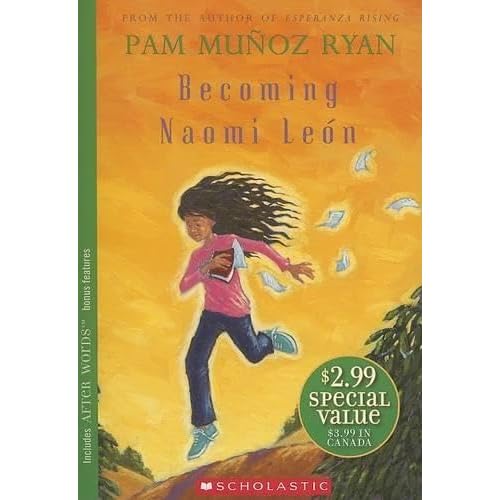
 Summary: Grade 4-7–Naomi Soledad Leon Outlaw lives with younger brother Owen and her fiercely practical Gram in a trailer park in California in this novel by Pam Munoz (Scholastic, 2004). An unpopular fifth grader, she spends lots of time in the library with the other outcasts and the kind librarian. Naomi's talent is carving objects out of soap. After being gone for seven years, her mother shows up one day with a scary boyfriend, Clive. Gram lets the children know that their mother, Terri Lynn, has always been wild and irresponsible. They're worried that she will assert her parental rights and take the children away. Naomi is insecure and particularly susceptible to her mother's attention. Owen is essentially ignored by Terri Lynn because he has some physical deformities, but Clive thinks he could use Owen's deformities to make money gambling. Gram, the neighbors, and the children go to Oaxaca to find the children's father and get him to sign papers making Gram their guardian. Their dad is thrilled to see them, and Naomi learns that her talent for soap carving is inherited from her father. This deeply moving story is expressively and sympathetically narrated by Annie Kozuch. Characterization is excellent and listeners will be happy that Naomi finds confidence, love, and security.–B. Allison Gray, John Jermain Memorial Library, Sag Harbor, NY
Themes: Identity, Family, Overcoming Adversity, Belonging
Classroom Implications: This novel carries a strong Latina voice of a female protagonist throughout the novel. Students are able to relate to the character's journey to discover her family history and her identity. This book makes a good choice for lower level readers ins 6th and 7th grade, as well as provides help to sp. ed. students in a full inclusion setting.
Purchase
 Summary: Ages 11+. Rarely do we see teen pregnancy from the father's perspective. Narrator Khalipa Oldjohn gives realistic insight into the consequences of unexpected parenthood on one teenaged father. Alternating between "then," when Nia told him on his sixteenth birthday that he was going to be a father, and "now," as he struggles to raise his daughter alone, we witness Bobby coming to grips with responsibility as he struggles to do the right thing. The back-and-forth between past and present requires close attention to the narration to understand why Bobby gave up the adoption option in favor of fatherhood. N.E.M. 2005 YALSA Selection © AudioFile 2005, Portland, Maine-- Copyright © AudioFile, Portland, Maine
Themes: Responsibility, Parenting, Choices
Classroom Implications: This novel includes a crucial voice for the male YA audience. It positions the male in a position that is normally not documented and explored in YA literature. There is also an audio version available that may be helpful for lower level readers, sp.ed. and e.l.l. students.
Purchase
 PreS-Gr. 2. This comic gem proves that Caldecott Medal-winner Willems, the Dr. Spock and Robin Williams of the lap-sit crowd, has just as clear a bead on pre-verbal children as on silver-tongued preschoolers. On a father-daughter trip to the Laundromat, before toddler Trixie "could even speak words," Daddy distractedly tosses her favorite stuffed bunny into the wash. Unfortunately, Trixie's desperate cries ("aggle flaggle klabble") come across as meaningless baby talk, so she pitches a fit until perceptive Mommy and abashed Daddy sprint back to retrieve the toy. Willems chronicles this domestic drama with pitch-perfect text and illustrations that boldly depart from the spare formula of his previous books. Sepia-tone photographs of a Brooklyn neighborhood provide the backdrops for his hand-drawn artwork, intensifying the humor of the gleefully stylized characters--especially Trixie herself, who effectively registers all the universal signs of toddler distress, from the first quavery grimace to the uncooperative, "boneless" stage to the googly-eyed, gape-mouthed crisis point. Even children who can already talk a blue streak will come away satisfied that their own strong emotions have been mirrored and legitimized, and readers of all ages will recognize the agonizing frustration of a little girl who knows far more than she can articulate. Jennifer Mattson Copyright © American Library Association. All rights reserved
Excerpt:

Classroom Implications: Great for non-verbal children, this book is a welcomed addition to primary classroom libraries. Educators can focus on non-verbal communication strategies with non-verbal and verbal children. This text encompasses the genre of realistic fiction by the plot and the illustrations.
Skills and Strategies
- Point of view
- Verbal and non-verbal cues
- Setting
Purchase
 From School Library Journal Grade 3 Up–Although organized as a conventional alphabet book, the letters here are far from ordinary. McLimans has created a black-and-white iconic representation of 26 endangered animals, and his art is striking. For example, the newt's eyes protrude slightly from the sides of N, while its tongue emerges from the lower point. An accompanying box on each page includes a small, stylized red-and-white image of the animal plus information about its class, habitat, range, and threats to its survival. Back matter includes a paragraph about each creature along with a list of Web sites for organizations that help endangered animals and books for further reading. This title will serve more as a tool to raise awareness and a place to begin searching for information rather than as a source of facts. However, the arresting graphics and clean design will hold viewers' attention and create interest in the topic. The book could also serve as a starting point for art and design projects for students well above elementary school age.–Kathy Piehl, Minnesota State University, Mankato Copyright © Reed Business Information, a division of Reed Elsevier Inc. All rights reserved.
Classroom Implications: This book has an innovative approach to the traditional alphabet book. It operates as an alphabet book and nonfiction text that advocates around the critical social issue of protecting endangered species. Students can not only use this text to learn the alphabet, but students can learn about the animals and organizations that support the preservation of the species. This text is also an important tool to support English language learners and special education students in the upper grades.
Skills and Strategies
- Letter learning & symbol making
- Nonfiction reading
- Social action
Purchase
 Summary: PreS-Gr. 2 (and beyond). As in his Caldecott Medal Book Tuesday (1991), Wiesner offers another exceptional, wordless picture book that finds wild magic in quiet, everyday settings. At the seaside, a boy holds a magnifying glass up to a flailing hermit crab; binoculars and a microscope lay nearby. The array of lenses signals the shifting viewpoints to come, and in the following panels, the boy discovers an old-fashioned camera, film intact. A trip to the photo store produces astonishing pictures: an octopus in an armchair holding story hour in a deep-sea parlor; tiny, green alien tourists peering at sea horses. There are portraits of children around the world and through the ages, each child holding another child's photo. After snapping his own image, the boy returns the camera to the sea, where it's carried on a journey to another child. Children may initially puzzle, along with the boy, over the mechanics of the camera and the connections between the photographed portraits. When closely observed, however, the masterful watercolors and ingeniously layered perspectives create a clear narrative, and viewers will eagerly fill in the story's wordless spaces with their own imagined story lines. Like Chris Van Allsburg's books and Wiesner's previous works, this visual wonder invites us to rethink how and what we see, out in the world and in our mind's eye. Gillian Engberg Copyright © American Library Association. All rights reserved
Classroom Implications: Never underestimate the power of words...or lack of words. This wordless picture book provides a fascinating narrative for children to explore without the constraints of a text written with words! This book allows children to dive into the complex concept of multiple perspectives by using an accessible visual text. In addition to the text being accessible, it is visually stimulating, imaginative and beautifully done. This text also lends itself well to English Language Learners in the classroom, as well as a mentor text for special education students in the upper grades.
Skills and Strategies
- Point of View
- Perspective
- Storytelling
- Narrative writing
Purchase