Showing posts with label Sp.Ed.. Show all posts

Poetry Speaks to Children by Elise Paschen


Summary: Grade 3-8–A fine, basic collection. Approximately half of the 97 selections are read or performed on the accompanying CD. The book provides a mix of adult writers (Rita Dove, Seamus Heaney, and Billy Collins, among others) and those whose work is specifically for children, such as X. J. Kennedy and Mary Ann Hoberman. Topics include childhood, animals, nonsense poems, and humor. The three illustrators have captured the different tones of the selections, from a comic portrait of the Jabberwock slayer wearing a colander and wielding a plunger and the wailing children in William Stafford's First Grade, to the moving paintings of a girl with flowers echoing the natural images of James Berry's Okay, Brown Girl, Okay. The CD gives children the opportunity to hear several of the poets, such as Robert Frost reading Stopping by Woods on a Snowy Evening and Langston Hughes reading The Negro Speaks of Rivers. They hear a variety of accents and dialects–an Irish lilt, New England inflections, or James Berry's lilting Jamaican-British voice. Readers of Roald Dahl's books will enjoy hearing him read The Dentist and the Crocodile, and fans of The Lord of the Rings books and movies will appreciate hearing Tolkien read Frodo's Song in Bree. Joy Harjo frames her Eagle Poem with a haunting vocalization that echoes its serious tone.–Barbara Chatton, College of Education, University of Wyoming, Laramie
Copyright © Reed Business Information, a division of Reed Elsevier Inc. All rights reserved.

Classroom Implications: This diverse and appealing collection of poems for children includes poets contemporary (Nikki Giovanni, Billy Collins) and, thanks to archival recordings, not so contemporary (Robert Frost, J.R.R. Tolkien) reading their own work. There are also performances of well-known poems such as "Jabberwocky" and "Casey at the Bat." Some tracks feature the welcome bonus of the poet talking briefly about the background or genesis of a poem. The narrated poems are often unidentified and unattributed, and there are no page-turn signals, so listeners must follow along carefully with the book to keep track of poems and authors. Older children will certainly have a deeper understanding of the poems, but the illustrated picture-book format and lively soundtrack are sure to help hook even the youngest listeners on poetry at an early age. J.M.D. © AudioFile 2006, Portland, Maine-- Copyright © AudioFile, Portland, Maine

Purchase

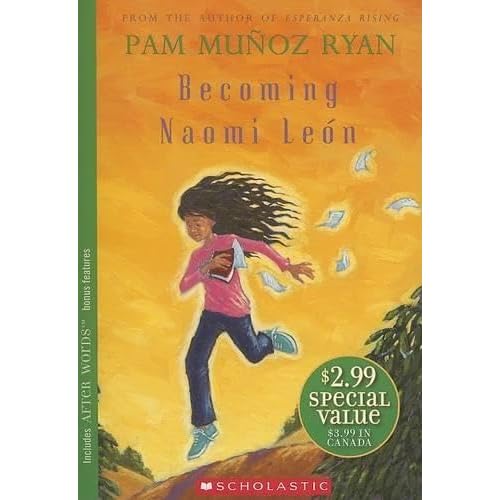
Becoming Naomi Leon by Pam Munoz Ryan

Summary: Grade 4-7–Naomi Soledad Leon Outlaw lives with younger brother Owen and her fiercely practical Gram in a trailer park in California in this novel by Pam Munoz (Scholastic, 2004). An unpopular fifth grader, she spends lots of time in the library with the other outcasts and the kind librarian. Naomi's talent is carving objects out of soap. After being gone for seven years, her mother shows up one day with a scary boyfriend, Clive. Gram lets the children know that their mother, Terri Lynn, has always been wild and irresponsible. They're worried that she will assert her parental rights and take the children away. Naomi is insecure and particularly susceptible to her mother's attention. Owen is essentially ignored by Terri Lynn because he has some physical deformities, but Clive thinks he could use Owen's deformities to make money gambling. Gram, the neighbors, and the children go to Oaxaca to find the children's father and get him to sign papers making Gram their guardian. Their dad is thrilled to see them, and Naomi learns that her talent for soap carving is inherited from her father. This deeply moving story is expressively and sympathetically narrated by Annie Kozuch. Characterization is excellent and listeners will be happy that Naomi finds confidence, love, and security.–B. Allison Gray, John Jermain Memorial Library, Sag Harbor, NY

Themes:
Identity, Family, Overcoming Adversity, Belonging

Classroom Implications: This novel carries a strong Latina voice of a female protagonist throughout the novel. Students are able to relate to the character's journey to discover her family history and her identity. This book makes a good choice for lower level readers ins 6th and 7th grade, as well as provides help to sp. ed. students in a full inclusion setting.

Purchase

The First Part Last by Angela Johnson

Summary: Ages 11+. Rarely do we see teen pregnancy from the father's perspective. Narrator Khalipa Oldjohn gives realistic insight into the consequences of unexpected parenthood on one teenaged father. Alternating between "then," when Nia told him on his sixteenth birthday that he was going to be a father, and "now," as he struggles to raise his daughter alone, we witness Bobby coming to grips with responsibility as he struggles to do the right thing. The back-and-forth between past and present requires close attention to the narration to understand why Bobby gave up the adoption option in favor of fatherhood. N.E.M. 2005 YALSA Selection © AudioFile 2005, Portland, Maine-- Copyright © AudioFile, Portland, Maine

Themes:
Responsibility, Parenting, Choices

Classroom Implications: This novel includes a crucial voice for the male YA audience. It positions the male in a position that is normally not documented and explored in YA literature. There is also an audio version available that may be helpful for lower level readers, sp.ed. and e.l.l. students.


Purchase

Witness by Karen Hesse

Summary--Ages 9-12 . It is 1924, and a small Vermont town finds itself under siege--by the Ku Klux Klan. Using free verse, Newbery Medal-winning author Karen Hesse (Out of the Dust) allows 11 unique and memorable voices to relate the story of the Klan's steady infiltration into the conscience of a small, Prohibition-era community. The Klan's "all-American" philosophy is at first embraced by several of the town's influential men, including Constable Parcelle Johnson and retailer Harvey Pettibone. But Harvey's sensible wife, Viola, and independent restaurant owner Iris Weaver suspect from the beginning that the Klan's arrival heralds trouble. As the only African Americans in town, 12-year old Leonora Sutter and her father try to escape Klan scrutiny, while 6-year-old, city-born Esther Hirsch remains blissfully unaware of the Klan's prejudice against Jews as she enjoys the Vermont countryside. And Sara Chickering, the lady farmer who has opened her home to Esther and her father, is torn between her own hidden biases and her growing love for Esther. All, however, are galvanized towards action when a shadowy figure shoots at Esther and her father right through Sara's front door. Who would commit such an evil act? And is it too late to remove the poison that has insidiously leaked into their once tight-knit community? Part mystery, part social commentary, Hesse's historically accurate chronicle is a riveting catalyst for discussion that thoughtfully explores race and identity from every possible point of view. The free verse format and distinct characterizations also make Witness a perfect choice for library or classroom reader's theater productions. --Jennifer Hubert

Themes:
Community, Justice, Fear, Prejudice

Classroom Implications: This book teaches
tough concepts and is written with the young or struggling reader in mind. It is an excellent historical fiction book for the struggling reader or younger reader. It also makes a nice transition between historical fiction and poetry/prose. Witness makes room to teach concepts such as, narrative voice, perspective, point of view, verse, and descriptive language.

Purchase

Milkweed by Jerry Spinelli

Summary: Ages 11 and up. Newbery Medal-winning author Jerry Spinelli (Maniac McGee, Stargirl) paints a vivid picture of the streets of the Nazi-occupied Warsaw during World War II, as seen through the eyes of a curious, kind, heartbreakingly naïve orphan with many names. His name is Stopthief when people shout "Stop! Thief!" as he flees with stolen bread. Or it's Jew, "filthy son of Abraham," depending on who's talking to him. Or, maybe he's a Gypsy, because his eyes are black, his skin is dark, and he wears a mysterious yellow stone around his neck. His new friend and protector Uri forces him to take the name Misha Pilsudski and to memorize a made-up story about his Gypsy background so that no one will mistake him for a Jew and kill him. Misha, a very young boy, is slow to understand what's happening around him. When he sees people running, he thinks it's a race. Nazis (Jackboots, as the children call them) marching through the streets appear to him as a delightful parade of magnificent boots. He wants to be a Jackboot! (Uri smacks him for saying this.) He compares bombs to sauerkraut kettles, machine guns to praying mantises, and tanks to "colossal gray long-snouted beetles." The story of Misha and his band of orphans trying to survive on their own would have a deliciously Dickensian quality, if it weren't for the devastation around them--people hurrying to dig trenches to stop Nazi tanks, shops exploding in flames, the wailing of sirens, buzzing airplanes, bombs, and human torture. Spinelli has written a powerfully moving story of survival--readers will love Misha the dreamer and his wonderfully poetic observations of the world around him, his instinct to befriend a Jewish girl and her family, his impulse to steal food for a local orphanage and his friends in the ghetto, and his ability to delight in small things even surrounded by the horror of the Holocaust. A remarkable achievement. --Karin Snelson

Themes: Survival, Perseverance

Classroom Implications: Milkweed takes a different slant on covering the holocaust. It fits a story of survival within the context of the Holocaust, but doesn't take place in a Jewish concentration camp. This novel would pair nicely with other Holocaust texts in a book club, such as Diary of Anne Frank, The Cage, Parallel Journeys. This text also accommodates special education students or lower-level readers in the middle school general education classroom.

Purchase

Rules by Cynthia Lord


Gr. 4-7. "No toys in the fish tank" is one of many rules that 12-year-old Catherine shares with her autistic younger brother, David, to help him understand his world. Lots of the rules are practical. Others are more subtle and shed light on issues in Catherine's own life. Torn between love for her brother and impatience with the responsibilities and embarrassment he brings, she strives to be on her parents' radar and to establish an identity of her own. At her brother's clinic, Catherine befriends a wheelchair-bound boy, Jason, who talks by pointing at word cards in a communication notebook. Her drawing skills and additional vocabulary cards--including "whatever" (which prompts Jason to roll his eyes at his mother)--enliven his speech. The details of autistic behavior are handled well, as are depictions of relationships: Catherine experiences some of the same unease with Jason that others do in the presence of her brother. In the end, Jason helps Catherine see that her rules may really be excuses, opening the way for her to look at things differently. A heartwarming first novel. Cindy DobrezCopyright © American Library Association. All rights reserved
Classroom Implications: This is a great story that embraces diversity, instead of parading it in front of the reader. The characters are developed deeply and complexly rather than defined by their disability. This would be an excellent book club book around disabilities/abilities and social issues.
Skills and Strategies
  • Characterization
  • Conflict
  • Making Connections

Gone Wild by David McLimans


From School Library Journal Grade 3 Up–Although organized as a conventional alphabet book, the letters here are far from ordinary. McLimans has created a black-and-white iconic representation of 26 endangered animals, and his art is striking. For example, the newt's eyes protrude slightly from the sides of N, while its tongue emerges from the lower point. An accompanying box on each page includes a small, stylized red-and-white image of the animal plus information about its class, habitat, range, and threats to its survival. Back matter includes a paragraph about each creature along with a list of Web sites for organizations that help endangered animals and books for further reading. This title will serve more as a tool to raise awareness and a place to begin searching for information rather than as a source of facts. However, the arresting graphics and clean design will hold viewers' attention and create interest in the topic. The book could also serve as a starting point for art and design projects for students well above elementary school age.–Kathy Piehl, Minnesota State University, Mankato Copyright © Reed Business Information, a division of Reed Elsevier Inc. All rights reserved.

Classroom Implications: This book has an innovative approach to the traditional alphabet book. It operates as an alphabet book and nonfiction text that advocates around the critical social issue of protecting endangered species. Students can not only use this text to learn the alphabet, but students can learn about the animals and organizations that support the preservation of the species. This text is also an important tool to support English language learners and special education students in the upper grades.

Skills and Strategies
  • Letter learning & symbol making
  • Nonfiction reading
  • Social action
Purchase

Flotsam by David Weisner


Summary: PreS-Gr. 2 (and beyond). As in his Caldecott Medal Book Tuesday (1991), Wiesner offers another exceptional, wordless picture book that finds wild magic in quiet, everyday settings. At the seaside, a boy holds a magnifying glass up to a flailing hermit crab; binoculars and a microscope lay nearby. The array of lenses signals the shifting viewpoints to come, and in the following panels, the boy discovers an old-fashioned camera, film intact. A trip to the photo store produces astonishing pictures: an octopus in an armchair holding story hour in a deep-sea parlor; tiny, green alien tourists peering at sea horses. There are portraits of children around the world and through the ages, each child holding another child's photo. After snapping his own image, the boy returns the camera to the sea, where it's carried on a journey to another child. Children may initially puzzle, along with the boy, over the mechanics of the camera and the connections between the photographed portraits. When closely observed, however, the masterful watercolors and ingeniously layered perspectives create a clear narrative, and viewers will eagerly fill in the story's wordless spaces with their own imagined story lines. Like Chris Van Allsburg's books and Wiesner's previous works, this visual wonder invites us to rethink how and what we see, out in the world and in our mind's eye. Gillian Engberg Copyright © American Library Association. All rights reserved

Classroom Implications: Never underestimate the power of words...or lack of words. This wordless picture book provides a fascinating narrative for children to explore without the constraints of a text written with words! This book allows children to dive into the complex concept of multiple perspectives by using an accessible visual text. In addition to the text being accessible, it is visually stimulating, imaginative and beautifully done. This text also lends itself well to English Language Learners in the classroom, as well as a mentor text for special education students in the upper grades.

Skills and Strategies
  • Point of View
  • Perspective
  • Storytelling
  • Narrative writing
Purchase