Showing posts with label female protagonist. Show all posts

Something Beautiful by Sharon Dennis Wyeth


Summary: This moving picture book offers a shining testament to the ability of human beings to find "something beautiful" in even the most unlikely places. An African American girl initially sees only the ugliness of her neighborhood. There is "trash in the courtyard and a broken bottle that looks like fallen stars." On her front door, someone has scrawled the word "DIE," and a homeless lady "sleeps on the sidewalk, wrapped in plastic." Searching for something beautiful?"something that when you have it, your heart is happy"?she polls various neighbors. For an old man it is the touch of a smooth stone; for Miss Delphine, it's the taste of the fried fish sandwich in her diner; for Aunt Carolyn, it's the sound of her baby's laugh. When the girl decides to create her own "something beautiful," she picks up the trash, scrubs her door clean and realizes, "I feel powerful." Wyeth's (Always My Dad) restrained text is thoughtful without being didactic. She creates a city landscape that is neither too dark nor too sweet; and her ending is just right, with the heroine's mother saying that her daughter is her "something beautiful." Soentpiet's (Peacebound Trains) paintings are luminously lifelike. Whether depicting the girl running past a chain-link fence in a dark alley or Miss Delphine's patrons sitting beneath the rows of glinting glasses, the paintings focus on a community with characters so real, readers can almost feel the sunlight on their faces. All ages. Copyright 1998 Reed Business Information, Inc. --This text refers to the Hardcover edition.

Classroom Implications
: This book resonates with urban community members and echos the salient point of community action. It offers a different perspective to preserving our environment by marking the importance of preserving ALL environments. It combines concepts of community organizing, social action and environmentalism. I also like the cover because it implies finding beauty in personal identities, as well as communities. This is an important image for our students to see, view and discuss, especially in regards to how community identity mirrors personal identity.

Purchase

Persepolis by Marijane Satripi

Summary: Satrapi's autobiography is a timely and timeless story of a young girl's life under the Islamic Revolution. Descended from the last Emperor of Iran, Satrapi is nine when fundamentalist rebels overthrow the Shah. While Satrapi's radical parents and their community initially welcome the ouster, they soon learn a new brand of totalitarianism is taking over. Satrapi's art is minimal and stark yet often charming and humorous as it depicts the madness around her. She idolizes those who were imprisoned by the Shah, fascinated by their tales of torture, and bonds with her Uncle Anoosh, only to see the new regime imprison and eventually kill him. Thanks to the Iran-Iraq war, neighbors' homes are bombed, playmates are killed and parties are forbidden. Satrapi's parents, who once lived in luxury despite their politics, struggle to educate their daughter. Her father briefly considers fleeing to America, only to realize the price would be too great. "I can become a taxi driver and you a cleaning lady?" he asks his wife. Iron Maiden, Nikes and Michael Jackson become precious symbols of freedom, and eventually Satrapi's rebellious streak puts her in danger, as even educated women are threatened with beatings for improper attire. Despite the grimness, Satrapi never lapses into sensationalism or sentimentality. Skillfully presenting a child's view of war and her own shifting ideals, she also shows quotidian life in Tehran and her family's pride and love for their country despite the tumultuous times. Powerfully understated, this work joins other memoirs-Spiegelman's Maus and Sacco's Safe Area Goradze-that use comics to make the unthinkable familiar. Copyright 2003 Reed Business Information, Inc.

Notable Information: This text has the power to convert the non-reader of graphic novels to an avid one! Reviewer after reviewer will testify that he or she sat down to begin the book and didn't get up until they finished. Middle and high school students can experience this, too. By starting them off with reading American Born Chinese, some will be ready to move onto this heavier, more mature text. The text is highly political while still managing to focus on the individual growth and development of the narrator. The reader has to rely heavily on reading between the lines of this text, as well as the illustrations in order to gain the full understanding of the story. Therefore, graphic novels, such as this one, create a rich environment to work on the tough reading and thinking skills of inference and interpretation.

Text Excerpt:

Sequel: Perspepolis II
This sequel begins where the first left off and chronicles the older years of Marji's life. This sequel presents a different subset of issues and best suits high school readers. Be advised: if this book sits next to the first one, the reader will immediately pick it up to find out what happened where the first left off!

Purchase


Monsters Are Afraid of the Moon by Marjane Satrapi


Book Preview: From the Publisher: Poor Marie! Every night as she climbed into bed, she got a visit from three monsters. They only came out in darkness, so she knew they must be afraid of the light. Marie took a huge pair of scissors, and cutting the moon out of the sky, hung it right in her bedroom. No darkness, no monsters!
Her plan worked perfectly, or so she thought . . . but without a moon in the sky, the village cats were in total darkness! They began bumping into everything, and winding up in the hospital. With no cats to chase them, the mice ran amuck. Finally the king found Marie: "You must return the moon to the sky!" he said. But Marie wouldn't agree--not until she was sure those monsters were gone. How could the king make things right for everyone? A delightful tall tale for bedtime or anytime.

Book Review: Children's Literature :Marie has fun all day, but the nights are another story. For then, "three of the scariest monsters who ever lived would come out from the shadows" to torture her. One night, Marie decides that the night monsters must be afraid of the light. She decides to bring the moon, which lights up the night, into her room. After she cuts it out of the sky and puts it in a cage over her bed, the monsters no longer bother her. But with the moon missing, cats all over the village have accidents in the dark, while the rascally rats begin to ruin the town. The Cat King negotiates with Marie. For the release of the moon, Marie receives a cat to guard her bed every night. The charming, imaginative story finds appropriate accompaniment in the very simple illustrations that need few details. Black outlines amusingly depict Marie, the melancholy felines, and the happily cavorting rats. The Cat King is properly regal; the three monsters are a multicolored trio of grimacing bullies whose sharply pointed shadows are menacing. The final picture is a peaceful view of a sleeping Marie and a cat with a watching eye open, and the moon back in the sky.

Notable Information: This protagonist is reminiscent of Marji's voice in Satrapi's graphic memoir, Persepolis. Both are scared of the dark as little girls. This may be an interesting component to read across the two texts, imagining what the monsters might symbolize for the author after reading her memoir.

Purchase

Homemade Love by bell hooks

Summary: PreSchool-K-Evans's wonderful illustrations raise this paean to parental love a notch above the ordinary. "My mama calls me girlpie. Her Sweet sweet. Daddy's honey bun chocolate Dew Drop. Homemade Love," says the small African-American narrator. The story line is minimal: her parents love her, even when she does something wrong, and their love supports her, even at night. The rhythm of the words, the smoothness of the text, and the positive message all combine to make a lovely read-aloud, despite a slightly treacly premise. Evans's folksy paintings, done in bright primary colors, are wonderful, with an appealing, dark-skinned, large-eyed little girl wearing dresses decorated with patterns that reflect the story. The artist fills up the pages so completely that readers only see the parents from the waist down for the first half of the book. When the child breaks something, her sorrow is evident, and after everything is all better, "kiss kiss," she goes outside and does cartwheels in the flowers, exuding happiness and a zest for life. An appealing addition for most collections. Amy Lilien-Harper, The Ferguson Library, Stamford, CT
Copyright 2002 Reed Business Information, Inc.

Classroom Implications: This book does not as strong of a story line as previous books by hooks, yet it still captures the love shared in a family. This story is about unconditional love, a subject that many students can identify or disidentify with based on their own experiences.

Purchase

I Love My Hair! by Natasha Tarpley

Summary: THE ROOT OF BEAUTY
Reviewer:BeatleBangs1964 (United States) -
The narrator of this tale is a bright, beautiful little girl who is proud of her naturally thick curly Black hair. She, like most folks find combout sessions quite painful, but her very wise mother tells her why she is lucky to have such beautiful, thick, naturally curly hair.

Keyana, the child narrator describes the care her hair requires; her mother rubs coconut oil into her scalp to help the comb glide through it. Her mother applies rich poetic descriptions to Keyana's hair; she tells Keyana every time she corn rows it, it is like planting a beautiful garden; when she combs it out into a big, beautiful Afro, it is a globe as round as the world that contains everybody; she tells Keyana she can spin it like silk the way their ancestors spun silk on a loom. Each description is accompanied by a lovely picture showing the mother's vision; for example, when she applies the silk comparison, Keyana is drawn with her beautiful hair being spun on a loom.

Keyana herself celebrates her natural beauty, hair and all and takes pride in the myriad of hairstyles her thick, curly hair will allow her to try. I like the way she said that the hair styling sessions were a time of mother-daughter bonding and the illustrations are first rate.

This is a book all parents and educators will want to use to promote self pride among all children, particularly children who are black. This book celebrates the beauty of being human. It is for everybody. I love this book!

Classroom Implication: This book pairs nicely with Happy to be Nappy and Nappy Hair, both books that praise African and Black American hair. This read aloud approaches the subject gently and could spark a nice conversation of what it means to celebrate identity.

Purchase

Happy to Be Nappy (Jump at the Sun) by bell hooks

Summary: Grades 1-4 Renowned feminist and social critic bell hooks takes on... hair! "Hair for hands to touch and play! Hair to take the gloom away." This rhythmic read-aloud is, on the surface, all about hair: nappy, plaited, long, short, natural, twisted, "soft like cotton, flower petal billowy soft, full of frizz and fuzz." Comb through the surface and find a celebration of childhood and girls and the freedom to express individuality. The rituals implied in the book are rooted in the traditions of hooks's own childhood, when "doing" hair was just as much an excuse for girls to laugh and tell stories and just be together. Going still deeper is the much-needed message encouraging girls to love and accept themselves (and others) just the way they are. In bell hooks's first venture into children's books, she wisely teams up with Caldecott Honor-winning illustrator Chris Raschka (Yo! Yes?, Mysterious Thelonious). Raschka's bold paint strokes on a color wash background are strikingly original--a perfect match for the exuberant text. This beautiful picture book will surely make any reader, young or old, happy to be nappy--and anyone who raved or ranted over Carolivia Herron and illustrator Joe Cepeda's Nappy Hair will welcome this joyful, celebratory book. --Emilie Coulter

Classroom Implication: A critical book at this time, bell hooks advocates for self-love and acceptance of individuality. She works to reclaim a term that has been used derogatorily and breeches the subject delicately through poetic texts. This picture book could pair nicely with identity-based novels, such as The Skin I'm In.

Text Excerpts:


Purchase

The Forbidden Schoolhouse: The True and Dramatic Story of Prudence Crandall and Her Students by Suzanne Jurmain

Summary: Gr. 5-8. Jurmain has plucked an almost forgotten incident from history and has shaped a compelling, highly readable book around it. In 1831, Prudence Crandall opened a school for young white ladies. When asked by an African American teenager if she might join the class, Crandall, whose sympathies were with the abolitionists, agreed. So begins a jolting episode in which Crandall turned her school into one for girls of color, and is both tormented and sued by the citizenry of Canterbury, Connecticut, who wanted no part of African Americans in their town. Writing with a sense of drama that propels readers forward (and quoting the language of the day, which includes the word nigger), Jurmain makes painfully clear what Crandall and her students faced, while showing their courage as they stood up to those who tried to deter them. Printed on thick, snowy stock and including a number of sepia-toned and color photographs as well as historical engravings, the book's look will draw in readers. Children will be especially pleased by the appended material, which includes an epilogue that tells what became of the principals, as well as source notes for the many quotes. Ilene CooperCopyright © American Library Association. All rights reserved

Classroom Implications: What's great about this nonfiction text is that it's about desegregation but takes place in a northern setting! Students often read about desegregating schools in the South during the civil rights movement. But this book takes readers back to the 1800's in New England. This book is a nice transition from nonfiction picture books and nonfiction reading students engage in during high school. Therefore, this books is a perfect nonfiction read for the middle grades.

Purchase

Runaway Girl: The Artist Louise Bourgeois by Jan Greensberg

Summary: Gr. 7 and Up As in Frank O. Gehry, Outside In (2000), the authors once again make challenging art accessible and exciting to teen readers. This time they focus on Louise Bourgeois, one of the best-known living sculptors, whose work deals with primal themes of jealousy, betrayal, and shifting sexual identities, which, according to Bourgeois are inspired by her painful childhood and her adulterous father. In clear, elegant prose, bolstered with numerous quotes from the artist, the authors seamlessly juxtapose stories of Bourgeois' life with relevant artworks, which are often explained in the artist's own words. Beautifully reproduced photographs, printed on well-designed pages, offer an excellent mix of the artist's personal life and her art, though the authors remind readers that "we don't have to know her story to have our own strong reaction," to her work. By showing the relationship among shapes, colors, materials, and emotions, the authors invite readers to approach even the most bewildering art with confidence and think about it in their own words. The book concludes with a glossary, a bibliography, and notes. Gillian Engberg
Copyright © American Library Association. All rights reserved

Classroom Implications: Another book by Greensberg to spruce up middle school biography collection. Text interweaves some personal struggles students can relate to and the art she manifested as in artist. This text does an excellent job connecting the personal life with what she produces in her professional world.

Purchase

Call Me Maria by Judith Ortiz Cofer


Summary: Ages 9-12 Maria is a girl caught between two worlds: Puerto Rico, where she was born, and New York, where she now lives in a basement apartment in the barrio. While her mother remains on the island, Maria lives with her father, the super of their building. As she struggles to lose her island accent, Maria does her best to find her place within the unfamiliar culture of the barrio. Finally, with the Spanglish of the barrio people ringing in her ears, she finds the poet within herself. In lush prose and spare, evocative poetry, Cofer weaves a powerful novel, bursting with life and hope.

Themes: Identity, Family, Community, Clashing Cultures

Classroom Implications: Poetic novels are a wonderful addition to classroom libraries. They build off of the alluring nature of poetry and reframe it in the context of a novel. Judith Ortiz Cofer is a must-have author in the classroom and speaks to the Puerto-Rican/American experience.

Judith Ortiz Cofer has an interesting outlook on language and identity. This excerpt may be an enriching addition to use with students while reading her works:

"People ask me: If I am a Puerto Rican writer, why don't I write in Spanish?" noted poet, essayist, and author Judith Ortiz Cofer in the online publication, The Global Education Project. "Isn't writing in English a sellout? I respond that English is my literary language. The language of the country my parents brought me to. Spanish is my familial language, that lies between the lines of my English language. Because I am a daughter of the Puerto Rican diaspora, English gives life to my writing." (http://www.answers.com)

Purchase

Me llamo Celia/My Name is Celia: La vida de Celia Cruz/The Life of Celia Cruz by Monica Brown

Summary: Grade 2-4 - An exuberant picture-book biography of the Cuban-born salsa singer. From its rhythmic opening, the first-person narrative dances readers through Cruz's youth in Havana, a childhood bounded by scents of nature and home, the sweet taste of sugar, and the sound of music. A singer from an early age, Cruz sang so continually that one of her teachers finally urged her to share her voice with the world. Thus encouraged, she entered competitions, undeterred when her racial heritage prevented her from competing - undeterred, even, when the advent of Castro's communist regime forced her to leave Cuba as a refugee. Positive even in exile, Cruz made New York City her own and took Miami by storm. The salsa-influenced prose presented in English and in Spanish is followed by a straightforward vita of the singer, noting her death in July 2003. Lopez's distinguished, luminous acrylic paintings are alive with motion, lush with brilliantly layered colors, and informed with verve and symbolism. This is a brilliant introduction to a significant woman and her music. The only enhancement required is the music itself. Copyright © Reed Business Information, a division of Reed Elsevier Inc. All rights reserved.

Parallel Texts: When Marian Sang by Pam Munoz Ryan matches the content of this picture book biography. Both stories tell of singers that battled society forces, whether they be racism or regimes, in order to share their gift of music with the world. These stories are especially important in the classroom due to the diminished time celebrating and exploring the music arts.

Other texts that celebrate the music arts include...
John Coltrane's Giant Steps

Ella Fitzgerald: The Tale of a Vocal Virtuoso
Duke Ellington: The Piano Prince and His Orchestra (Caldecott Honor Book)
Charlie Parker Played Be Bop

Purchase

Love To Mama: A Tribute To Mothers by Pat Mora


Summary: Gr 3 Up-In a beautiful tribute to mothers, grandmothers, and care-giving women, 13 poets write with joy, humor, and love about the maternal bond. Representing a wide spectrum of Latino voices, the poets range from award-winning authors (Francisco X. Alarc-n, Mora) to a 15-year-old newcomer (Cristina Mu-iz Mutchler). Without exception, the poems are, in their differing forms and voices, of superb literary quality, making effective use of rhythm and meter. While cultural heritage provides a fundamental context, the universality of emotions expressed makes this a book with broad applicability and appeal. Barrag n's bright, bold illustrations are a fitting complement to the selections. Rendered in pencil, cut paper, and gouache, and computer enhanced, they express the varying moods of the poems-from vitality and joie de vivre to sadness and pathos-with precision, force, and grace. Wonderful for reading aloud or for enjoying quietly alone, this is that rare book that will resonate across age ranges and cultures to appeal to the common human experience. A tour de force.-Ann Welton, Terminal Park Elementary School, Auburn, WA

Excerpt from the text:
Wearing a sky-blue skirt embroidered by an old woman named Consuelo
from a story she told Mami a long time ago on her island,
a cuento in gold, brown, and silver threads,
a shower of sunlight falling like drops of gold
on a little golden girl
who turns into a silver dove and flies around and around
a blue sky,
my mami is walking with me in the park.

Classroom Implications: This collection of poems pays tribute to
a variety of Latino cultures and authors (Mexican American, Puerto Rican, Cuban, and Venezuelan). Each poem is accompanied by a beautiful illustration. This collection celebrates many different faces of motherhood, while illustrating the originality of different cultures. This is especially important because motherhood is seen different thoughout different cultures. This collection writes these experiences into the world of our classrooms.


Purchase

Dona Flor: A Tall Tale About a Giant Woman with a Great Big Heart by Pat Mora

Summary: PreS-Gr. 3. The creators of Tomas and the Library Lady (1997) offer another glowing picture book set in the American Southwest, but this time, the story is a magical tall tale. In a cozy village, Dona Flor grows from an unusual child, who can speak the language of plants and animals, into a giant, whose heart is as large as her enormous hands and feet. After ferocious animal cries terrorize the villagers, Flor sets out to find their source. The culprit--a tiny, mischievous puma, who ingeniously amplifies his kittenish growl into a beastly roar--is an amusing surprise, and Flor soothes the cat in its own language, returning peace to her village. Mora strengthens her economical, poetic text with vivid, fanciful touches: the villagers use Flor's colossal homemade tortillas as roofs, for example. Colon's signature scratchboard art extends the whimsy and gentle humor in lovely scenes of the serene heroine sweet-talking the animals or plucking a star from the sky. A winning read-aloud, particularly for children who can recognize the intermittent Spanish phrases. Gillian Engberg Copyright © American Library Association. All rights reserved

Themes: Peace, Fear, Leadership, Compassion

Classroom Implications: An American Southwest myth is an excellent addition to a study on myths and folktales in a classroom. This picture book includes Spanish phrases, which always benefit native and emerging Spanish speakers. The author uses descriptive, poetic language that is sure to bring students into the story.

Purchase

The Tequila Worm by Viola Canales

Summary: Gr. 6-9. From an early age, Sofia has watched the comadres in her close-knit barrio community, in a small Texas town, and she dreams of becoming "someone who makes people into a family," as the comadres do. The secret, her young self observes, seems to lie in telling stories and "being brave enough to eat a whole tequila worm." In this warm, entertaining debut novel, Canales follows Sofia from early childhood through her teen years, when she receives a scholarship to attend an exclusive boarding school. Each chapter centers on the vivid particulars of Mexican American traditions--celebrating the Day of the Dead, preparing for a cousin's quinceanera. The explanations of cultural traditions never feel too purposeful; they are always rooted in immediate, authentic family emotions, and in Canales' exuberant storytelling, which, like a good anecdote shared between friends, finds both humor and absurdity in sharply observed, painful situations--from weathering slurs and other blatant harassment to learning what it means to leave her community for a privileged, predominately white school. Readers of all backgrounds will easily connect with Sofia as she grows up, becomes a comadre, and helps rebuild the powerful, affectionate community that raised her. Gillian Engberg Copyright © American Library Association. All rights reserved

Themes: Leadership, Family, Traditions, Identity, Community, Privilege, Prejudice

Classroom Implications: This book speaks to the development of a child's identity within her Mexican-American heritage. Many traditions are interwoven through the text that help celebrate and educate around Mexican-American traditions. The book is entertaining, but also delicately tackles white privilege and prejudice. This notion of white privilege is also covered in Woodson's If You Come Softly and would make an interesting parallel text for this piece.

Purchase

Before We Were Free by Julia Alvarez

Summary: (Ages 12+) What would life be like for a teen living under a dictatorship? Afraid to go to school or to talk freely? Knowing that, at the least suspicion, the secret police could invade your house, even search and destroy your private treasures? Or worse, that your father or uncles or brothers could be suddenly taken away to be jailed or tortured or killed? Such experiences have been all too common in the many Latin American dictatorships of the last 50 years. Author Julia Alvarez (How the Garcia Girls Lost Their Accents) and her family escaped from the Trujillo regime in the Dominican Republic when she was 10, but in Before We Were Free she imagines, through the stories of her cousins and friends, how it was for those who stayed behind.

Twelve-year-old Anita de la Torre is too involved with her own life to be more than dimly aware of the growing menace all around her, until her last cousins and uncles and aunts have fled to America and a fleet of black Volkswagens comes up the drive, bringing the secret police to the family compound to search their houses. Gradually, through overheard conversations and the explanations of her older sister, Lucinda, she comes to understand that her father and uncles are involved in a plot to kill El Jefe, the dictator, and that they are all in deadly peril. Anita's story is universal in its implications--she even keeps an Anne Frank-like diary when she and her mother must hide in a friend's house--and a tribute to those brave souls who feel, like Anita's father, that "life without freedom is no life at all." --Patty Campbell

Themes: Oppression, Activism, Family, Membership, Identity, Resistance

Classroom Implications: This book takes a different spin on identity and immigration by telling the story of those left behind. This novel is to be appreciated for its honest look at Latin American dictatorships and the impact they have on families, advocacy and identity. This book can move through different themed book clubs: realistic fiction, social issues, and even possibly historical fiction. Lower level readers can help access this text by listening to the audio version.

Purchase

Finding Miracles by Julia Alvarez


Summary: Grade 6-9–In spite of her family's openness, Milly Kaufman has never wanted to talk about her adoption. However, during ninth grade, Pablo Bolívar, a refugee from an unnamed Central American country, joins her class and immediately identifies her as someone who might have come from his family's hometown. Then, her grandmother attempts to make a will that differentiates between her and her siblings. While her mother and father's angry reaction makes the woman back down, their increasingly close relationship with Pablo's family makes it impossible for Milly to stop thinking about the parents who gave her up and the war-torn nation she came from. When that country's dictator is deposed in a democratic election, the Bolívars go home to visit and invite Milly along. There she discovers a world quite different from her Vermont home, an extended family, a boyfriend in Pablo, and several possible sets of birth parents. She realizes, too, how much she loves her own family, and they join her for a grand reunion. The strength of this book lies in its description of adoption issues–Milly's feelings of abandonment and difference and her sister's fear that Milly's increased identification as Latina will destroy their close relationship. However, the plot is contrived to help Milly find her identity, and the characters never really come alive. The home country has been stripped of any identifying characteristics that might make the setting interesting. Still, readers interested in this subject will be pleased with the satisfying resolution.–Kathleen Isaacs, Edmund Burke School, Washington, DC Copyright © Reed Business Information, a division of Reed Elsevier Inc. All rights reserved.

Themes: Adoption, Family, Identity, Heritage, Abandonment, Belonging, Hybrid Identities

Classroom Implications: Becoming Naomi Leon iimmediately comes to mind when the character in this book struggles with a piece of her identity that lingers in her native country. Alvarez carefully explores relationships in this book--relationships between characters, countries and identities.

Purchase

How Tia Lola Came to Stay by Julia Alvarez

Summary: (Ages 9 to 12) Amazon.com Review With her brilliantly hued flower-print dresses, her maracas and tambor, and the migrating beauty mark over her lipsticked mouth, Tia Lola stands out in Vermont like a tropical bird in a snowstorm. Her nephew, 10-year-old Miguel, just wants to fit in to his new home. He and his mother and sister have just moved here from New York following his parents' divorce. With his black hair and brown skin, it's hard enough already without the flamboyant antics of his friendly, nutty aunt, visiting from the Dominican Republic. But even while she is dancing her merengues in front of his new friends and painting the white farmhouse purple, Tia Lola is also weaving a magical spell of love and support that Miguel and his wounded family sorely need. Miguel's growing appreciation for his crazy aunt's ways, and the entire town's admiration and respect for an outsider who, without even speaking the same language, wins the hearts of all, is a funny, uplifting story. Julia Alvarez is the author of many award-winning novels, including How the Garcia Girls Lost Their Accents and In the Time of the Butterflies, and the picture book The Secret Footprints. She writes with a warmth and humor that crosses all boundaries. --Emilie Coulter

Themes: Family, Identity, Membership

Important Links:
Author's Bio
Complete List of Author's Works
Book in Spanish

Classroom Implications: Julia Alvarez's books typically work best with upper-level readers in 8th grade classrooms. However, this book fits very nicely with younger readers, ages9-12. This book could bridge readers into Alvarez'a more difficult books.

Purchase

Beauty: A Retelling of the Story of Beauty and the Beast by Robin McKinley

Summary: Ages 9-12 Amazon.com Review This much-loved retelling of the classic French tale Beauty and the Beast elicits the familiar magical charm, but is more believable and complex than the traditional story. In this version, Beauty is not as beautiful as her older sisters, who are both lovely and kind. Here, in fact, Beauty has no confidence in her appearance but takes pride in her own intelligence, her love of learning and books, and her talent in riding. She is the most competent of the three sisters, which proves essential when they are forced to retire to the country because of their father's financial ruin.

The plot follows that of the renowned legend: Beauty selflessly agrees to inhabit the Beast's castle to spare her father's life. Beauty's gradual acceptance of the Beast and the couple's deepening trust and affection are amplified in novel form. Robin McKinley's writing has the flavor of another century, and Beauty heightens the authenticity as a reliable and competent narrator.

This was McKinley's first book, written almost 20 years ago. Since that time she has been awarded the Newbery Medal for The Hero and the Crown and has delighted her fans with another retelling of the Beauty and the Beast fable, Rose Daughter. Still, McKinley's first novel has a special place in the hearts of her devoted readers, many of whom attest to relishing Beauty time and again.

Possible other texts:
Classroom Implications: McKinley's first book, Beauty, provides an excellent starting point for students to dive into a fantasy study. McKinley also chooses strong female narrators and points of view for her characters, an added plus in fantasy.

Purchase

Switchers by Kate Thompson

Summary: Tess has a secret that keeps her apart from others: she can change into an animal at will. Disturbed when scruffy Kevin keeps following her after school, Tess wonders what he wants from her, and why an arctic front is sweeping over the globe, causing a blizzard in Dublin in September. Then she learns that Kevin shares her gift, and they set out across Ireland, disguised as rats, and guided by fellow rats to "little old lady" Lizzie. The eccentric woman sends them on a quest north to stop the krools, ravenous monsters responsible for the Earth's ice ages. The pair races against time (Kevin is about to turn 15, when all Switchers have to choose their final form) and U.N. warplanes seeking alien invaders, to halt the global icing. In occasionally poetic language (which may need some explaining to younger readers), Thompson interweaves elements from mythology and science fiction with insights into animal nature to create a coming-of-age fantasy that, like Peter Pan, ends with an open window and, for many readers, a lump in the throat. Copyright 1998 Reed Business Information, Inc.

Themes: Identity, Adventure

Classroom Implications: This text does have a nice blend of mythology and science fiction that combines to create a fantasy novel best used with lower level readers in a middle school classroom. Students can explore the genre of fantasy by examining the symbols and themes of the novel.

Purchase

Heaven by Angela Johnson

Summary: Grade 6-9-What makes a person who she is? Is it her name, the people she lives with, or is blood the only link to identity? Marley, 14, suddenly plunges head first into these complex questions when she discovers that the people she's been living with her entire life aren't her real parents. Butchy is not her real brother, and her mysterious Uncle Jack, who has been writing her short but beautiful letters for as long as she can remember, turns out to be her real, very absent father. In spare, often poetic prose reminiscent of Patricia MacLachlan's work, Johnson relates Marley's insightful quest into what makes a family. Her extreme anger with her supposed parents, who turn out to be her aunt and uncle, for not telling her the truth, for not being the perfect family that she'd always thought them to be, wars with her knowledge that not even her friend Shoogy Maple's model family is as perfect and beautiful as it seems. The various examples of "family" Marley encounters make her question what's real, what's true, what makes sense, and if any of that really matters as much as the love she continues to feel for her parents in spite of their seeming betrayal. Johnson exhibits admirable stylistic control over Marley's struggle to understand a concept that is often impossible to understand or even to define. Linda Bindner, formerly at Athens Clarke County Library, GA
Copyright 1998 Reed Business Information, Inc

Themes:
Identity, Family, Betrayal

Classroom Implications: Immediately, Becoming Naomi Leon comes to mind (see next post) in terms of family and identity. Whereas Leon takes a Latina perspective, Heaven takes an American American perspective. This book works well in a on-level or higher-level book club.

Purchase

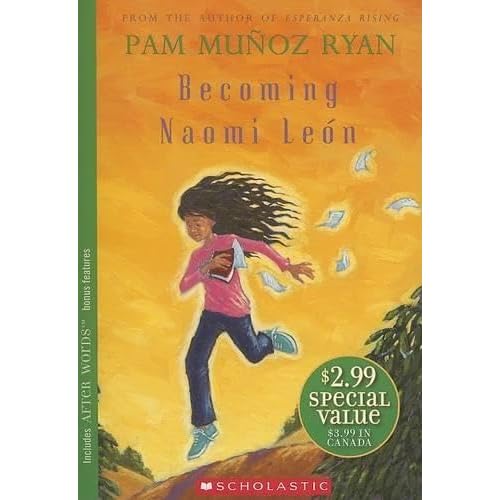
Becoming Naomi Leon by Pam Munoz Ryan

Summary: Grade 4-7–Naomi Soledad Leon Outlaw lives with younger brother Owen and her fiercely practical Gram in a trailer park in California in this novel by Pam Munoz (Scholastic, 2004). An unpopular fifth grader, she spends lots of time in the library with the other outcasts and the kind librarian. Naomi's talent is carving objects out of soap. After being gone for seven years, her mother shows up one day with a scary boyfriend, Clive. Gram lets the children know that their mother, Terri Lynn, has always been wild and irresponsible. They're worried that she will assert her parental rights and take the children away. Naomi is insecure and particularly susceptible to her mother's attention. Owen is essentially ignored by Terri Lynn because he has some physical deformities, but Clive thinks he could use Owen's deformities to make money gambling. Gram, the neighbors, and the children go to Oaxaca to find the children's father and get him to sign papers making Gram their guardian. Their dad is thrilled to see them, and Naomi learns that her talent for soap carving is inherited from her father. This deeply moving story is expressively and sympathetically narrated by Annie Kozuch. Characterization is excellent and listeners will be happy that Naomi finds confidence, love, and security.–B. Allison Gray, John Jermain Memorial Library, Sag Harbor, NY

Themes:
Identity, Family, Overcoming Adversity, Belonging

Classroom Implications: This novel carries a strong Latina voice of a female protagonist throughout the novel. Students are able to relate to the character's journey to discover her family history and her identity. This book makes a good choice for lower level readers ins 6th and 7th grade, as well as provides help to sp. ed. students in a full inclusion setting.

Purchase