Showing posts with label wordless. Show all posts

The Mysteries of Harris Burdick by Chris Van Allsberg

Summary: This book is a collection of illustrations that resemble old photographs of surreal events and images. Each illustration has an accompanying title and quote that entice the reader to image a plot for the picture. The premise of the book is that a man named Harris Burdick dropped off a sample of his work to a publisher to consider publishing. The sample only includes illustrations with these enticing titles and quotes. The publisher discloses that the artist never returned again. The publisher finds this so compelling, he ends up making a book out of this mystery.

Classroom Implications: The book is set up with a long author's note to the reader, thereby creating a very "real" feeling for this fictitious book. I've used this book over and over when teaching short stories and have ALWAYS led on that the story is "real" with my middle schoolers. They instantly become intrigued with the mystery and look forward to writing stories that accompany the illustration and the quotes. This text is a fantastic wordless fantasy book that serves as inspiration for writing projects in the classroom!

Purchase

Text Excerpts:

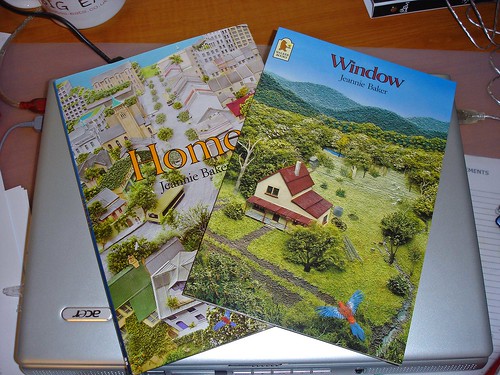
Home by Jeannie Baker

Summary: K-Gr. 3. This wordless picture book with exquisitely detailed collage illustrations speaks eloquently about urban conservation. Every double-page spread is a view through the same window, a view that changes over a generation, beginning with a couple expecting a baby and continuing as the baby grows up, is courted, and is married in the neighborhood street. At first the sprawl and smog nearly smother the view, but gradually the place changes. The community brings back a variety of local plants, and by the time the young woman's own baby is born, trees block the billboards, there are birds on the roof and in the sky, and cyclists and a bus can be seen on the roadway. Suddenly, there's a glimpse of the river in the distance, a dragonfly on the windowsill, and the full moon shines at night. Unlike some collage art, the technique here never gets in the way. The details show and tell a story about the small things in one neighborhood--their fragility, strength, and connection--and their power to make a difference. With each look at the pictures, there's more to see in the crowded neighborhood that is transformed into a wild and beautiful place. Hazel Rochman Copyright © American Library Association. All rights reserved

Classroom Implications
: This is a great companion piece with Baker's other book, Window. It takes the opposite look at development and the environment. It starts with an urban decay of a scene. With time, care, and community effort, the city-scape transforms into something beautiful. It would also be a picture book to support Paul Fleishman's book Seedfolks, which is based on social action, community and gardening.

Purchase

Zoom by Istvan Banyai

Summary: From Booklist:Grades 3-8. Beginning with a close-up of a rooster's comb, each picture zooms out to give a more distant perspective; for example, the "camera" zooms out to show increasingly distant figures of children watching the rooster. Then, a large hand appears, showing that the scene was not depicting a real farm, but a toy farm set. But zoom out a few more times, and the scene reveals that the picture of the girl playing with the farm set is really on the magazine held by a boy, who's sleeping in a chair, which is by a pool, which is on an ocean liner, which is out at sea--no, wait--that picture is on a cruise-line poster on the side of a city bus, but that picture is on a television screen in the Arizona desert . . . and so on until the earth is shown from above, growing smaller with each turn of the page. The final scene is one white dot on a black page. Clear-cut paintings outlined in ink appear on each right-hand page; the left-hand pages are black. Not a story, but an "idea" book, it makes the viewer ask, "What am I really seeing here?" This clever picture book could be intriguing..., depending on the viewer's frame of mind, but children will find it worth a look. Once, anyway. Carolyn Phelan

Sequel Information: Re-Zoom
Summary: From Publishers Weekly:Re-Zoom resumes, or more accurately, reprises, the layout and nothing-is-as-it-seems perspective of last season's Zoom. Featuring detailed drawings backpainted on animation cels, this text-free volume opens with a red-on-blue cave painting that, with the turn of a page, becomes a detail on a wristwatch. The next spread reveals that the watch belongs to a young man doing a rubbing of carved hieroglyphs... and so on. To surprise his audience, which may already expect the sequence of pictures to expand to infinity, as in Zoom, Banyai toys not only with spatial relations but with time and with cultural referents: people in 19th-century garb, admiring an image of Napoleon, turn out to be on a movie set; a woman in traditional Japanese dress sports a yellow Walkman. There are nods to the arts as well. A black-and-white Alfred Hitchcock and a blue bodhisattva sit astride a thundering elephant, and a dejected-looking Picasso rides the New York City subway. The finale-which leaves readers in a subway tunnel as the train's red taillights recede-may not be as mindbending as Zoom's outer-space flight, but is nonetheless a clever solution. All ages. Copyright 1995 Reed Business Information, Inc. --This text refers to an out of print or unavailable edition of this title.

Purchase

The Other Side by Istvan Banyai

Summary: Grade 6 and Up–There's nothing mundane or predictable about Banyai's wordless picture book. As in Zoom and Re-Zoom (both Viking, 1995), the illustrator takes his audience on a visual journey that begins with a nearly blank page that, when turned, reveals instructions for folding a paper airplane. On the next page, a girl in her high-rise apartment practices her cello and a paper airplane can be seen outside her window. Readers flip the page to see the girl's building from the outside looking in. Paper airplanes are everywhere, thanks to a young neighbor one floor up who has been practicing his folding skills. Each pair of pages, front and back, presents inside and outside views, and although the scenes are not obviously linked to a larger plotline, they are connected through reoccurring images, colors, and themes. This is a challenging book, one that allows for creative speculation. The graphite-rendered artwork is quirky as well as infinitely interesting. Not everyone will get the sly humor, or be prepared to indulge in a book that demands such work. However, those who give it a try will be drawn into a thought-provoking, whimsical world. It's a book that begs to be talked about, and teachers will find it a useful tool for discussions about point-of-view and perspective.–Carol L. MacKay, Camrose Public Library, Alberta, Canada Copyright © Reed Business Information, a division of Reed Elsevier Inc. All rights reserved.

Notable Information: This text would be most efficiently used in an upper grade classroom. The way the story builds off of the perspective shifts is highly complex. It is a highly usable text to teach perspective, point of view and symbolism. The Other Side would also pair nicely with a writing activity based around the perspectives of the text. Students could also develop complex conceptual ideas that could become literary essays.

Text Excerpt:

Purchase

The Red Book by Barbara Lehman


Summary: Kindergarten and Up: In this wordless mind trip for tots, Lehman develops a satisfying fantasy in a series of panels framed with thick white borders. The effect is of peering through portals, an experience shared by the characters as they independently stumble across enchanted red books that provide them with a videophone-like connection. Though wordless picture books often seem to be the province of fine artists indulging in high-concept braggadocio (as in Istvan Banyai's 1995 Zoom), Lehman's effort ensures child appeal with an unaffected drawing style and a simple, easy-to-follow story line about a friendship forged between a city girl and a faraway island boy. The message about the transporting power of story will moisten the eyes of many adult readers, but children will most appreciate the thought-provoking visuals, in which characters' actions influence the course of their own storybook narratives--likewise affecting the larger "red book," cleverly packaged to mimic the shape and color of its fictional counterpart. Ideal for fueling creative-writing exercises. Jennifer Mattson Copyright © American Library Association. All rights reserved

Classroom Implications: This post-modern, book within a book, plays with perspective like Flotsam or Zoom. The Red Book deconstructs the common picture book motif, where the characters seem to affect and create the story as the pages turn. The wonderful teaching point this book carries is that character's actions influence the course of the story. This is an essential element of reading and writing to expose students to in the classroom. Kids in the upper grades can take advantage of this wordless text and use the pictures to create their own story.

Purchase

Window by Jeannie Baker

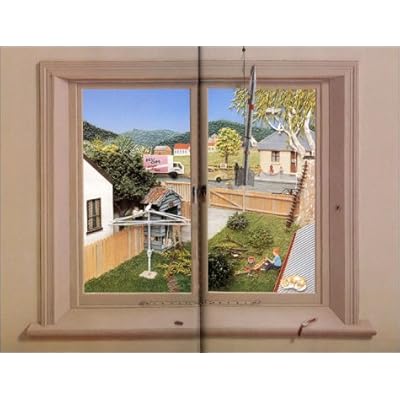
Summary: Grade 1 Up-- A mother, holding her newborn son, gazes out the window of his room at lush vegetation, tropical birds, a pond, a kangaroo. Ten double-page illustrations following show the development--during a 20-year period--of the area outside the window. As Sam (the baby) grows older, the land is cleared, a road is built, then a farm. A housing development goes up, then takes over a hill that was once green with lush growth. Development becomes suburb, then city, complete with billboards, high-rises, noise pollution, litter, and overpopulation. Sam marries and moves to a new house in the country, where the final window scene shows him, holding his baby, staring at a sign announcing, "House Blocks For Sale". Words are unnecessary, as Baker's carefully rendered collage scenes explicitly detail the situation. Varying symbolic objects on Sam's windowsill (and the cracking and peeling of paint on the wall) add to the book's message. Baker's meticulous collages, formed from natural materials, clay, fabric, and real hair, are so detailed that they require many viewings. A final, short author's note explains the inspiration for the book: ". . .by understanding and changing the way we personally affect the environment, we can make a difference." This unusual, exceptionally well-crafted picture book might be a good way to begin. --Susan Scheps, Shaker Heights Public Library, OH Copyright 1991 Reed Business Information, Inc. --This text refers to an out of print or unavailable edition of this title.

Curricular Connections: This text can be used in a science classroom where students study the effect of development on indigenous ecosystems. It is a crucial outlook and environmental perspective that should be support with today's youth.

Purchase

Alphabet City by Stephen T. Johnson


Summary: Grade 1 Up: Beginning with the A formed by a construction site's sawhorse and ending with the Z found in the angle of a fire escape, Johnson draws viewers' eyes to tiny details within everyday objects to find letters. In this wordless tour of sights from Times Square to the Brooklyn Bridge, he invites young and old alike to take a new look at familiar surroundings, discovering the alphabet without ever looking in a book or reading from a sign. Conceived in the tradition of Ann Jonas's work, especially The Thirteenth Clue (Greenwillow, 1992), Johnson's pastel, watercolor, gouache, and charcoal paintings are much more realistic than his illustrations for The Samurai's Daughter (Dial, 1992); in fact, they are almost photographic in appearance. Some of the images are both clever and incredibly clear, e.g., the E found in the sideways view of a traffic light. Others, such as the C in the rose window of a Gothic church, are more obscure. Nevertheless, all of the paintings are beautifully executed and exhibit a true sense of artistic vision. While parents or teachers might assume from the title that this is a traditional alphabet book, they should be encouraged to look at it as an art book. It's sure to inspire older children to venture out on their own walks to discover the alphabet in the familiar objects of their own hometowns. Nancy Menaldi-Scanlan, LaSalle Academy, Providence, RICopyright 1996 Reed Business Information, Inc. --This text refers to the Hardcover edition.

Notable Information: This is a fantastic mix of art, alphabet and wordless picture book! Best used with students already accustomed with the alphabet. Kids can play hide and go seek with the city of New York!

Purchase

Hot Air: The (Mostly) True Story of the First Hot-Air Balloon Ride by Marjorie Priceman


PreSchool-Grade 3-Inventive illustrations depict the true story of the duck, sheep, and rooster that were "ballooning's first brave passengers" when the Montgolfiers tested their hot-air balloon in 1783. The first three spreads set the stage with lively conversational descriptions of the scene before the balloon takes off. A dramatic shift on the fourth page turn reveals the befuddled animal passengers as they ascend. Most of the remaining text is wordless, with occasional "quacks," "baas," and "cock-a-doodle-doos." With vibrant colors and varied use of panels, full-page illustrations, and spreads, Priceman paces the tale perfectly. An early four-panel scene showing the balloon at various heights while the animals try to figure out what's going on is priceless. So is the spread in which all three become attached to windblown laundry. The voyagers' progress is easy to follow, and events along the way are delightfully rendered. A time line on the endpapers fills in some of the historical data, but this "(mostly) true" version (which the author "heard…from a duck, who heard it from a sheep, who heard it from a rooster a long, long time ago") is just the way it should have happened. Sarah Wilson's Three in a Balloon (Scholastic, 1990; o.p.) covers the same event nicely, but this intriguing historical episode stands up to varied presentations, as Priceman's dynamic visual storytelling ably demonstrates.-Steven Engelfried, Beaverton City Library, OR
Copyright © Reed Business Information, a division of Reed Elsevier Inc. All rights reserved.

Classroom Implications: Nonfiction meets fiction in this book. Historical data is paired with imaginative illustrations and wordless pages to provoke thought, predictions and inferences around the nonfiction. A non-traditional historical nonfiction text, this book blends nicely into a library that includes a section on flight.

Skills and Strategies
  • Nonfiction reading
  • Questioning
  • Inferences
Purchase

Flotsam by David Weisner


Summary: PreS-Gr. 2 (and beyond). As in his Caldecott Medal Book Tuesday (1991), Wiesner offers another exceptional, wordless picture book that finds wild magic in quiet, everyday settings. At the seaside, a boy holds a magnifying glass up to a flailing hermit crab; binoculars and a microscope lay nearby. The array of lenses signals the shifting viewpoints to come, and in the following panels, the boy discovers an old-fashioned camera, film intact. A trip to the photo store produces astonishing pictures: an octopus in an armchair holding story hour in a deep-sea parlor; tiny, green alien tourists peering at sea horses. There are portraits of children around the world and through the ages, each child holding another child's photo. After snapping his own image, the boy returns the camera to the sea, where it's carried on a journey to another child. Children may initially puzzle, along with the boy, over the mechanics of the camera and the connections between the photographed portraits. When closely observed, however, the masterful watercolors and ingeniously layered perspectives create a clear narrative, and viewers will eagerly fill in the story's wordless spaces with their own imagined story lines. Like Chris Van Allsburg's books and Wiesner's previous works, this visual wonder invites us to rethink how and what we see, out in the world and in our mind's eye. Gillian Engberg Copyright © American Library Association. All rights reserved

Classroom Implications: Never underestimate the power of words...or lack of words. This wordless picture book provides a fascinating narrative for children to explore without the constraints of a text written with words! This book allows children to dive into the complex concept of multiple perspectives by using an accessible visual text. In addition to the text being accessible, it is visually stimulating, imaginative and beautifully done. This text also lends itself well to English Language Learners in the classroom, as well as a mentor text for special education students in the upper grades.

Skills and Strategies
  • Point of View
  • Perspective
  • Storytelling
  • Narrative writing
Purchase