Summary: Gr. 7-12. "Dating is not a concept adults in our barrio really get." The contemporary teenage voices are candid, funny, weary, and irreverent in these stories about immigrant kids caught between their Puerto Rican families and the pull and push of the American dream. The young people hang out on the street in front of the tenement El Building in Paterson, New Jersey, where the radios are always turned full blast to the Spanish station and the thin walls can't hold the dramas of the real-life telenovelas. As in her autobiographical adult collection Silent Dancing (1990), Cofer depicts a diverse neighborhood that's warm, vital, and nurturing, and that can be hell if you don't fit in. Some of the best stories are about those who try to leave. Each piece stands alone with its own inner structure, but the stories also gain from each other, and characters reappear in major and minor roles. The teen narrators sometimes sound too articulate, their metaphors overexplained, but no neat resolutions are offered, and the metaphor can get it just right (the people next door "could be either fighting or dancing"). Between the generations, there is tenderness and anger, sometimes shame. In one story, a teenage girl despises the newcomer just arrived from the island, but to her widowed mother, the hick (jibaro) represents all she's homesick for. Raul Colon's glowing cover captures what's best about this collection: the sense of the individual in the pulsing, crowded street. Hazel Rochman
Themes: Culture, Hybrid Identities, Generational Differences, Individuality, Community
First Sentence:
When I was sent to spend the summer at my grandparents' house in Puerto Rico, I knew it was going to be strange, I just didn't know how strange.
Classroom Implications: Many classrooms have and use W.D.Myer's 145th Street Stories or G. Soto's Baseball in April collection of stories. Ortiz adds to this base of literature and gives a voice to the Puerto Rican communities that she reflects in her writing.
Purchase
 Summary: Ages 9-12 Maria is a girl caught between two worlds: Puerto Rico, where she was born, and New York, where she now lives in a basement apartment in the barrio. While her mother remains on the island, Maria lives with her father, the super of their building. As she struggles to lose her island accent, Maria does her best to find her place within the unfamiliar culture of the barrio. Finally, with the Spanglish of the barrio people ringing in her ears, she finds the poet within herself. In lush prose and spare, evocative poetry, Cofer weaves a powerful novel, bursting with life and hope.
Themes: Identity, Family, Community, Clashing Cultures
Classroom Implications: Poetic novels are a wonderful addition to classroom libraries. They build off of the alluring nature of poetry and reframe it in the context of a novel. Judith Ortiz Cofer is a must-have author in the classroom and speaks to the Puerto-Rican/American experience.
Judith Ortiz Cofer has an interesting outlook on language and identity. This excerpt may be an enriching addition to use with students while reading her works:
"People ask me: If I am a Puerto Rican writer, why don't I write in Spanish?" noted poet, essayist, and author Judith Ortiz Cofer in the online publication, The Global Education Project. "Isn't writing in English a sellout? I respond that English is my literary language. The language of the country my parents brought me to. Spanish is my familial language, that lies between the lines of my English language. Because I am a daughter of the Puerto Rican diaspora, English gives life to my writing." (http://www.answers.com)
Purchase
 Summary: Gr. 6-9. From an early age, Sofia has watched the comadres in her close-knit barrio community, in a small Texas town, and she dreams of becoming "someone who makes people into a family," as the comadres do. The secret, her young self observes, seems to lie in telling stories and "being brave enough to eat a whole tequila worm." In this warm, entertaining debut novel, Canales follows Sofia from early childhood through her teen years, when she receives a scholarship to attend an exclusive boarding school. Each chapter centers on the vivid particulars of Mexican American traditions--celebrating the Day of the Dead, preparing for a cousin's quinceanera. The explanations of cultural traditions never feel too purposeful; they are always rooted in immediate, authentic family emotions, and in Canales' exuberant storytelling, which, like a good anecdote shared between friends, finds both humor and absurdity in sharply observed, painful situations--from weathering slurs and other blatant harassment to learning what it means to leave her community for a privileged, predominately white school. Readers of all backgrounds will easily connect with Sofia as she grows up, becomes a comadre, and helps rebuild the powerful, affectionate community that raised her. Gillian Engberg Copyright © American Library Association. All rights reserved
Themes: Leadership, Family, Traditions, Identity, Community, Privilege, Prejudice
Classroom Implications: This book speaks to the development of a child's identity within her Mexican-American heritage. Many traditions are interwoven through the text that help celebrate and educate around Mexican-American traditions. The book is entertaining, but also delicately tackles white privilege and prejudice. This notion of white privilege is also covered in Woodson's If You Come Softly and would make an interesting parallel text for this piece.
Purchase
 Summary: (Ages 12+) What would life be like for a teen living under a dictatorship? Afraid to go to school or to talk freely? Knowing that, at the least suspicion, the secret police could invade your house, even search and destroy your private treasures? Or worse, that your father or uncles or brothers could be suddenly taken away to be jailed or tortured or killed? Such experiences have been all too common in the many Latin American dictatorships of the last 50 years. Author Julia Alvarez (How the Garcia Girls Lost Their Accents) and her family escaped from the Trujillo regime in the Dominican Republic when she was 10, but in Before We Were Free she imagines, through the stories of her cousins and friends, how it was for those who stayed behind.
Twelve-year-old Anita de la Torre is too involved with her own life to be more than dimly aware of the growing menace all around her, until her last cousins and uncles and aunts have fled to America and a fleet of black Volkswagens comes up the drive, bringing the secret police to the family compound to search their houses. Gradually, through overheard conversations and the explanations of her older sister, Lucinda, she comes to understand that her father and uncles are involved in a plot to kill El Jefe, the dictator, and that they are all in deadly peril. Anita's story is universal in its implications--she even keeps an Anne Frank-like diary when she and her mother must hide in a friend's house--and a tribute to those brave souls who feel, like Anita's father, that "life without freedom is no life at all." --Patty Campbell
Themes: Oppression, Activism, Family, Membership, Identity, Resistance
Classroom Implications: This book takes a different spin on identity and immigration by telling the story of those left behind. This novel is to be appreciated for its honest look at Latin American dictatorships and the impact they have on families, advocacy and identity. This book can move through different themed book clubs: realistic fiction, social issues, and even possibly historical fiction. Lower level readers can help access this text by listening to the audio version.
Purchase

Summary: Grade 6-9–In spite of her family's openness, Milly Kaufman has never wanted to talk about her adoption. However, during ninth grade, Pablo Bolívar, a refugee from an unnamed Central American country, joins her class and immediately identifies her as someone who might have come from his family's hometown. Then, her grandmother attempts to make a will that differentiates between her and her siblings. While her mother and father's angry reaction makes the woman back down, their increasingly close relationship with Pablo's family makes it impossible for Milly to stop thinking about the parents who gave her up and the war-torn nation she came from. When that country's dictator is deposed in a democratic election, the Bolívars go home to visit and invite Milly along. There she discovers a world quite different from her Vermont home, an extended family, a boyfriend in Pablo, and several possible sets of birth parents. She realizes, too, how much she loves her own family, and they join her for a grand reunion. The strength of this book lies in its description of adoption issues–Milly's feelings of abandonment and difference and her sister's fear that Milly's increased identification as Latina will destroy their close relationship. However, the plot is contrived to help Milly find her identity, and the characters never really come alive. The home country has been stripped of any identifying characteristics that might make the setting interesting. Still, readers interested in this subject will be pleased with the satisfying resolution.–Kathleen Isaacs, Edmund Burke School, Washington, DC Copyright © Reed Business Information, a division of Reed Elsevier Inc. All rights reserved.
Themes: Adoption, Family, Identity, Heritage, Abandonment, Belonging, Hybrid Identities
Classroom Implications: Becoming Naomi Leon iimmediately comes to mind when the character in this book struggles with a piece of her identity that lingers in her native country. Alvarez carefully explores relationships in this book--relationships between characters, countries and identities.
Purchase
 Summary: (Ages 9 to 12) Amazon.com Review With her brilliantly hued flower-print dresses, her maracas and tambor, and the migrating beauty mark over her lipsticked mouth, Tia Lola stands out in Vermont like a tropical bird in a snowstorm. Her nephew, 10-year-old Miguel, just wants to fit in to his new home. He and his mother and sister have just moved here from New York following his parents' divorce. With his black hair and brown skin, it's hard enough already without the flamboyant antics of his friendly, nutty aunt, visiting from the Dominican Republic. But even while she is dancing her merengues in front of his new friends and painting the white farmhouse purple, Tia Lola is also weaving a magical spell of love and support that Miguel and his wounded family sorely need. Miguel's growing appreciation for his crazy aunt's ways, and the entire town's admiration and respect for an outsider who, without even speaking the same language, wins the hearts of all, is a funny, uplifting story. Julia Alvarez is the author of many award-winning novels, including How the Garcia Girls Lost Their Accents and In the Time of the Butterflies, and the picture book The Secret Footprints. She writes with a warmth and humor that crosses all boundaries. --Emilie Coulter
Themes: Family, Identity, Membership
Important Links:
Author's Bio
Complete List of Author's Works
Book in Spanish
Classroom Implications: Julia Alvarez's books typically work best with upper-level readers in 8th grade classrooms. However, this book fits very nicely with younger readers, ages9-12. This book could bridge readers into Alvarez'a more difficult books.
Purchase
 Summary: Grade 7 Up–Even though random shootings have become increasingly common in his neighborhood, Mann is horrified when his little brother is gunned down while playing on his own front porch. Two years later, the 13-year-old and his parents are still struggling with their grief. His father believes that if he had been less loving and protective, Jason might have been tougher and capable of avoiding the shot. Mann and his friend Kee-lee keep track of the shooting deaths around them, certain that their own time may come and make them nothing more than numbers on their list. Influenced by ancient African coming-of-age rituals in which young boys are sent into the wilderness to attempt to survive, Mann's father takes him and Kee-lee camping and abandons them far from home. For two urban teens with little food or money, this is a dangerous, frightening experience that leads to crime and violence. After the boys make their treacherous way back home, Mann's father turns him out to live on the streets, determined he will not lose another son because he is too soft. This disturbing, thought-provoking novel will leave readers with plenty of food for thought and should fuel lively discussions.–Ginny Gustin, Sonoma County Library System, Santa Rosa, CA
Copyright © Reed Business Information, a division of Reed Elsevier Inc. All rights reserved.
Themes: Survival, Ethnic History, Coming of Age—male, Urban Struggles
Classroom Implications: Makes a good choice for a male book club or provides an additional male perspective on coming of age in an urban setting. This is available on audio to support lower level readers. Flake writes to capture the attention of her young adult audience. She is successful with writing literature that students have an easy time making connections with the text and the characters. Bang! could also be in interesting match with Hatchet or Spirit Bear, both outdoor survival stories with male narrators.
Purchase
 Summary: Grade 6-9-What makes a person who she is? Is it her name, the people she lives with, or is blood the only link to identity? Marley, 14, suddenly plunges head first into these complex questions when she discovers that the people she's been living with her entire life aren't her real parents. Butchy is not her real brother, and her mysterious Uncle Jack, who has been writing her short but beautiful letters for as long as she can remember, turns out to be her real, very absent father. In spare, often poetic prose reminiscent of Patricia MacLachlan's work, Johnson relates Marley's insightful quest into what makes a family. Her extreme anger with her supposed parents, who turn out to be her aunt and uncle, for not telling her the truth, for not being the perfect family that she'd always thought them to be, wars with her knowledge that not even her friend Shoogy Maple's model family is as perfect and beautiful as it seems. The various examples of "family" Marley encounters make her question what's real, what's true, what makes sense, and if any of that really matters as much as the love she continues to feel for her parents in spite of their seeming betrayal. Johnson exhibits admirable stylistic control over Marley's struggle to understand a concept that is often impossible to understand or even to define. Linda Bindner, formerly at Athens Clarke County Library, GA
Copyright 1998 Reed Business Information, Inc
Themes: Identity, Family, Betrayal
Classroom Implications: Immediately, Becoming Naomi Leon comes to mind (see next post) in terms of family and identity. Whereas Leon takes a Latina perspective, Heaven takes an American American perspective. This book works well in a on-level or higher-level book club.
Purchase
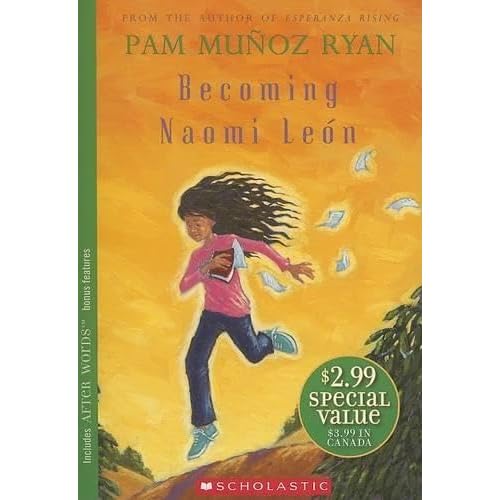
 Summary: Grade 4-7–Naomi Soledad Leon Outlaw lives with younger brother Owen and her fiercely practical Gram in a trailer park in California in this novel by Pam Munoz (Scholastic, 2004). An unpopular fifth grader, she spends lots of time in the library with the other outcasts and the kind librarian. Naomi's talent is carving objects out of soap. After being gone for seven years, her mother shows up one day with a scary boyfriend, Clive. Gram lets the children know that their mother, Terri Lynn, has always been wild and irresponsible. They're worried that she will assert her parental rights and take the children away. Naomi is insecure and particularly susceptible to her mother's attention. Owen is essentially ignored by Terri Lynn because he has some physical deformities, but Clive thinks he could use Owen's deformities to make money gambling. Gram, the neighbors, and the children go to Oaxaca to find the children's father and get him to sign papers making Gram their guardian. Their dad is thrilled to see them, and Naomi learns that her talent for soap carving is inherited from her father. This deeply moving story is expressively and sympathetically narrated by Annie Kozuch. Characterization is excellent and listeners will be happy that Naomi finds confidence, love, and security.–B. Allison Gray, John Jermain Memorial Library, Sag Harbor, NY
Themes: Identity, Family, Overcoming Adversity, Belonging
Classroom Implications: This novel carries a strong Latina voice of a female protagonist throughout the novel. Students are able to relate to the character's journey to discover her family history and her identity. This book makes a good choice for lower level readers ins 6th and 7th grade, as well as provides help to sp. ed. students in a full inclusion setting.
Purchase
 Summary: Ages 11+. Rarely do we see teen pregnancy from the father's perspective. Narrator Khalipa Oldjohn gives realistic insight into the consequences of unexpected parenthood on one teenaged father. Alternating between "then," when Nia told him on his sixteenth birthday that he was going to be a father, and "now," as he struggles to raise his daughter alone, we witness Bobby coming to grips with responsibility as he struggles to do the right thing. The back-and-forth between past and present requires close attention to the narration to understand why Bobby gave up the adoption option in favor of fatherhood. N.E.M. 2005 YALSA Selection © AudioFile 2005, Portland, Maine-- Copyright © AudioFile, Portland, Maine
Themes: Responsibility, Parenting, Choices
Classroom Implications: This novel includes a crucial voice for the male YA audience. It positions the male in a position that is normally not documented and explored in YA literature. There is also an audio version available that may be helpful for lower level readers, sp.ed. and e.l.l. students.
Purchase
 Summary: Gr. 7-12. "Dating is not a concept adults in our barrio really get." The contemporary teenage voices are candid, funny, weary, and irreverent in these stories about immigrant kids caught between their Puerto Rican families and the pull and push of the American dream. The young people hang out on the street in front of the tenement El Building in Paterson, New Jersey, where the radios are always turned full blast to the Spanish station and the thin walls can't hold the dramas of the real-life telenovelas. As in her autobiographical adult collection Silent Dancing (1990), Cofer depicts a diverse neighborhood that's warm, vital, and nurturing, and that can be hell if you don't fit in. Some of the best stories are about those who try to leave. Each piece stands alone with its own inner structure, but the stories also gain from each other, and characters reappear in major and minor roles. The teen narrators sometimes sound too articulate, their metaphors overexplained, but no neat resolutions are offered, and the metaphor can get it just right (the people next door "could be either fighting or dancing"). Between the generations, there is tenderness and anger, sometimes shame. In one story, a teenage girl despises the newcomer just arrived from the island, but to her widowed mother, the hick (jibaro) represents all she's homesick for. Raul Colon's glowing cover captures what's best about this collection: the sense of the individual in the pulsing, crowded street. Hazel Rochman