Showing posts with label symbolism. Show all posts

The Other Side by Istvan Banyai

Summary: Grade 6 and Up–There's nothing mundane or predictable about Banyai's wordless picture book. As in Zoom and Re-Zoom (both Viking, 1995), the illustrator takes his audience on a visual journey that begins with a nearly blank page that, when turned, reveals instructions for folding a paper airplane. On the next page, a girl in her high-rise apartment practices her cello and a paper airplane can be seen outside her window. Readers flip the page to see the girl's building from the outside looking in. Paper airplanes are everywhere, thanks to a young neighbor one floor up who has been practicing his folding skills. Each pair of pages, front and back, presents inside and outside views, and although the scenes are not obviously linked to a larger plotline, they are connected through reoccurring images, colors, and themes. This is a challenging book, one that allows for creative speculation. The graphite-rendered artwork is quirky as well as infinitely interesting. Not everyone will get the sly humor, or be prepared to indulge in a book that demands such work. However, those who give it a try will be drawn into a thought-provoking, whimsical world. It's a book that begs to be talked about, and teachers will find it a useful tool for discussions about point-of-view and perspective.–Carol L. MacKay, Camrose Public Library, Alberta, Canada Copyright © Reed Business Information, a division of Reed Elsevier Inc. All rights reserved.

Notable Information: This text would be most efficiently used in an upper grade classroom. The way the story builds off of the perspective shifts is highly complex. It is a highly usable text to teach perspective, point of view and symbolism. The Other Side would also pair nicely with a writing activity based around the perspectives of the text. Students could also develop complex conceptual ideas that could become literary essays.

Text Excerpt:

Purchase

Persepolis by Marijane Satripi

Summary: Satrapi's autobiography is a timely and timeless story of a young girl's life under the Islamic Revolution. Descended from the last Emperor of Iran, Satrapi is nine when fundamentalist rebels overthrow the Shah. While Satrapi's radical parents and their community initially welcome the ouster, they soon learn a new brand of totalitarianism is taking over. Satrapi's art is minimal and stark yet often charming and humorous as it depicts the madness around her. She idolizes those who were imprisoned by the Shah, fascinated by their tales of torture, and bonds with her Uncle Anoosh, only to see the new regime imprison and eventually kill him. Thanks to the Iran-Iraq war, neighbors' homes are bombed, playmates are killed and parties are forbidden. Satrapi's parents, who once lived in luxury despite their politics, struggle to educate their daughter. Her father briefly considers fleeing to America, only to realize the price would be too great. "I can become a taxi driver and you a cleaning lady?" he asks his wife. Iron Maiden, Nikes and Michael Jackson become precious symbols of freedom, and eventually Satrapi's rebellious streak puts her in danger, as even educated women are threatened with beatings for improper attire. Despite the grimness, Satrapi never lapses into sensationalism or sentimentality. Skillfully presenting a child's view of war and her own shifting ideals, she also shows quotidian life in Tehran and her family's pride and love for their country despite the tumultuous times. Powerfully understated, this work joins other memoirs-Spiegelman's Maus and Sacco's Safe Area Goradze-that use comics to make the unthinkable familiar. Copyright 2003 Reed Business Information, Inc.

Notable Information: This text has the power to convert the non-reader of graphic novels to an avid one! Reviewer after reviewer will testify that he or she sat down to begin the book and didn't get up until they finished. Middle and high school students can experience this, too. By starting them off with reading American Born Chinese, some will be ready to move onto this heavier, more mature text. The text is highly political while still managing to focus on the individual growth and development of the narrator. The reader has to rely heavily on reading between the lines of this text, as well as the illustrations in order to gain the full understanding of the story. Therefore, graphic novels, such as this one, create a rich environment to work on the tough reading and thinking skills of inference and interpretation.

Text Excerpt:

Sequel: Perspepolis II
This sequel begins where the first left off and chronicles the older years of Marji's life. This sequel presents a different subset of issues and best suits high school readers. Be advised: if this book sits next to the first one, the reader will immediately pick it up to find out what happened where the first left off!

Purchase


The Greatest Power by Demi


Summary: K-Gr. 3. This companion to The Empty Pot (1990) continues the story of the life of Ping, the young emperor who wants to bring harmony to his kingdom. Ping sends all the children in the kingdom on a year-long quest to find the greatest power in the world, telling them, "A wise person must be able to see the unseen and know the unknown." The boys believe the power is great weapons; the girls, great beauty; the students, great technology; and the practical children, great amounts of money. When the children come to show the emperor what they have discovered, the last child in line, a little girl named Sing, remembers Ping's words. She presents a lotus seed as the powerful force of eternal life, and Ping names her the new prime minister. The text and the handsomely designed, richly colored artwork, which is touched with gold leaf, are set within a circular motif that reinforces the idea of eternity. As usual, Demi ably combines striking artwork and a meaningful story, with quiet dignity and wisdom. Julie Cummins Copyright © American Library Association. All rights reserved

Classroom Application: This book has been critiqued by some reviewers to be too conceptually heavy for young readers. The book can be modified and presented in a more concrete way by using it as an instructional read aloud: the teacher focusing on heavy inferring and interpretation as the story unfolds. Students can use their prior knowledge of The Empty Pot to uncover the meaning of this text.

This book is great to be read critically because gender and other classification stereotypes are used to create the story (i.e. the girls saying that beauty is the greatest power).

Purchase

The Empty Pot by Demi


Summary: Grade 1-3-- When the Chinese emperor proclaims that his successor will be the child who grows the most beautiful flowers from the seeds the emperor distributes, Ping is overjoyed. Like the emperor, he loves flowers and anything he plants bursts into bloom. But the emperor's seed will not grow, despite months of loving care, and Ping goes before the emperor carrying only his empty pot. The emperor ignores the beautiful blossoms brought by the other children and chooses Ping, revealing that the seeds he handed out had been cooked and could not grow. This simple story with its clear moral is illustrated with beautiful paintings.

Each page contains a single picture, shaped like a stiff, rounded, paper fan and framed in celadon brocade that subtly changes pattern from one spread to the next. Isometric perspective, traditional Chinese architecture, and landscape motifs are combined with Demi's fine line and lively children and animals. While all the landscapes featuring the emperor and the other children are in brilliant red, gold, and purple, the scenes involving Ping alone are predominantly beige and delicate green. Ping is almost always shown as a solitary figure in contrast to the busy groups of running, smiling children, reinforcing the portrait of him as a quieter, more contemplative person whose values make him a worthy heir to the emperor. A beautifully crafted book that will be enjoyed as much for the richness of its illustrations as for the simplicity of its story. --Eleanor K. MacDonald, Beverly Hills Public Library Copyright 1990 Reed Business Information, Inc

Notable Information: This is a beautiful book to teach theme and the moral of stories. In this story, Ping stays true to himself and in the end, is rewarded. IT is a remarkable story that children and adults will latch onto and want to read again and again.

Purchase

Shh! The Whale is Smiling by Josephine Nobisso

Summary: From Amazon.com: C. Penn "WordWeaving" (Greenville, SC) - Author Josephine Nobisso and illustrator Maureen Hyde bring enchantment to the play of shadows and wind deep in the night in SHH! THE WHALE IS SMILING. As a fierce wind blows outside their home, a sister comforts her brother turning fear of the cold dark into a warm, safe place of imagination. Flying in their bed to the sea, they join a whale swimming among bubbles in a world of their marvelous creation.

The fear of the dark, wind and storms is gently confronted in this imaginative story for children. The dark becomes deep water, movement the swimming of a whale, and wind a part of the mystery of the sea, thereby replacing the fearful with the imaginative. A delightful tale, with fabulously realized illustrations, SHH! THE WHALE IS SMILING comes very highly recommended.
Text Excerpts:


Moonflute by Audrey Wood


Summary: Grades 3-6 In this long bedtime mood-piece, a little girl, Firen, accuses the moon of taking her sleep; she resolves to "go out in the night and find it.'' Outside, a moonbeam lands in her hands and becomes a magic flute with which she flies through the night. She encounters creatures of town, sea, and jungle in a dreamlike sequence illustrated in deep greens, blues, and violet. Firen herself has a pixie-ish, flower-fairy look, and is silvery-shiny with moonlight. Susan Patron, Los Angeles Public LibraryCopyright 1987 Reed Business Information, Inc.

Notable Information: This is another dream-like fantasy text that can open the doors into the genre of fantasy. The text is long and more like a short story with illustrations. With this in mind, it makes a stronger text to use in the upper elementary grade classrooms.

Purchase

When the Sun Rose by Barbara Berger


Summary: As in her earlier Grandfather Twilight, Berger has created a picture book dreamscape, full of radiant colors and intriguing possibilities. Alone with her doll in a playhouse, the young narrator receives an unusual visitor who comes calling "in a carriage bright as the sun." The visitor's consort is a lemon-yellow lion who dines on blueberries and cream as the two girls play dolls and paint a rainbow. At day's end, the visitor departs into a glowing sunset, promising to return. Berger's skillful blending of the metaphysical and a child's inner life make this an inspired work of art. Copyright 1986 Reed Business Information, Inc.

Notable Information: This makes a good book to deeply talk about the lasting effects that friendship can have on people.

Purchase

There Is a Flower at the Tip of My Nose Smelling Me by Alice Walker

Summary: From Publishers Weekly
Walker (The Color Purple; Finding the Green Stone) praises the surroundings that fortify the human experience. In her vision, people do not work their will on the things around them, but rather the people and the universe influence each other: "There is a flower/ At the tip/ Of my nose/ Smelling/ Me./ There is a sky/ At the end/ Of my/ Eye/ Seeing/ Me." Vitale (When the Wind Stops) paints great swaths of sunset sky that glow from the horizon, illuminating the serene face of a dreaming girl who looks as if she would be at home anywhere. "There is a dance/ That lives/ In my bones/ Dancing/ Me," reads the text, as the heroine, charged from within by streams of incandescent energy, leaps and sways in swirls of sunlight that stream out from her fingertips. "There is a story/ At the end/ Of my arms," Walker concludes, "Telling/ Me!" Now a rainbow falls over the girl's face, and creation holds out marvelous possibilities. Smaller versions of herself surround the girl in a frieze: in these miniature images she flies, dives into the waves with a fish and climbs the leaves of an enormous white flower to kiss its face. It's less a story than an illuminated prayer"an expression of gratitude for one girl, all humans and the whole of the cosmos. All ages. (Apr.)
Copyright © Reed Business Information, a division of Reed Elsevier Inc. All rights reserved.

Classroom Implications: In the author's note in the back of the book, Alice Walker writes that this book began as a thank-you note. Students would really latch onto this concept. This text extends the idea of gratitude and shifts to a more universal way of looking at things. Middle school students may use this as a mentor text to inspire a new kind of writing that originates from a different, more universal perspective.

Text Excerpt:


Purchase

Dona Flor: A Tall Tale About a Giant Woman with a Great Big Heart by Pat Mora

Summary: PreS-Gr. 3. The creators of Tomas and the Library Lady (1997) offer another glowing picture book set in the American Southwest, but this time, the story is a magical tall tale. In a cozy village, Dona Flor grows from an unusual child, who can speak the language of plants and animals, into a giant, whose heart is as large as her enormous hands and feet. After ferocious animal cries terrorize the villagers, Flor sets out to find their source. The culprit--a tiny, mischievous puma, who ingeniously amplifies his kittenish growl into a beastly roar--is an amusing surprise, and Flor soothes the cat in its own language, returning peace to her village. Mora strengthens her economical, poetic text with vivid, fanciful touches: the villagers use Flor's colossal homemade tortillas as roofs, for example. Colon's signature scratchboard art extends the whimsy and gentle humor in lovely scenes of the serene heroine sweet-talking the animals or plucking a star from the sky. A winning read-aloud, particularly for children who can recognize the intermittent Spanish phrases. Gillian Engberg Copyright © American Library Association. All rights reserved

Themes: Peace, Fear, Leadership, Compassion

Classroom Implications: An American Southwest myth is an excellent addition to a study on myths and folktales in a classroom. This picture book includes Spanish phrases, which always benefit native and emerging Spanish speakers. The author uses descriptive, poetic language that is sure to bring students into the story.

Purchase

Beauty: A Retelling of the Story of Beauty and the Beast by Robin McKinley

Summary: Ages 9-12 Amazon.com Review This much-loved retelling of the classic French tale Beauty and the Beast elicits the familiar magical charm, but is more believable and complex than the traditional story. In this version, Beauty is not as beautiful as her older sisters, who are both lovely and kind. Here, in fact, Beauty has no confidence in her appearance but takes pride in her own intelligence, her love of learning and books, and her talent in riding. She is the most competent of the three sisters, which proves essential when they are forced to retire to the country because of their father's financial ruin.

The plot follows that of the renowned legend: Beauty selflessly agrees to inhabit the Beast's castle to spare her father's life. Beauty's gradual acceptance of the Beast and the couple's deepening trust and affection are amplified in novel form. Robin McKinley's writing has the flavor of another century, and Beauty heightens the authenticity as a reliable and competent narrator.

This was McKinley's first book, written almost 20 years ago. Since that time she has been awarded the Newbery Medal for The Hero and the Crown and has delighted her fans with another retelling of the Beauty and the Beast fable, Rose Daughter. Still, McKinley's first novel has a special place in the hearts of her devoted readers, many of whom attest to relishing Beauty time and again.

Possible other texts:
Classroom Implications: McKinley's first book, Beauty, provides an excellent starting point for students to dive into a fantasy study. McKinley also chooses strong female narrators and points of view for her characters, an added plus in fantasy.

Purchase

A Swiftly Tilting Planet by Madeleine L'Engle

Summary: (Ages 9 and older) Fifteen-year-old Charles Wallace Murry, whom readers first met in A Wrinkle in Time, has a little task he must accomplish. In 24 hours, a mad dictator will destroy the universe by declaring nuclear war--unless Charles Wallace can go back in time to change one of the many Might-Have-Beens in history. In an intricately layered and suspenseful journey through time, this extraordinary young man psychically enters four different people from other eras. As he perceives through their eyes "what might have been," he begins to comprehend the cosmic significance and consequences of every living creature's actions. As he witnesses first-hand the transformation of civilization from peaceful to warring times, his very existence is threatened, but the alternative is far worse. The Murry family, also appearing in A Wind in the Door and Many Waters, acts as a carrier of Madeleine L'Engle's unique message about human responsibility for the world. Themes of good versus evil, time and space travel, and the invincibility of the human spirit predominate. Even while she entertains, L'Engle kindles the intellect, inspiring young people to ask questions of the world, and learn by challenging. --Emilie Coulter

First Sentence:
The big kitchen of the Murrys' house was bright and warm, curtains drawn against the dark outside, against the rain driving past the house from the northeast.


Classroom Implications: Students can really study the themes of good vs. evil with the L'Engle books. These books are essentials for students to read in their reading lives, and a book club would be an excellent way to incorporate these texts into the lives of students.

Purchase

Touching Spirit Bear by Ben Mikaelsen

Summary: (Ages 12 and older) Cole Matthews is angry. Angry, defiant, smug--in short, a bully. His anger has taken him too far this time, though. After beating up a ninth-grade classmate to the point of brain damage, Cole is facing a prison sentence. But then a Tlingit Indian parole officer named Garvey enters his life, offering an alternative called Circle Justice, based on Native American traditions, in which victim, offender, and community all work together to find a healing solution. Privately, Cole sneers at the concept, but he's no fool--if it gets him out of prison, he'll do anything. Ultimately, Cole ends up banished for one year to a remote Alaskan island, where his arrogance sets him directly in the path of a mysterious, legendary white bear. Mauled almost to death, Cole awaits his fate and begins the transition from anger to humility.

Ben Mikaelsen's depiction of a juvenile delinquent's metamorphosis into a caring, thinking individual is exciting and fascinating, if at times heavy-handed. Cole's nastiness and the vivid depictions of the lengths he must go to survive after the (equally vivid) attack by the bear are excruciating at times, but the concept of finding a way to heal a whole community when one individual wrongs another is compelling. --Emilie Coulter

Themes: Survival, Tradition, Anger and Redemption, Healing

Classroom Implications: This may be more fitting in the social issues book category, but the symbolic image of the bear compelled me to place it under Fantasy. It makes a good match with Hatchet and Bang!, both being survival stories but in different contexts. It is also a great CONTEMPORARY Native American book to have in the classroom.

Purchase


Switchers by Kate Thompson

Summary: Tess has a secret that keeps her apart from others: she can change into an animal at will. Disturbed when scruffy Kevin keeps following her after school, Tess wonders what he wants from her, and why an arctic front is sweeping over the globe, causing a blizzard in Dublin in September. Then she learns that Kevin shares her gift, and they set out across Ireland, disguised as rats, and guided by fellow rats to "little old lady" Lizzie. The eccentric woman sends them on a quest north to stop the krools, ravenous monsters responsible for the Earth's ice ages. The pair races against time (Kevin is about to turn 15, when all Switchers have to choose their final form) and U.N. warplanes seeking alien invaders, to halt the global icing. In occasionally poetic language (which may need some explaining to younger readers), Thompson interweaves elements from mythology and science fiction with insights into animal nature to create a coming-of-age fantasy that, like Peter Pan, ends with an open window and, for many readers, a lump in the throat. Copyright 1998 Reed Business Information, Inc.

Themes: Identity, Adventure

Classroom Implications: This text does have a nice blend of mythology and science fiction that combines to create a fantasy novel best used with lower level readers in a middle school classroom. Students can explore the genre of fantasy by examining the symbols and themes of the novel.

Purchase

The New Policeman (Costa Children's Book Award ) by Kate Thompson

Summary: Grades 7-10 Heart-pounding Irish music is the common ground between material and magical worlds in this ambitious fantasy, which begins in western Ireland. When J. J. Liddy is 15, his mother jokingly asks for a birthday present of more time. From an eccentric neighbor, J. J. learns to his astonishment that his mother's request may not be impossible to fill. Bravely venturing into an alternate fairy world, J. J. takes on a thrilling, epic quest in which he confronts dark family rumors and tries to repair a cosmic time leak between his world and "the land of eternal youth." Thompson packs her mesmerizing, chaotic novel with Irish culture (including phrases defined in a glossary), interconnected mysteries, and sly questions about the stresses of contemporary life and the age-old frictions between religion and folklore. Readers will quickly overlook any creaky plot connections and fall eagerly into the rich, comic language and the captivating characters and scenes, particularly those that feature musicians (including talented J. J.), who play the "wild, anarchic music" that bridges worlds. Musical scores for Irish tunes (some written by Thompson) close each chapter in this soulful, wildly imagined tale that has already won several British awards, including the Guardian Children's Book Prize and the Whitbread Children's Book Award. Suggest it to fans of O. R. Melling's The Hunter's Moon (2005) and Eoin Colfer's Artemis Fowl books. Gillian Engberg Copyright © American Library Association. All rights reserved

Excerpt:
'Brilliant timing,' she said. 'Tea's just made.'

But J.J. walked straight past the pot, which steamed on the range in the kitchen, and the plates of fresh scones on the table. Upstairs in his room, his schoolbag lay open on his bed, leaking overdue homework. He glanced at the clock. If he got up half an hour early the next morning he could get a bit of it done.

He spilled the bag and its contents onto the floor, and as he set the alarm he wondered, as he wondered every day, where on earth all the time went.
--from THE NEW POLICEMAN


Classroom Implications: This 2007 release is a great pick for a fantasy book club in 7th or 8th grades. The language is beautiful and students can unpack the genre, studying theme, symbolism and descriptive language.

Purchase

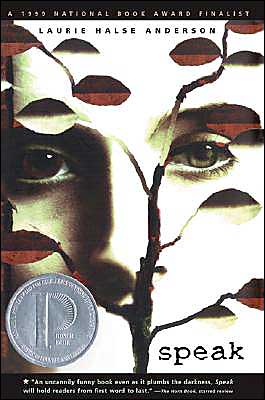
Speak by Laurie Halse Anderson

Summary: Ages 12-up. In a stunning first novel, Anderson uses keen observations and vivid imagery to pull readers into the head of an isolated teenager. Divided into the four marking periods of an academic year, the novel, narrated by Melinda Sordino, begins on her first day as a high school freshman. No one will sit with Melinda on the bus. At school, students call her names and harass her; her best friends from junior high scatter to different cliques and abandon her. Yet Anderson infuses the narrative with a wit that sustains the heroine through her pain and holds readers' empathy. A girl at a school pep rally offers an explanation of the heroine's pariah status when she confronts Melinda about calling the police at a summer party, resulting in several arrests. But readers do not learn why Melinda made the call until much later: a popular senior raped her that night and, because of her trauma, she barely speaks at all. Only through her work in art class, and with the support of a compassionate teacher there, does she begin to reach out to others and eventually find her voice. Through the first-person narration, the author makes Melinda's pain palpable: "I stand in the center aisle of the auditorium, a wounded zebra in a National Geographic special." Though the symbolism is sometimes heavy-handed, it is effective. The ending, in which her attacker comes after her once more, is the only part of the plot that feels forced. But the book's overall gritty realism and Melinda's hard-won metamorphosis will leave readers touched and inspired. Copyright 1999 Reed Business Information, Inc.

Themes:
Identity, Inclusion/Exclusion, Teenage/Female Violence

Classroom Implications: This novel pulls the reader into the world of an isolated teenager. This novel would be matched well with The Misfits, The Perks of Being a Wallflower, The Pinballs, The Outsiders, or Define Normal--all books that address identities and lives on the periphery. This is an excellent novel to study first person narration, symbolism, internal/external conflict and point of view.

Purchase

Show Way by Jacqueline Woodson

Kindergarten-5. A Show Way is a quilt with secret meanings, and the image works as both history and haunting metaphor in this exquisite picture book. Based on Woodson's own history, the unforgettable story tells of African American women across generations, from slavery and the civil rights movement to the present. The cut-out jacket design is impressive, as is Talbott's mixed-media artwork inside, which extends Woodson's clear poetic narrative with beautiful collages that make use of big triangles, squares, and curves to emphasize portraits and landscapes and show connections and courage. The first double-page spread is of anguished separation when Soonie's great-grandmother is sold "without her ma or pa." Growing up on a plantation in South Carolina, Soonie learns from Big Mama about children "growing up and getting themselves free," and also how to sew quilts with signs that show the way to freedom. Time passes: Soonie's granddaughter, Georgiana, has twin girls who march for freedom in the 1960s. The final glorious spread shows Georgiana's granddaughter, Jacqueline Woodson, laughing at home with her own beloved daughter, Toshi Georgiana, whose picture is embedded in a quilt, connecting her with those who came before. A must for the classroom, this story will move many readers to explore their own family roots; link to the Booklist interview with Woodson , in which she talks about what she owes to those who came before her. Hazel RochmanCopyright © American Library Association. All rights reserved

Classroom Implications: Woodson crafts a perfect text to introduce a study of family history in the classroom. This text inspires students to research their own family history. Tar Beach by Faith Ringold would make an excellent match with this text. This pairing opens the door to a parallel study on quilt making and community.

Skills and Strategies

  • Descriptive Language
  • Symbolism
  • Point of view
  • Characterization
  • Timelines of text

Purchase

Zen Shorts by Jon Muth


Kindergarten-Grade 4 - Beautifully illustrated in two distinct styles, this book introduces readers to a Zen approach to the world, wrapped in a story about three siblings and their new neighbor, a panda. One by one, the children visit Stillwater, enjoying his company and listening to him tell a brief tale that illustrates a Zen principle. Each time, there is a link between the conversation shared by Stillwater and his visitor and the story he tells; it's somewhat tenuous in regard to the two older siblings, quite specific in the case of Karl, the youngest. The tales invite the children to consider the world and their perceptions from a different angle; for Karl, the panda's story gently but pointedly teaches the benefits of forgiveness. Richly toned and nicely detailed watercolors depict the "real world" scenes, while those accompanying the Zen lessons employ black lines and strokes on pastel pages to create an interesting blend of Western realism and more evocative Japanese naturalism. Taken simply as a picture book, Zen Shorts is interesting and visually lovely. As an introduction to Zen, it is a real treat, employing familiar imagery to prod children to approach life and its circumstances in profoundly "un-Western" ways. An author's note discusses the basic concept of Zen and details the sources of Stillwater's stories. Appealing enough for a group read-aloud, but also begging to be shared and discussed by caregiver and child, Zen Shorts is a notable achievement. - Coop Renner, Hillside Elementary, El Paso, TX Copyright © Reed Business Information, a division of Reed Elsevier Inc. All rights reserved.

Classroom Implications: This book captivates audiences with beautiful images and messages conveyed throughout the text. The simplistic images match the simple Zen-Buddist messages of the story. These lessons span ages, so the book can be used with multiple age groups. A perfect book to work on themes and main messages of texts. This book would also work cross-curricularly with a history class on non-western cultures and thought.

Skills and Strategies
  • theme/main message
  • symbolism
Purchases

The Hello, Goodbye Window by Norton Juster (Author), Chris Raschka (Illustrator)


PreS-Gr. 2. Two well-known names come together in a book that speaks to the real lives of children and their experiences. The young narrator visits her grandparents, Nanna and Poppy, in their big house. They explore Nanna's garden, and Poppy plays his harmonica. The narrator rides her bike and takes a nap, "and nothing happens till I get up." Looking out the picture window, the "hello, goodbye window," she sees the pizza guy, and, more fancifully, a dinosaur. She also spots her parents coming to pick her up. The curly-haired girl is happy to see them, but sad because it means the end of the visit. The window imagery is less important than the title would make it seem. More intrinsic is Juster's honest portrayal of a child's perceptions (a striped cat in the yard is a tiger) and emotions (being happy and sad at the same time "just happens that way sometimes"). Raschka's swirling lines, swaths, and dabs of fruity colors seem especially vibrant, particularly in the double-page spreads, which have ample room to capture both the tender moments between members of the interracial family and the exuberance of spending time in the pulsating outdoors, all flowers, grass, and sky. Ilene Cooper Copyright © American Library Association. All rights reserved

Classroom Implications: This book speaks to the children's experience of play and family. A great book to introduce students to a family-themed study, this text embraces diversity as it paints the image of a family. This text also works well to describe inter-generational relationships. The window image creates a teachable moment around symbols and symbolism in literature.

Skills and Strategies
  • Character relationships
  • Symbolism
Purchase