Showing posts with label blue ribbon nonfiction award. Show all posts

Owen & Mzee: Language Of Friendship by Isabelle Hatkoff

Summary: For somewhat older readers than Marion Dane Bauer's A Mama for Owen (2007), this book updates children on its famous subjects through crisp, immediate photos taken at the Kenyan refuge they call home. The same complicated supporting cast is featured in this book, including a father-daughter team; a naturalist from the refuge; and photojournalist Greste, whose photos here are more varied, abundant, and consistent in quality than before. Along with assuring children that the bond between Owen and Mzee is "stronger than ever," the authors chronicle the animals' system of communication, involving nudges, nips, and even a special kind of call. Libraries that own the first title will certainly want to add this title; those that don't may wish to purchase just this one, which gives the necessary context and duplicates some elements from the earlier book, while extending the information--through references to naturalists' concerns about Owen's need to interact with other hippos, and about Mzee's safety as his companion grows to his 7,000-pound size--in a way that moves beyond the pat, heartwarming aspects of the incident to ask fascinating questions about animal behavior. Jennifer Mattson
Copyright © American Library Association. All rights reserved

Classroom Implications: Kids will be begging for a sequel if they read the original book about Owen and Mzee. This is a great book to have on hand for follow up readings kids may want to do during independent reading. It also makes a great book to read aloud to children if the level of text is too difficult for the readers. It is a nonfiction picture book that adds depth and emotional feeling to the nonfiction genre.

Purchase

Owen & Mzee: The True Story Of A Remarkable Friendship by Isabella Hatkoff

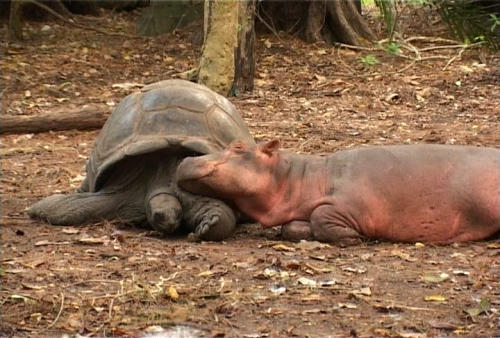
Summary: Kindergarten-Grade 5 When the six-year-old contributor to this book saw the photograph documenting the extraordinary friendship between a baby hippo (Owen) and a 130-year-old giant tortoise (Mzee), she persuaded her father to help tell their story. Originally an e-book, the hardcover version begins with images of the duo, whetting readers' appetite and providing reassurance as the potentially disturbing plot unfolds. After a scene depicting a pod of hippos near the Sabuki River in Kenya, the text describes the 600-pound baby's displacement and separation from the group during the 2004 tsunami. Children witness the challenging rescue and meet the knowledgeable staff at an animal sanctuary. From Owen's first approach for protection to Mzee's unexpected tolerance, the photographs, mostly by BBC photojournalist Greste, capture the pair eating, swimming, snuggling, and playing together. Their contentment and peace are palpable. Because it is sensitively structured, with careful choices about what is emphasized and illustrated, the situation does not overwhelm readers. The text and the back matter are brimming with information about the animals, their caregivers, and the locale. This touching story of the power of a surprising friendship to mitigate the experience of loss is full of heart and hope. A worthy complement is Ann Morris and Heidi Larson's glimpse at a human family's loss and recovery in Tsunami: Helping Each Other (Millbrook, 2005). Wendy Lukehart, Washington DC Public LibraryCopyright © Reed Business Information, a division of Reed Elsevier Inc. All rights reserved.

Additional Illustrations:

This is how Owen appeared on the morning of Dec. 27, 2004 before any attempts were made to catch him. Picture taken by Uncle Joe before putting camera down and entering ocean with two French volunteers (one was named Owen) and one KWS Ranger named Said.

Purchase

Hachiko: The True Story of a Loyal Dog by Pamela Turner

Summary: Gr. 1-4. This small, square picture book pays tribute to one of the world's lesser-known animal heroes: Hachiko, a dog who kept vigil for nearly 10 years at a Tokyo train station, waiting for his deceased master to return from work. Turner unfolds this poignant true story in the natural, unaffected voice of Kentaro, a fictional little boy, who wonders at the dog's unswerving devotion. Unobtrusive details evoke a sense of place ("Ladies in kimonos walked carefully, trying to keep their white tabi socks away from the grime of the streets"), as does Nascimbene's spare line-and-watercolor artwork, reminiscent of Japanese woodblock prints. American children will find the scenes of kimono-clad women bustling alongside men in Western suits especially intriguing. Though Hachiko's eventual death may be upsetting to some (he dies at the station, "still waiting for Mr. Ueno"), the sad news is leavened by an ending that emphasizes his status as a furry folk hero in Tokyo, further elaborated in an afterword. This will resonate with any child who has loved a dog and been loved in return; for reading aloud to groups of older kids, pair the story with The Mightiest Heart (2003), a Welsh legend about another selfless hound. Jennifer Mattson Copyright © American Library Association. All rights reserved

Classroom Implications: A true story taking place in the early 1900's in Japan, students will relate with the resounding message of trust, faithfulness and heroic animals found in this story! It is another nonfiction picture book that captures the warm-hearted animals at their most loyal.

Here is a link to a chapter book about Hachiko that older kids may be inspired to read after they read this picture book. The book is called, Hachiko Waits by Leslie Newman.

Purchase

Remember: The Journey to School Integration by Toni Morrison

Summary: Grade 3-8–This unusual blend of archival photographs, historical background, and fictional narrative brings to life the experiences and emotions of the African-American students who made the tumultuous journey to school integration. Dramatic, mostly full-page, black-and-white photographs make up the bulk of the book. An introduction sets the scene, and factual pages, consisting of several sentences, are scattered throughout. They explain the significance of the events, the trauma of racial conflict, the courage and determination of African Americans and their supporters, and the importance of remembering and understanding. With poignant simplicity and insight, Morrison imagines the thoughts and feelings of some of the people in the pictures. The wrenching, inspiring autobiographical school integration memoirs of first-grader Ruby Bridges (Through My Eyes [Scholastic, 1999]) and Little Rock Nine high school junior Melba Pettillo Beals (Warriors Don't Cry [Washington Square, 1995]) offer greater immediacy and convey a powerful message for future generations about the need for understanding, self-awareness, and self-respect. However, Morrison's reflective interpretation presents a gentler guide for younger readers. Appended are a chronology of "Key Events in Civil Rights and School Integration History"; "Photo Notes" that describe the actual date, location, and content of each picture; and a dedication that recalls the four young girls killed in the bombing of their Birmingham, AL, church in 1963. The provocative, candid images and conversational text should spark questions and discussion, a respect for past sacrifices, and inspiration for facing future challenges.–Gerry Larson, Durham School of the Arts, NC
Copyright © Reed Business Information, a division of Reed Elsevier Inc. All rights reserved.

Classroom Implications: This text is "a gentle guide" for younger, less-experienced or highly sensitive readers. It is an interpretive text that straddles the lines between fiction and nonfiction (Morrison inserts thoughts/feelings to certain photographs in the text). This is a text that recounts AND reflects on the school desegration that the nation faced during the civil rights movement. Would be a nice pair with The Forbidden Schoolhouse: The True and Dramatic Story of Prudence Crandall and Her Students.


Purchase

The Forbidden Schoolhouse: The True and Dramatic Story of Prudence Crandall and Her Students by Suzanne Jurmain

Summary: Gr. 5-8. Jurmain has plucked an almost forgotten incident from history and has shaped a compelling, highly readable book around it. In 1831, Prudence Crandall opened a school for young white ladies. When asked by an African American teenager if she might join the class, Crandall, whose sympathies were with the abolitionists, agreed. So begins a jolting episode in which Crandall turned her school into one for girls of color, and is both tormented and sued by the citizenry of Canterbury, Connecticut, who wanted no part of African Americans in their town. Writing with a sense of drama that propels readers forward (and quoting the language of the day, which includes the word nigger), Jurmain makes painfully clear what Crandall and her students faced, while showing their courage as they stood up to those who tried to deter them. Printed on thick, snowy stock and including a number of sepia-toned and color photographs as well as historical engravings, the book's look will draw in readers. Children will be especially pleased by the appended material, which includes an epilogue that tells what became of the principals, as well as source notes for the many quotes. Ilene CooperCopyright © American Library Association. All rights reserved

Classroom Implications: What's great about this nonfiction text is that it's about desegregation but takes place in a northern setting! Students often read about desegregating schools in the South during the civil rights movement. But this book takes readers back to the 1800's in New England. This book is a nice transition from nonfiction picture books and nonfiction reading students engage in during high school. Therefore, this books is a perfect nonfiction read for the middle grades.

Purchase

Odd Boy Out: Young Albert by Don Brown


Summary: Grade 2-5–This well-crafted picture-book biography focuses on Einstein's hard-to-classify brilliance, which led to awesome scientific discoveries, but all too often left him a misunderstood outsider. Brown describes his subject's loving, cultured parents who were frequently nonplussed by their son's behavior and temper. He found himself the "odd boy" at school, and as the only Jewish student, was sometimes taunted by other children. He puzzled his instructors as well; though clearly gifted in science, math, and music, he was an indifferent student in most subjects. Brown's pen-and-ink and watercolor illustrations, rendered in a palette of dusky mauve and earthy brown, portray a doubtful, somewhat unhappy-looking child, except for a picture in which he gazes fondly at a compass, a gift that astonishes him as he ponders its mysteries. In many scenes he is marginalized on the sidelines, set apart by color and shading. One dramatic spread features an adult Einstein pushing his child in a carriage, looking small against a backdrop that highlights some of the scientific puzzles that so engaged him. Through eloquent narrative and illustration, Brown offers a thoughtful introduction to an enigmatic man. This book will pique the interest of readers with little or no knowledge of Einstein.–Marilyn Taniguchi, Beverly Hills Public Library, CA
Copyright © Reed Business Information, a division of Reed Elsevier Inc. All rights reserved.

Classroom Implications: This picture book biography reminds students that academic icons, such as Albert Einstein, were once children! This nonfiction text is accessible to students due to it's picture book format. This is helpful as a read aloud to younger children and a hands-on text with the older grades. A great connection with science curriculum in the upper grades, too!

Purchase

The Curse of the Pharoahs : My Adventures with Mummies by Zahi Hawass

Summary: Grade 4-8–Some children will already be familiar with the work of this Egyptian archaeologist from TV documentaries about his excavations along the Nile. Hawass is passionate about this work and effectively relates his enthusiasm for it in this first-person account that has the same immediacy as the televised specials. The history of the mummy's curse becomes the frame of his narrative, but the author is at his best when describing his excavations, their inherent dangers (ancient germs, crumbling rock, snakes), and the excitement of discovery. His stories of grave robbers caught millennium ago, and documented in papyrus texts, are fascinating. He also discusses his recent excavations at Giza and his discovery of multichambered tombs at Bahariya Oasis that contain hundreds of mummies. After providing readers with some history of the many myths and legends surrounding the "curse," which he attributes to novelists and "silly" Hollywood movies, he adds a few of his own stories and experiences with the "magic" of the tombs. The full-color photos are superb; they include clear close-up shots of mummies, statues, artifacts, sites, and a number of the scientist at work. There are also a few helpful cutaway diagrams. Appendixes provide tips for kids thinking about a future in archaeology, information on mummification, and useful glossaries. While the exciting title and cover will draw young readers in, it's Hawass's passion, storytellling skills, and the terrific illustrations that will keep them reading.—Daryl Grabarek, School Library Journal
Copyright © Reed Business Information, a division of Reed Elsevier Inc. All rights reserved.

Classroom Implications: Enthusiasm from the author seeps through this text and demonstrates how passion for things found in the world can transfer over to nonfiction writing. This text is a wonderful supplemental text for social studies to use in the classroom. It also helps students to build their comfort levels around nonfiction reading.

Purchase

I See a Kookaburra!: Discovering Animal Habitats Around the World by Robin Page

Summary: Kindergarten-Grade 4–This colorful introduction to six different biomes mixes clearly presented information with seek-and-find fun. The book opens with a glorious two-page collage made of cut and torn paper that depicts a desert in the American Southwest. Eight indigenous animals are included in the picture, but readers will have to search hard to find them as they are mostly camouflaged by cacti and rocks. On the next spread, the creatures are shown against a white backdrop; each one remains in the same position on the page, allowing youngsters to refer back and find the ones they missed. Each animal is introduced by name and given a brief yet tantalizing descriptive line. The same pattern is repeated for a tide pool on the English coast, a rain forest in the Amazon River basin, the grasslands of central Africa, an Australian forest, and a pond in the American Midwest. As an added challenge, and to make the point that ants live all over the world, one of these insects is hidden in each scene. Additional, well-chosen facts about these habitats and the depicted creatures are appended, along with an outline map of the locales. Filled with vibrant colors and palpable textures, the illustrations are breathtaking and give a real sense of the vitality, diversity, and beauty of nature. A first-rate foray into ecology that will encourage readers to explore the world around them.–Joy Fleishhacker, School Library Journal Copyright © Reed Business Information, a division of Reed Elsevier Inc. All rights reserved.

Classroom Implications: In many classrooms, students study habitats and ecology. This is a modern I Spy game that students can play with their classmates during a partner reading session in reading workshop. The art and lines from the text help create a magical mood for kids to bring their science curriculum to life.

Purchase

Runaway Girl: The Artist Louise Bourgeois by Jan Greensberg

Summary: Gr. 7 and Up As in Frank O. Gehry, Outside In (2000), the authors once again make challenging art accessible and exciting to teen readers. This time they focus on Louise Bourgeois, one of the best-known living sculptors, whose work deals with primal themes of jealousy, betrayal, and shifting sexual identities, which, according to Bourgeois are inspired by her painful childhood and her adulterous father. In clear, elegant prose, bolstered with numerous quotes from the artist, the authors seamlessly juxtapose stories of Bourgeois' life with relevant artworks, which are often explained in the artist's own words. Beautifully reproduced photographs, printed on well-designed pages, offer an excellent mix of the artist's personal life and her art, though the authors remind readers that "we don't have to know her story to have our own strong reaction," to her work. By showing the relationship among shapes, colors, materials, and emotions, the authors invite readers to approach even the most bewildering art with confidence and think about it in their own words. The book concludes with a glossary, a bibliography, and notes. Gillian Engberg
Copyright © American Library Association. All rights reserved

Classroom Implications: Another book by Greensberg to spruce up middle school biography collection. Text interweaves some personal struggles students can relate to and the art she manifested as in artist. This text does an excellent job connecting the personal life with what she produces in her professional world.

Purchase

Andy Warhol, Prince of Pop by Jan Greenberg


Summary: Grade 6-9–Warhol's career spanned advertising, painting, filmmaking, and magazine publishing. This competent, well-documented biography covers his childhood and art school years in Pittsburgh, his successful career in commercial art, and his rise in the Pop Art movement. Chapters also cover his dependence on his mother; his pursuit of celebrity; the lively social, drug, and art scene at his studio (christened the "Factory"); a near-fatal shooting; and his death at age 59. The authors provide a good balance of personal and art history, showing how Warhol's signature silkscreen soup cans and portraits were rooted in his commercial beginnings and 1960s commentary on consumerism. Throughout, they provide insight into specific works of art and their relationship to one another. Their liberal use of quotes by Warhol and his contemporaries paints a picture of a man who was often flip or evasive, who wore a very public persona but was extremely guarded about his personal life. The excellent glossary will aid students new to art terms. From the cover design to the quality of the paper and well-selected reproductions and photos, this is attractive bookmaking. While this eccentric, enigmatic subject is not likely to engender affection among readers, they will finish the book with an understanding of his legacy to the art world.–Daryl Grabarek, School Library Journal Copyright © Reed Business Information, a division of Reed Elsevier Inc. All rights reserved.


Classroom Implications: This book is sure to update and liven a book study of biographies in a middle school classroom! Winner of the Blue Ribbon Nonfiction Book Award, Greenberg works to humanize a controversial subject of history and a past art scene.

Purchase

The World According to Dog: Poems and Teen Voices by Joyce Sidman

Summary: Grade 6 Up-Sidman's poetic observations of beloved pets interspersed with short essays by teens are sure to engage dog fanciers. The poems, mostly blank verse with a scattering of haiku, are rueful, contemplative, and sensory as they comment on canine behavior indoors and out and on interaction with humans, other dogs, and the natural world: "-and I am trying to understand this/ecstasy of stink that has me/retching but made you/dive and roll, eyes closed in bliss-." The occasional pieces by young people recount special characteristics of the canines in their lives, sometimes with almost painful honesty. The finding of an abandoned puppy makes a positive change in more than one family. Another teen writes about the enduring spirit of a dog living with cancer. Small black-and-white photos of the featured animals accompany most of the essays. Mindell's larger photographs facing the poems are often in soft focus. Sometimes the blur is poetically suggestive, and sometimes the indistinct image is confusing. Overall, though, the impressive variety of breeds is winning. Sidman sometimes gropes for fitting imagery, but the pacing and flow of her poetry are sure and her appreciation of her subject is astute. Many readers will chuckle or sigh in empathy, and some may well be inspired to express their own thoughts about the world of dog in writing or pictures. Margaret Bush, Simmons College, Boston
Copyright 2003 Reed Business Information, Inc.

Teaching Implications: This text is an interesting blend of poetry, student voices, essays and photograph. These genres tend to capture the attention and love of middle school students. Coupled with the subject matter of dogs and this book becomes an immediate popular book in the classroom library!


Purchase

Blues Journey by Walter Dean Myers

Summary: Gr. 5-8. The blues' deceptively simple rhyme scheme tracks the deeper feelings of lives that have been bruised. In this picture book for older readers, Myers offers blues-inspired verse that touches on the black-and-blue moments of individual lives. His son Christopher's images, which illustrate the call-and-response text, alternate between high spirited and haunting. Myers begins with a very necessary introduction to the history of the blues that includes an explanation of the rhyme scheme. Still, the level of sophistication necessary for kids to get into the book is considerable: "Strange fruit hanging, high in the big oak tree / Strange fruit hanging high in the big oak tree / You can see what it did to Willie, / and you see what it did to me." Myers' original verse is unsettling if young people know the reference from the Billie Holiday song, but unclear if they don't ("strange fruit" is defined in the glossary). The accompanying illustration, though it's one of the less inspired ones, helps clarify things--a boy walks in a crowd carrying a sign saying, "yesterday a man was lynched." But there's no cohesion between the spreads, and the next one features a blues singer at a mike: "The thrill is gone, but love is still in my heart . . . I can feel you in the music and it's tearing me apart." Much of Myers' poetry here is terrific, by turn, sweet, sharp, ironic, but it's the memorable collage artwork, executed in the bluest of blue ink and brown paper, that will draw readers first. Once inside the book, some children will immediately hear the songs the poetry sings; others will have to listen more closely. Ilene CooperCopyright © American Library Association. All rights reserved

Unique Features: This text blends nicely into a poetry or music study in the upper grade classrooms. A particularly complex nonfiction picture book, this text could be examined by higher level readers. The style of language in this "blues" book can compare nicely to Myer's Jazz writing style.

Purchase

Invisible Allies: Microbes That Shape Our Lives (Bccb Blue Ribbon Nonfiction Book Award by Jeanette Farrell

Summary: Gr. 6-9. The author of Invisible Enemies (1998), Farrell now offers a fascinating, broad-ranging and imminently readable book on the beneficial roles of microbes. After stating some amazing facts about microbes and advising readers against "running, somewhat futilely, for a bar of soap," the introduction provides a vivid picture of Antony van Leeuwenhoek's discovery of microorganisms in 1676. The chapters that follow consider beneficial microbes in the production of bread, cheese, and chocolate as well as their vital role in the gut, where they break down certain foods, kill harmful microbes, and enable certain genes in the intestines to maximize digestion. Finally, Farrell explains the process by which microbes dispose of human waste in sewage treatment plants, noting that they are also used to clean up oil spills and toxins in the environments. Illustrations include photos as well as interesting archival material. Without talking down to her audience or hyping the grosser aspects of the subject, Farrell presents what is known about beneficial microbes and acknowledges the ongoing study of these amazing life-forms. Carolyn Phelan Copyright © American Library Association. All rights reserved

Teaching Points: Prediction (Skill)-->Students can examine the roles that microbes play in our world. Student begin with a microbe (cause) and trace the effect it has on the world (effect). By studying this cause and effect relationship, students can use the relationship to make predictions. For instance, students can examine what would happen to the world in the absence of certain microbes.

Classroom Implications:
This text would match well with Invisible Enemies and New York Times Deadly Invaders, especially if the students are in nonfiction book clubs. These nonfiction pieces make great additions to information contained in novels.

Purchase