Showing posts with label social action. Show all posts

Something Beautiful by Sharon Dennis Wyeth


Summary: This moving picture book offers a shining testament to the ability of human beings to find "something beautiful" in even the most unlikely places. An African American girl initially sees only the ugliness of her neighborhood. There is "trash in the courtyard and a broken bottle that looks like fallen stars." On her front door, someone has scrawled the word "DIE," and a homeless lady "sleeps on the sidewalk, wrapped in plastic." Searching for something beautiful?"something that when you have it, your heart is happy"?she polls various neighbors. For an old man it is the touch of a smooth stone; for Miss Delphine, it's the taste of the fried fish sandwich in her diner; for Aunt Carolyn, it's the sound of her baby's laugh. When the girl decides to create her own "something beautiful," she picks up the trash, scrubs her door clean and realizes, "I feel powerful." Wyeth's (Always My Dad) restrained text is thoughtful without being didactic. She creates a city landscape that is neither too dark nor too sweet; and her ending is just right, with the heroine's mother saying that her daughter is her "something beautiful." Soentpiet's (Peacebound Trains) paintings are luminously lifelike. Whether depicting the girl running past a chain-link fence in a dark alley or Miss Delphine's patrons sitting beneath the rows of glinting glasses, the paintings focus on a community with characters so real, readers can almost feel the sunlight on their faces. All ages. Copyright 1998 Reed Business Information, Inc. --This text refers to the Hardcover edition.

Classroom Implications
: This book resonates with urban community members and echos the salient point of community action. It offers a different perspective to preserving our environment by marking the importance of preserving ALL environments. It combines concepts of community organizing, social action and environmentalism. I also like the cover because it implies finding beauty in personal identities, as well as communities. This is an important image for our students to see, view and discuss, especially in regards to how community identity mirrors personal identity.

Purchase

Just a Dream by Chris Van Allsberg


Summary: Two-time Caldecott Medalist Van Allsburg reaches a new pinnacle of excellence in both illustration and storytelling in his latest work. Since his first book, The Garden of Abdul Gasazi, appeared just over a decade ago, he has spun many strange and fantastic modern fairy tales, all of which spill over the edge of reality into magnificent dreamscapes. Here Van Allsburg introduces Walter, a boy who imagines the future as a marvelous time, with tiny airplanes that can be parked on the roof of your house and robots that take care of all your work for you. In the present, however, Walter is a litterbug who can't be bothered to sort the trash for recycling and laughs at Rose, the girl next door, because she receives a sapling for her birthday. One night, when Walter goes to sleep, his bed travels to the future. But he finds neither tiny airplanes nor robots, only piles of trash covering the street where he used to live, acres and acres of stumps where forests used to stand, rows and rows of great smokestacks belching out acrid smoke, and many other environmental nightmares. Van Allsburg renders each of these chilling scenarios in elaborate, superbly executed two-page spreads that echo the best work of M. C. Escher and Winsor McKay (creator of the Little Nemo comic strips). Walter and his bed land right in the middle of the action in each of these hallucinatory paintings, heightening the visual impact and forcing a hard look at the devastation surrounding Van Allsburg's protagonist. An awakened Walter, jolted by his dream, changes his ways: he begins to sort the trash and, like Rose, plants a tree for his birthday. Then his bed takes him to a different future, one where people tend their lawns with powerless mowers and where the trees he and Rose have planted stand tall and strong beneath a blue sky. Not only are Just a Dream 's illustrations some of the most striking Van Allsburg has ever created, but the text is his best yet. Van Allsburg has sacrificed none of the powerful, otherworldly spirit that suffuses his earlier works, and he has taken a step forward by bringing this spirit to bear on a vitally important issue. His fable builds to an urgent plea for action as it sends a rousing message of hope. All ages. Copyright 1990 Reed Business Information, Inc.

Cross Curricular Connections: This is really a book with an environmental twist. This fantasy picture book would make a nice pair with Home or Window by Jeannie Baker.

Purchase

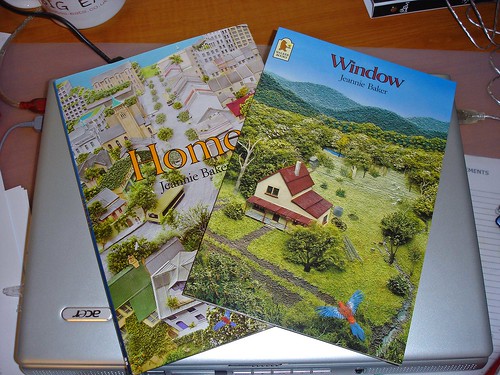
Home by Jeannie Baker

Summary: K-Gr. 3. This wordless picture book with exquisitely detailed collage illustrations speaks eloquently about urban conservation. Every double-page spread is a view through the same window, a view that changes over a generation, beginning with a couple expecting a baby and continuing as the baby grows up, is courted, and is married in the neighborhood street. At first the sprawl and smog nearly smother the view, but gradually the place changes. The community brings back a variety of local plants, and by the time the young woman's own baby is born, trees block the billboards, there are birds on the roof and in the sky, and cyclists and a bus can be seen on the roadway. Suddenly, there's a glimpse of the river in the distance, a dragonfly on the windowsill, and the full moon shines at night. Unlike some collage art, the technique here never gets in the way. The details show and tell a story about the small things in one neighborhood--their fragility, strength, and connection--and their power to make a difference. With each look at the pictures, there's more to see in the crowded neighborhood that is transformed into a wild and beautiful place. Hazel Rochman Copyright © American Library Association. All rights reserved

Classroom Implications
: This is a great companion piece with Baker's other book, Window. It takes the opposite look at development and the environment. It starts with an urban decay of a scene. With time, care, and community effort, the city-scape transforms into something beautiful. It would also be a picture book to support Paul Fleishman's book Seedfolks, which is based on social action, community and gardening.

Purchase

Window by Jeannie Baker

Summary: Grade 1 Up-- A mother, holding her newborn son, gazes out the window of his room at lush vegetation, tropical birds, a pond, a kangaroo. Ten double-page illustrations following show the development--during a 20-year period--of the area outside the window. As Sam (the baby) grows older, the land is cleared, a road is built, then a farm. A housing development goes up, then takes over a hill that was once green with lush growth. Development becomes suburb, then city, complete with billboards, high-rises, noise pollution, litter, and overpopulation. Sam marries and moves to a new house in the country, where the final window scene shows him, holding his baby, staring at a sign announcing, "House Blocks For Sale". Words are unnecessary, as Baker's carefully rendered collage scenes explicitly detail the situation. Varying symbolic objects on Sam's windowsill (and the cracking and peeling of paint on the wall) add to the book's message. Baker's meticulous collages, formed from natural materials, clay, fabric, and real hair, are so detailed that they require many viewings. A final, short author's note explains the inspiration for the book: ". . .by understanding and changing the way we personally affect the environment, we can make a difference." This unusual, exceptionally well-crafted picture book might be a good way to begin. --Susan Scheps, Shaker Heights Public Library, OH Copyright 1991 Reed Business Information, Inc. --This text refers to an out of print or unavailable edition of this title.

Curricular Connections: This text can be used in a science classroom where students study the effect of development on indigenous ecosystems. It is a crucial outlook and environmental perspective that should be support with today's youth.

Purchase

Persepolis by Marijane Satripi

Summary: Satrapi's autobiography is a timely and timeless story of a young girl's life under the Islamic Revolution. Descended from the last Emperor of Iran, Satrapi is nine when fundamentalist rebels overthrow the Shah. While Satrapi's radical parents and their community initially welcome the ouster, they soon learn a new brand of totalitarianism is taking over. Satrapi's art is minimal and stark yet often charming and humorous as it depicts the madness around her. She idolizes those who were imprisoned by the Shah, fascinated by their tales of torture, and bonds with her Uncle Anoosh, only to see the new regime imprison and eventually kill him. Thanks to the Iran-Iraq war, neighbors' homes are bombed, playmates are killed and parties are forbidden. Satrapi's parents, who once lived in luxury despite their politics, struggle to educate their daughter. Her father briefly considers fleeing to America, only to realize the price would be too great. "I can become a taxi driver and you a cleaning lady?" he asks his wife. Iron Maiden, Nikes and Michael Jackson become precious symbols of freedom, and eventually Satrapi's rebellious streak puts her in danger, as even educated women are threatened with beatings for improper attire. Despite the grimness, Satrapi never lapses into sensationalism or sentimentality. Skillfully presenting a child's view of war and her own shifting ideals, she also shows quotidian life in Tehran and her family's pride and love for their country despite the tumultuous times. Powerfully understated, this work joins other memoirs-Spiegelman's Maus and Sacco's Safe Area Goradze-that use comics to make the unthinkable familiar. Copyright 2003 Reed Business Information, Inc.

Notable Information: This text has the power to convert the non-reader of graphic novels to an avid one! Reviewer after reviewer will testify that he or she sat down to begin the book and didn't get up until they finished. Middle and high school students can experience this, too. By starting them off with reading American Born Chinese, some will be ready to move onto this heavier, more mature text. The text is highly political while still managing to focus on the individual growth and development of the narrator. The reader has to rely heavily on reading between the lines of this text, as well as the illustrations in order to gain the full understanding of the story. Therefore, graphic novels, such as this one, create a rich environment to work on the tough reading and thinking skills of inference and interpretation.

Text Excerpt:

Sequel: Perspepolis II
This sequel begins where the first left off and chronicles the older years of Marji's life. This sequel presents a different subset of issues and best suits high school readers. Be advised: if this book sits next to the first one, the reader will immediately pick it up to find out what happened where the first left off!

Purchase


Remember: The Journey to School Integration by Toni Morrison

Summary: Grade 3-8–This unusual blend of archival photographs, historical background, and fictional narrative brings to life the experiences and emotions of the African-American students who made the tumultuous journey to school integration. Dramatic, mostly full-page, black-and-white photographs make up the bulk of the book. An introduction sets the scene, and factual pages, consisting of several sentences, are scattered throughout. They explain the significance of the events, the trauma of racial conflict, the courage and determination of African Americans and their supporters, and the importance of remembering and understanding. With poignant simplicity and insight, Morrison imagines the thoughts and feelings of some of the people in the pictures. The wrenching, inspiring autobiographical school integration memoirs of first-grader Ruby Bridges (Through My Eyes [Scholastic, 1999]) and Little Rock Nine high school junior Melba Pettillo Beals (Warriors Don't Cry [Washington Square, 1995]) offer greater immediacy and convey a powerful message for future generations about the need for understanding, self-awareness, and self-respect. However, Morrison's reflective interpretation presents a gentler guide for younger readers. Appended are a chronology of "Key Events in Civil Rights and School Integration History"; "Photo Notes" that describe the actual date, location, and content of each picture; and a dedication that recalls the four young girls killed in the bombing of their Birmingham, AL, church in 1963. The provocative, candid images and conversational text should spark questions and discussion, a respect for past sacrifices, and inspiration for facing future challenges.–Gerry Larson, Durham School of the Arts, NC
Copyright © Reed Business Information, a division of Reed Elsevier Inc. All rights reserved.

Classroom Implications: This text is "a gentle guide" for younger, less-experienced or highly sensitive readers. It is an interpretive text that straddles the lines between fiction and nonfiction (Morrison inserts thoughts/feelings to certain photographs in the text). This is a text that recounts AND reflects on the school desegration that the nation faced during the civil rights movement. Would be a nice pair with The Forbidden Schoolhouse: The True and Dramatic Story of Prudence Crandall and Her Students.


Purchase

The Forbidden Schoolhouse: The True and Dramatic Story of Prudence Crandall and Her Students by Suzanne Jurmain

Summary: Gr. 5-8. Jurmain has plucked an almost forgotten incident from history and has shaped a compelling, highly readable book around it. In 1831, Prudence Crandall opened a school for young white ladies. When asked by an African American teenager if she might join the class, Crandall, whose sympathies were with the abolitionists, agreed. So begins a jolting episode in which Crandall turned her school into one for girls of color, and is both tormented and sued by the citizenry of Canterbury, Connecticut, who wanted no part of African Americans in their town. Writing with a sense of drama that propels readers forward (and quoting the language of the day, which includes the word nigger), Jurmain makes painfully clear what Crandall and her students faced, while showing their courage as they stood up to those who tried to deter them. Printed on thick, snowy stock and including a number of sepia-toned and color photographs as well as historical engravings, the book's look will draw in readers. Children will be especially pleased by the appended material, which includes an epilogue that tells what became of the principals, as well as source notes for the many quotes. Ilene CooperCopyright © American Library Association. All rights reserved

Classroom Implications: What's great about this nonfiction text is that it's about desegregation but takes place in a northern setting! Students often read about desegregating schools in the South during the civil rights movement. But this book takes readers back to the 1800's in New England. This book is a nice transition from nonfiction picture books and nonfiction reading students engage in during high school. Therefore, this books is a perfect nonfiction read for the middle grades.

Purchase

Harvesting Hope: The Story of Cesar Chavez by Kathleen Krull

Summary: Grade 4-8-The dramatic story of Chavez's 340-mile march to protest the working conditions of migrant farmworkers in California is the centerpiece of this well-told biography. Readers meet Chavez at his grandparents' home in Arizona where he lived happily amid a large extended family. His childhood was cut short when, due to financial difficulties, the family was forced to move to California to seek employment. After years of laboring in the fields, Chavez became increasingly disturbed by the inhuman living conditions imposed by the growers. The historic 1965 strike against grape growers and the subsequent march for "La Causa" are vividly recounted, and Chavez's victory-the agreement by the growers granting the workers better conditions and higher pay-is palpable. While sufficient background information is provided to support the story and encourage further research, focusing on one event makes the story appealing to younger readers. The text is largely limited to one side of a spread; beautifully rendered earth-toned illustrations flow out from behind the words and onto the facing page. A fine addition to any collection.Sue Morgan, Tom Kitayama Elementary School, Union City, CA Copyright 2003 Reed Business Information, Inc.

Themes:
Activism, Peace, Social Activism, Hope, Prejudice, Perseverance

Classroom Implications: A must to match with Cesar: Si, Se Puede!/ Yes, We Can! by Carmen Bernier-Grand. This picture book is an excellent piece of nonfiction/biography that will reach and inspire students. Cesar's life is an accessible venue by which to teach fairness, activism, peace and perseverance.

Teacher's Guide to Book

Purchase

César: ¡Sí, Se Puede! Yes, We Can! by Carmen T. Bernier-Grand

Summary: Grade 2-6–The life and times of César Chávez are vividly re-created in this collection of poems. Where most biographies stick to the facts of what a person did, this one also touches on the man's character and values. Children will learn about Chávez, but, more importantly, they will learn the important lessons he taught, and they will be able to apply them to their own lives. The lyrical language describes events and paints evocative pictures to which children will relate. Diaz's stylized, computer-drawn, folk-art illustrations capture the subject's private and public life, from the images of picking fruit to peaceful demonstrations. A glossary and translation of the Spanish words used, a concise well-written biographical essay, and famous Chávez quotes are appended. An excellent choice for most libraries.–Scott La Counte, Anaheim Public Library, CA Copyright © Reed Business Information, a division of Reed Elsevier Inc. All rights reserved.

Themes: Activism, Peace, Social Activism, Hope, Prejudice,

Classroom Implications: This books makes a perfect compliment iwth Harvesting Hope: The Story of Cesar Chavez by Kathleen Krull. Whereas Krull's book is a biographical picture book, Bernier-Grand's book offers a more poetic, minimalistic tribute to Chavez's life's work.

Note:
A glossary and translation of the Spanish words used, a concise well-written biographical essay, and famous Chávez quotes are appended. (amazon.com)


Purchase

Before We Were Free by Julia Alvarez

Summary: (Ages 12+) What would life be like for a teen living under a dictatorship? Afraid to go to school or to talk freely? Knowing that, at the least suspicion, the secret police could invade your house, even search and destroy your private treasures? Or worse, that your father or uncles or brothers could be suddenly taken away to be jailed or tortured or killed? Such experiences have been all too common in the many Latin American dictatorships of the last 50 years. Author Julia Alvarez (How the Garcia Girls Lost Their Accents) and her family escaped from the Trujillo regime in the Dominican Republic when she was 10, but in Before We Were Free she imagines, through the stories of her cousins and friends, how it was for those who stayed behind.

Twelve-year-old Anita de la Torre is too involved with her own life to be more than dimly aware of the growing menace all around her, until her last cousins and uncles and aunts have fled to America and a fleet of black Volkswagens comes up the drive, bringing the secret police to the family compound to search their houses. Gradually, through overheard conversations and the explanations of her older sister, Lucinda, she comes to understand that her father and uncles are involved in a plot to kill El Jefe, the dictator, and that they are all in deadly peril. Anita's story is universal in its implications--she even keeps an Anne Frank-like diary when she and her mother must hide in a friend's house--and a tribute to those brave souls who feel, like Anita's father, that "life without freedom is no life at all." --Patty Campbell

Themes: Oppression, Activism, Family, Membership, Identity, Resistance

Classroom Implications: This book takes a different spin on identity and immigration by telling the story of those left behind. This novel is to be appreciated for its honest look at Latin American dictatorships and the impact they have on families, advocacy and identity. This book can move through different themed book clubs: realistic fiction, social issues, and even possibly historical fiction. Lower level readers can help access this text by listening to the audio version.

Purchase

A Swiftly Tilting Planet by Madeleine L'Engle

Summary: (Ages 9 and older) Fifteen-year-old Charles Wallace Murry, whom readers first met in A Wrinkle in Time, has a little task he must accomplish. In 24 hours, a mad dictator will destroy the universe by declaring nuclear war--unless Charles Wallace can go back in time to change one of the many Might-Have-Beens in history. In an intricately layered and suspenseful journey through time, this extraordinary young man psychically enters four different people from other eras. As he perceives through their eyes "what might have been," he begins to comprehend the cosmic significance and consequences of every living creature's actions. As he witnesses first-hand the transformation of civilization from peaceful to warring times, his very existence is threatened, but the alternative is far worse. The Murry family, also appearing in A Wind in the Door and Many Waters, acts as a carrier of Madeleine L'Engle's unique message about human responsibility for the world. Themes of good versus evil, time and space travel, and the invincibility of the human spirit predominate. Even while she entertains, L'Engle kindles the intellect, inspiring young people to ask questions of the world, and learn by challenging. --Emilie Coulter

First Sentence:
The big kitchen of the Murrys' house was bright and warm, curtains drawn against the dark outside, against the rain driving past the house from the northeast.


Classroom Implications: Students can really study the themes of good vs. evil with the L'Engle books. These books are essentials for students to read in their reading lives, and a book club would be an excellent way to incorporate these texts into the lives of students.

Purchase

The Voice that Challenged a Nation: Marian Anderson and the Struggle for Equal Rights by Russell Freedman

Gr. 4-8. In lush operatic style, Pam Munoz Ryan's picture-book biography When Marian Sang (2002), with beautiful illustrations by Brian Selznick, celebrated the triumph of the great African American vocalist in the face of the vicious segregation of her time. Now for middle-grade and junior-high readers comes this handsome, spaciously designed photo-biography. In his signature prose, plain yet eloquent, Freedman tells Anderson's triumphant story, with numerous black-and-white documentary photos and prints that convey her personal struggle, professional artistry, and landmark civil rights role. Everything leads up to her 1939 historic performance at the Lincoln Memorial, where, denied the right to sing at Constitution Hall, she thrilled a crowd of 75,000 and a national radio audience. Freedman reveals that Anderson never invited political confrontation, but with the support of such friends as Eleanor Roosevelt, she had a profound effect on the nation. Documentation is an essential part of her exciting story, with many pages of source notes as well as an enthusiastic, annotated bibliography, and, of course, a discography. Older readers and adults will want this, too. Hazel RochmanCopyright © American Library Association. All rights reserved
Classroom Implications: Pairing this book with Ryan's picture book is a great way to make nonfiction texts accessible for the intermediate and upper grade classrooms. This book is an essential for biography studies and nonfiction reading.
Skills and Strategies
  • Determining Importance
  • Fact and Opinion
  • Retelling
  • Scanning
  • Summarizing

Rosa by Nikki Giovanni and Bryan Collier


Grade 3-5–Rosa Parks's personal story moves quickly into a summary of the Civil Rights movement in this striking picture book. Parks is introduced in idealized terms. She cares for her ill mother and is married to one of the best barbers in the county. Sewing in an alterations department, Rosa Parks was the best seamstress. Her needle and thread flew through her hands like the gold spinning from Rumpelstiltskin's loom. Soon the story moves to her famous refusal to give up her seat on the bus, but readers lose sight of her as she waits to be arrested. Giovanni turns to explaining the response of the Women's Political Caucus, which led to the bus boycott in Montgomery. A few events of the movement are interjected–the Supreme Court decision in Brown v. Board of Education, the aftermath and reactions to the murder of Emmett Till, the role of Martin Luther King, Jr., as spokesperson. Collier's watercolor and collage scenes are deeply hued and luminous, incorporating abstract and surreal elements along with the realistic figures. Set on colored pages, these illustrations include an effective double foldout page with the crowd of successful walkers facing a courthouse representing the 1956 Supreme Court verdict against segregation on the buses. Many readers will wonder how it all went for Parks after her arrest, and there are no added notes. Purposeful in its telling, this is a handsome and thought-provoking introduction to these watershed acts of civil disobedience.–Margaret Bush, Simmons College, Boston
Copyright © Reed Business Information, a division of Reed Elsevier Inc. All rights reserved.

Classroom Implications:
"...She was tired. Not tired from work, but tired of putting white people first..." This line captures the essence of this book; a book that not only captures Rosa's political role, but illustrates her life as a woman. Giovanni and Collier are a must for an in-depth study of African American history and the civil rights movement. Not just a book for February, Rosa is a must for library shelves throughout the grades.

Skills and Strategies
  • Nonfiction reading--biography
  • Determining Importance
  • Predicting
  • Questioning
  • Note-taking
Purchase

Moses: When Harriet Tubman Led Her People to Freedom by Carole Boston Weatherford (Author), Kadir Nelson (Illustrator)


Grades 2-5 (and beyond) Weatherford's handsome picture book about Harriet Tubman focuses mostly on Tubman's religious inspiration, with echoes of spirituals ringing throughout the spare poetry about her struggle ("Lord, don't let nobody turn me 'round"). God cradles Tubman and talks with her; his words (printed in block capitals) both inspire her and tell her what to do ("SHED YOUR SHOES; WADE IN THE WATER TO TRICK THE DOGS"). Nelson's stirring, beautiful artwork makes clear the terror and exhaustion Tubman felt during her own escape and also during her brave rescue of others. There's no romanticism: the pictures are dark, dramatic, and deeply colored--whether showing the desperate young fugitive "crouched for days in a potato hole" or the tough middle-aged leader frowning at the band of runaways she's trying to help. The full-page portrait of a contemplative Tubman turning to God to help her guide her people is especially striking. Hazel Rochman
Copyright © American Library Association. All rights reserved

Sample Page


Classroom Implications: A critical addition to any library, this book uses poetry and call and response format to paint an accurate portrayal of Tubman's journey. The illustrations and language team together to create a teaching tool that spans audiences.

Skills and Strategies
  • Nonfiction reading--historical and social action
  • Poetry
  • Call and Response
  • Descriptive language
  • Character study
Purchase

Gone Wild by David McLimans


From School Library Journal Grade 3 Up–Although organized as a conventional alphabet book, the letters here are far from ordinary. McLimans has created a black-and-white iconic representation of 26 endangered animals, and his art is striking. For example, the newt's eyes protrude slightly from the sides of N, while its tongue emerges from the lower point. An accompanying box on each page includes a small, stylized red-and-white image of the animal plus information about its class, habitat, range, and threats to its survival. Back matter includes a paragraph about each creature along with a list of Web sites for organizations that help endangered animals and books for further reading. This title will serve more as a tool to raise awareness and a place to begin searching for information rather than as a source of facts. However, the arresting graphics and clean design will hold viewers' attention and create interest in the topic. The book could also serve as a starting point for art and design projects for students well above elementary school age.–Kathy Piehl, Minnesota State University, Mankato Copyright © Reed Business Information, a division of Reed Elsevier Inc. All rights reserved.

Classroom Implications: This book has an innovative approach to the traditional alphabet book. It operates as an alphabet book and nonfiction text that advocates around the critical social issue of protecting endangered species. Students can not only use this text to learn the alphabet, but students can learn about the animals and organizations that support the preservation of the species. This text is also an important tool to support English language learners and special education students in the upper grades.

Skills and Strategies
  • Letter learning & symbol making
  • Nonfiction reading
  • Social action
Purchase