Showing posts with label animals. Show all posts

Maus a Survivors Tale: My Father Bleeds History by Art Spiegelman


Summary: Some historical events simply beggar any attempt at description--the Holocaust is one of these. Therefore, as it recedes and the people able to bear witness die, it becomes more and more essential that novel, vigorous methods are used to describe the indescribable. Examined in these terms, Art Spiegelman's Maus is a tremendous achievement, from a historical perspective as well as an artistic one.

Spiegelman, a stalwart of the underground comics scene of the 1960s and '70s, interviewed his father, Vladek, a Holocaust survivor living outside New York City, about his experiences. The artist then deftly translated that story into a graphic novel. By portraying a true story of the Holocaust in comic form--the Jews are mice, the Germans cats, the Poles pigs, the French frogs, and the Americans dogs--Spiegelman compels the reader to imagine the action, to fill in the blanks that are so often shied away from. Reading Maus, you are forced to examine the Holocaust anew.

This is neither easy nor pleasant. However, Vladek Spiegelman and his wife Anna are resourceful heroes, and enough acts of kindness and decency appear in the tale to spur the reader onward (we also know that the protagonists survive, else reading would be too painful). This first volume introduces Vladek as a happy young man on the make in pre-war Poland. With outside events growing ever more ominous, we watch his marriage to Anna, his enlistment in the Polish army after the outbreak of hostilities, his and Anna's life in the ghetto, and then their flight into hiding as the Final Solution is put into effect. The ending is stark and terrible, but the worst is yet to come--in the second volume of this Pulitzer Prize-winning set. --Michael Gerber
Classroom Implications: This book adds a new dimension to a Holocaust study. The graphic novel provides a different angle, a new lens, for students to examine a subject that they may already know a lot about.

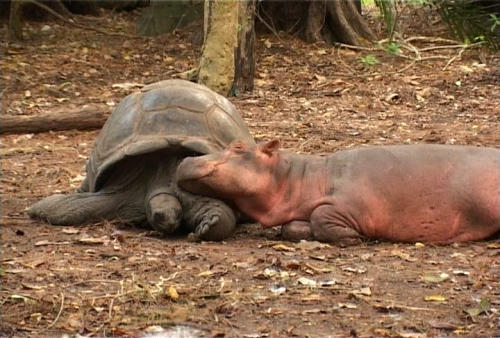
Owen & Mzee: Language Of Friendship by Isabelle Hatkoff

Summary: For somewhat older readers than Marion Dane Bauer's A Mama for Owen (2007), this book updates children on its famous subjects through crisp, immediate photos taken at the Kenyan refuge they call home. The same complicated supporting cast is featured in this book, including a father-daughter team; a naturalist from the refuge; and photojournalist Greste, whose photos here are more varied, abundant, and consistent in quality than before. Along with assuring children that the bond between Owen and Mzee is "stronger than ever," the authors chronicle the animals' system of communication, involving nudges, nips, and even a special kind of call. Libraries that own the first title will certainly want to add this title; those that don't may wish to purchase just this one, which gives the necessary context and duplicates some elements from the earlier book, while extending the information--through references to naturalists' concerns about Owen's need to interact with other hippos, and about Mzee's safety as his companion grows to his 7,000-pound size--in a way that moves beyond the pat, heartwarming aspects of the incident to ask fascinating questions about animal behavior. Jennifer Mattson
Copyright © American Library Association. All rights reserved

Classroom Implications: Kids will be begging for a sequel if they read the original book about Owen and Mzee. This is a great book to have on hand for follow up readings kids may want to do during independent reading. It also makes a great book to read aloud to children if the level of text is too difficult for the readers. It is a nonfiction picture book that adds depth and emotional feeling to the nonfiction genre.

Purchase

Owen & Mzee: The True Story Of A Remarkable Friendship by Isabella Hatkoff

Summary: Kindergarten-Grade 5 When the six-year-old contributor to this book saw the photograph documenting the extraordinary friendship between a baby hippo (Owen) and a 130-year-old giant tortoise (Mzee), she persuaded her father to help tell their story. Originally an e-book, the hardcover version begins with images of the duo, whetting readers' appetite and providing reassurance as the potentially disturbing plot unfolds. After a scene depicting a pod of hippos near the Sabuki River in Kenya, the text describes the 600-pound baby's displacement and separation from the group during the 2004 tsunami. Children witness the challenging rescue and meet the knowledgeable staff at an animal sanctuary. From Owen's first approach for protection to Mzee's unexpected tolerance, the photographs, mostly by BBC photojournalist Greste, capture the pair eating, swimming, snuggling, and playing together. Their contentment and peace are palpable. Because it is sensitively structured, with careful choices about what is emphasized and illustrated, the situation does not overwhelm readers. The text and the back matter are brimming with information about the animals, their caregivers, and the locale. This touching story of the power of a surprising friendship to mitigate the experience of loss is full of heart and hope. A worthy complement is Ann Morris and Heidi Larson's glimpse at a human family's loss and recovery in Tsunami: Helping Each Other (Millbrook, 2005). Wendy Lukehart, Washington DC Public LibraryCopyright © Reed Business Information, a division of Reed Elsevier Inc. All rights reserved.

Additional Illustrations:

This is how Owen appeared on the morning of Dec. 27, 2004 before any attempts were made to catch him. Picture taken by Uncle Joe before putting camera down and entering ocean with two French volunteers (one was named Owen) and one KWS Ranger named Said.

Purchase

Hachiko: The True Story of a Loyal Dog by Pamela Turner

Summary: Gr. 1-4. This small, square picture book pays tribute to one of the world's lesser-known animal heroes: Hachiko, a dog who kept vigil for nearly 10 years at a Tokyo train station, waiting for his deceased master to return from work. Turner unfolds this poignant true story in the natural, unaffected voice of Kentaro, a fictional little boy, who wonders at the dog's unswerving devotion. Unobtrusive details evoke a sense of place ("Ladies in kimonos walked carefully, trying to keep their white tabi socks away from the grime of the streets"), as does Nascimbene's spare line-and-watercolor artwork, reminiscent of Japanese woodblock prints. American children will find the scenes of kimono-clad women bustling alongside men in Western suits especially intriguing. Though Hachiko's eventual death may be upsetting to some (he dies at the station, "still waiting for Mr. Ueno"), the sad news is leavened by an ending that emphasizes his status as a furry folk hero in Tokyo, further elaborated in an afterword. This will resonate with any child who has loved a dog and been loved in return; for reading aloud to groups of older kids, pair the story with The Mightiest Heart (2003), a Welsh legend about another selfless hound. Jennifer Mattson Copyright © American Library Association. All rights reserved

Classroom Implications: A true story taking place in the early 1900's in Japan, students will relate with the resounding message of trust, faithfulness and heroic animals found in this story! It is another nonfiction picture book that captures the warm-hearted animals at their most loyal.

Here is a link to a chapter book about Hachiko that older kids may be inspired to read after they read this picture book. The book is called, Hachiko Waits by Leslie Newman.

Purchase

I See a Kookaburra!: Discovering Animal Habitats Around the World by Robin Page

Summary: Kindergarten-Grade 4–This colorful introduction to six different biomes mixes clearly presented information with seek-and-find fun. The book opens with a glorious two-page collage made of cut and torn paper that depicts a desert in the American Southwest. Eight indigenous animals are included in the picture, but readers will have to search hard to find them as they are mostly camouflaged by cacti and rocks. On the next spread, the creatures are shown against a white backdrop; each one remains in the same position on the page, allowing youngsters to refer back and find the ones they missed. Each animal is introduced by name and given a brief yet tantalizing descriptive line. The same pattern is repeated for a tide pool on the English coast, a rain forest in the Amazon River basin, the grasslands of central Africa, an Australian forest, and a pond in the American Midwest. As an added challenge, and to make the point that ants live all over the world, one of these insects is hidden in each scene. Additional, well-chosen facts about these habitats and the depicted creatures are appended, along with an outline map of the locales. Filled with vibrant colors and palpable textures, the illustrations are breathtaking and give a real sense of the vitality, diversity, and beauty of nature. A first-rate foray into ecology that will encourage readers to explore the world around them.–Joy Fleishhacker, School Library Journal Copyright © Reed Business Information, a division of Reed Elsevier Inc. All rights reserved.

Classroom Implications: In many classrooms, students study habitats and ecology. This is a modern I Spy game that students can play with their classmates during a partner reading session in reading workshop. The art and lines from the text help create a magical mood for kids to bring their science curriculum to life.

Purchase

The World According to Dog: Poems and Teen Voices by Joyce Sidman

Summary: Grade 6 Up-Sidman's poetic observations of beloved pets interspersed with short essays by teens are sure to engage dog fanciers. The poems, mostly blank verse with a scattering of haiku, are rueful, contemplative, and sensory as they comment on canine behavior indoors and out and on interaction with humans, other dogs, and the natural world: "-and I am trying to understand this/ecstasy of stink that has me/retching but made you/dive and roll, eyes closed in bliss-." The occasional pieces by young people recount special characteristics of the canines in their lives, sometimes with almost painful honesty. The finding of an abandoned puppy makes a positive change in more than one family. Another teen writes about the enduring spirit of a dog living with cancer. Small black-and-white photos of the featured animals accompany most of the essays. Mindell's larger photographs facing the poems are often in soft focus. Sometimes the blur is poetically suggestive, and sometimes the indistinct image is confusing. Overall, though, the impressive variety of breeds is winning. Sidman sometimes gropes for fitting imagery, but the pacing and flow of her poetry are sure and her appreciation of her subject is astute. Many readers will chuckle or sigh in empathy, and some may well be inspired to express their own thoughts about the world of dog in writing or pictures. Margaret Bush, Simmons College, Boston
Copyright 2003 Reed Business Information, Inc.

Teaching Implications: This text is an interesting blend of poetry, student voices, essays and photograph. These genres tend to capture the attention and love of middle school students. Coupled with the subject matter of dogs and this book becomes an immediate popular book in the classroom library!


Purchase