If You Come Softly by Jacqueline Woodson

Summary: Ages 10-up. Once again, Woodson (I Hadn't Meant to Tell You This) handles delicate, even explosive subject matter with exceptional clarity, surety and depth. In this contemporary story about an interracial romance, she seems to slip effortlessly into the skins of both her main characters, Ellie, an upper-middle-class white girl who has just transferred to Percy, an elite New York City prep school, and Jeremiah, one of her few African American classmates, whose parents (a movie producer and a famous writer) have just separated. A prologue intimates heartbreak to come; thereafter, sequences alternate between Ellie's first-person narration and a third-person telling that focuses on Jeremiah. Both voices convincingly describe the couple's love-at-first-sight meeting and the gradual building of their trust. The intensity of their emotions will make hearts flutter, then ache as evidence mounts that Ellie's and Jeremiah's "perfect" love exists in a deeply flawed society. Even as Woodson's lyrical prose draws the audience into the tenderness of young love, her perceptive comments about race and racism will strike a chord with black readers and open the eyes of white readers ("Thing about white people," Jeremiah's father tells him, "they know what everybody else is, but they don't know they're white"). Knowing from the beginning that tragedy lies just around the corner doesn't soften the sharp impact of this wrenching book. Copyright 1998 Reed Business Information, Inc.

Themes:
Inter-racial dating, Families, Membership, Prejudice

Classroom Implications:
If a classroom was focusing on author study book clubs, this would be an excellent book to start with in a J. Woodson group. There are several of her books posted on this blog. This book is great for teaching first- and third-person narration, membership, prejudice, and descriptive language.

Purchase

Define "Normal" by Julie Anne Peters

Summary: Grade 7-10-When Antonia is assigned to Jazz as a peer counselor, she figures there is no way she can help this tattooed, pierced, incorrigible girl. They are complete opposites. Antonia is a straight-A student whose parents are divorced and she is struggling to keep what's left of her family together as her mother battles depression. Jazz's family is wealthy and seemingly perfect. As they continue through the 15 hours of peer counseling, it becomes clear that both girls have issues they need to work through. They go from wary classmates to friends who support and help one another. As Antonia's mother is hospitalized for her depression, Jazz battles her own mother's need to control by quitting the one thing she loves most-playing classical piano. Both girls deal with their losses by finding new ways to look at their problems and to resume life as "normally" as possible. This believable book is well written and readers will feel that they know both Jazz and Antonia, and they will want to see them triumph over the frustrations in their lives. Kimberly A. Ault, Lewisburg Area High School, PA Copyright 2000 Reed Business Information, Inc

Themes:
Identity, Inclusion/Exclusion, Stereotypes, Membership

Classroom Implications:
This is a wonderful book to begin a conversation on what is considered "normal" in different communities. Middle school students can latch onto this tough subject using this novel. It is also a great novel to reach out to marginalized youth that sit on the peripheries of normalized school student bodies. Julie Anne Peters has a variety of books that touch on this issue and uses her literature to advocate for marginalized youth. In Luna, she features and advocates for a transgendered character. Another book that reaches out to LGBTQ youth is What Happened to Lani Garver? This text is recommended for high school and carries some controversial images, language and content, but can be used as an excellent tool to inspire students to question identity and labels.

Purchase

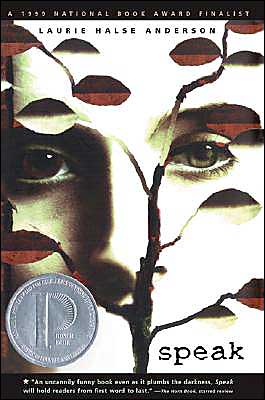
Speak by Laurie Halse Anderson

Summary: Ages 12-up. In a stunning first novel, Anderson uses keen observations and vivid imagery to pull readers into the head of an isolated teenager. Divided into the four marking periods of an academic year, the novel, narrated by Melinda Sordino, begins on her first day as a high school freshman. No one will sit with Melinda on the bus. At school, students call her names and harass her; her best friends from junior high scatter to different cliques and abandon her. Yet Anderson infuses the narrative with a wit that sustains the heroine through her pain and holds readers' empathy. A girl at a school pep rally offers an explanation of the heroine's pariah status when she confronts Melinda about calling the police at a summer party, resulting in several arrests. But readers do not learn why Melinda made the call until much later: a popular senior raped her that night and, because of her trauma, she barely speaks at all. Only through her work in art class, and with the support of a compassionate teacher there, does she begin to reach out to others and eventually find her voice. Through the first-person narration, the author makes Melinda's pain palpable: "I stand in the center aisle of the auditorium, a wounded zebra in a National Geographic special." Though the symbolism is sometimes heavy-handed, it is effective. The ending, in which her attacker comes after her once more, is the only part of the plot that feels forced. But the book's overall gritty realism and Melinda's hard-won metamorphosis will leave readers touched and inspired. Copyright 1999 Reed Business Information, Inc.

Themes:
Identity, Inclusion/Exclusion, Teenage/Female Violence

Classroom Implications: This novel pulls the reader into the world of an isolated teenager. This novel would be matched well with The Misfits, The Perks of Being a Wallflower, The Pinballs, The Outsiders, or Define Normal--all books that address identities and lives on the periphery. This is an excellent novel to study first person narration, symbolism, internal/external conflict and point of view.

Purchase

American Born Chinese by Gene Luen Yang

Summary: Indie graphic novelist Gene Yang's intelligent and emotionally challenging American Born Chinese is made up of three individual plotlines: the determined efforts of the Chinese folk hero Monkey King to shed his humble roots and be revered as a god; the struggles faced by Jin Wang, a lonely Asian American middle school student who would do anything to fit in with his white classmates; and the sitcom plight of Danny, an All-American teen so shamed by his Chinese cousin Chin-Kee (a purposefully painful ethnic stereotype) that he is forced to change schools. Each story works well on its own, but Yang engineers a clever convergence of these parallel tales into a powerful climax that destroys the hateful stereotype of Chin-Kee, while leaving both Jin Wang and the Monkey King satisfied and happy to be who they are. Yang skillfully weaves these affecting, often humorous stories together to create a masterful commentary about race, identity, and self-acceptance that has earned him a spot as a finalist for the National Book Award for Young People. The artwork, rendered in a chromatically cool palette, is crisp and clear, with clean white space around center panels that sharply focuses the reader's attention in on Yang's achingly familiar characters. There isn't an adolescent alive who won't be able to relate to Jin's wish to be someone other than who he is, and his gradual realization that there is no better feeling than being comfortable in your own skin.--Jennifer Hubert

Themes:
Identity, Inclusion/Exclusion, Ethnicity

Classroom Implications: This graphic novel could combine with other graphic novels, like Maus and Persepolis, to create a social issue book club of graphic novels. It also has a strong identity theme and could be matched with similarly themed books, like The Skin I'm In and Becoming Naomi Leon.

Purchase


The Voice that Challenged a Nation: Marian Anderson and the Struggle for Equal Rights by Russell Freedman

Gr. 4-8. In lush operatic style, Pam Munoz Ryan's picture-book biography When Marian Sang (2002), with beautiful illustrations by Brian Selznick, celebrated the triumph of the great African American vocalist in the face of the vicious segregation of her time. Now for middle-grade and junior-high readers comes this handsome, spaciously designed photo-biography. In his signature prose, plain yet eloquent, Freedman tells Anderson's triumphant story, with numerous black-and-white documentary photos and prints that convey her personal struggle, professional artistry, and landmark civil rights role. Everything leads up to her 1939 historic performance at the Lincoln Memorial, where, denied the right to sing at Constitution Hall, she thrilled a crowd of 75,000 and a national radio audience. Freedman reveals that Anderson never invited political confrontation, but with the support of such friends as Eleanor Roosevelt, she had a profound effect on the nation. Documentation is an essential part of her exciting story, with many pages of source notes as well as an enthusiastic, annotated bibliography, and, of course, a discography. Older readers and adults will want this, too. Hazel RochmanCopyright © American Library Association. All rights reserved
Classroom Implications: Pairing this book with Ryan's picture book is a great way to make nonfiction texts accessible for the intermediate and upper grade classrooms. This book is an essential for biography studies and nonfiction reading.
Skills and Strategies
  • Determining Importance
  • Fact and Opinion
  • Retelling
  • Scanning
  • Summarizing

Al Capone Does My Shirts by Gennifer Choldenko

Gr. 5-8. Twelve-year-old Moose moves to Alcatraz in 1935 so his father can work as a prison guard and his younger, autistic sister, Natalie, can attend a special school in San Francisco. It is a time when the federal prison is home to notorious criminals like gangster Al Capone. Depressed about having to leave his friends and winning baseball team behind, Moose finds little to be happy about on Alcatraz. He never sees his dad, who is always working; and Natalie's condition-- her tantrums and constant needs--demand all his mother's attention. Things look up for Moose when he befriends the irresistible Piper, the warden's daughter, who has a knack for getting Moose into embarrassing but harmless trouble. Helped by Piper, Moose eventually comes to terms with his new situation. With its unique setting and well-developed characters, this warm, engaging coming-of-age story has plenty of appeal, and Choldenko offers some fascinating historical background on Alcatraz Island in an afterword. Ed Sullivan Copyright © American Library Association. All rights reserved
Classroom Implications: This text combines adventure, historical fiction, and a young boy's perspective and serves up a great addition to a historical fiction book club selection. The author is meticulous about historical accuracies and inaccuracies. If used in a book club or literature circle, teachers can access this literature circle guide for discussion questions and activities.
Skills and Strategies
  • Determining Importance
  • Making Connections
  • Fact and Opinion

Show Way by Jacqueline Woodson

Kindergarten-5. A Show Way is a quilt with secret meanings, and the image works as both history and haunting metaphor in this exquisite picture book. Based on Woodson's own history, the unforgettable story tells of African American women across generations, from slavery and the civil rights movement to the present. The cut-out jacket design is impressive, as is Talbott's mixed-media artwork inside, which extends Woodson's clear poetic narrative with beautiful collages that make use of big triangles, squares, and curves to emphasize portraits and landscapes and show connections and courage. The first double-page spread is of anguished separation when Soonie's great-grandmother is sold "without her ma or pa." Growing up on a plantation in South Carolina, Soonie learns from Big Mama about children "growing up and getting themselves free," and also how to sew quilts with signs that show the way to freedom. Time passes: Soonie's granddaughter, Georgiana, has twin girls who march for freedom in the 1960s. The final glorious spread shows Georgiana's granddaughter, Jacqueline Woodson, laughing at home with her own beloved daughter, Toshi Georgiana, whose picture is embedded in a quilt, connecting her with those who came before. A must for the classroom, this story will move many readers to explore their own family roots; link to the Booklist interview with Woodson , in which she talks about what she owes to those who came before her. Hazel RochmanCopyright © American Library Association. All rights reserved

Classroom Implications: Woodson crafts a perfect text to introduce a study of family history in the classroom. This text inspires students to research their own family history. Tar Beach by Faith Ringold would make an excellent match with this text. This pairing opens the door to a parallel study on quilt making and community.

Skills and Strategies

  • Descriptive Language
  • Symbolism
  • Point of view
  • Characterization
  • Timelines of text

Purchase