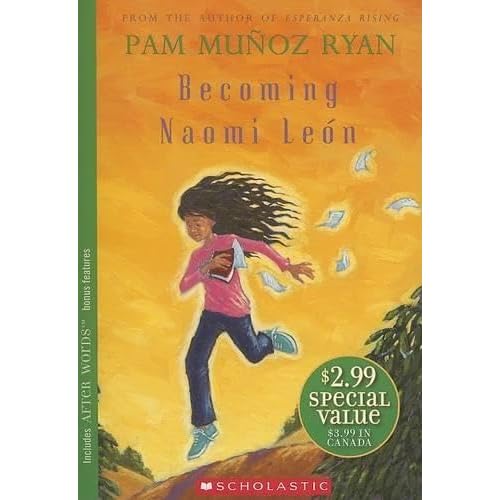
Becoming Naomi Leon by Pam Munoz Ryan

Summary: Grade 4-7–Naomi Soledad Leon Outlaw lives with younger brother Owen and her fiercely practical Gram in a trailer park in California in this novel by Pam Munoz (Scholastic, 2004). An unpopular fifth grader, she spends lots of time in the library with the other outcasts and the kind librarian. Naomi's talent is carving objects out of soap. After being gone for seven years, her mother shows up one day with a scary boyfriend, Clive. Gram lets the children know that their mother, Terri Lynn, has always been wild and irresponsible. They're worried that she will assert her parental rights and take the children away. Naomi is insecure and particularly susceptible to her mother's attention. Owen is essentially ignored by Terri Lynn because he has some physical deformities, but Clive thinks he could use Owen's deformities to make money gambling. Gram, the neighbors, and the children go to Oaxaca to find the children's father and get him to sign papers making Gram their guardian. Their dad is thrilled to see them, and Naomi learns that her talent for soap carving is inherited from her father. This deeply moving story is expressively and sympathetically narrated by Annie Kozuch. Characterization is excellent and listeners will be happy that Naomi finds confidence, love, and security.–B. Allison Gray, John Jermain Memorial Library, Sag Harbor, NY

Themes:
Identity, Family, Overcoming Adversity, Belonging

Classroom Implications: This novel carries a strong Latina voice of a female protagonist throughout the novel. Students are able to relate to the character's journey to discover her family history and her identity. This book makes a good choice for lower level readers ins 6th and 7th grade, as well as provides help to sp. ed. students in a full inclusion setting.

Purchase

The First Part Last by Angela Johnson

Summary: Ages 11+. Rarely do we see teen pregnancy from the father's perspective. Narrator Khalipa Oldjohn gives realistic insight into the consequences of unexpected parenthood on one teenaged father. Alternating between "then," when Nia told him on his sixteenth birthday that he was going to be a father, and "now," as he struggles to raise his daughter alone, we witness Bobby coming to grips with responsibility as he struggles to do the right thing. The back-and-forth between past and present requires close attention to the narration to understand why Bobby gave up the adoption option in favor of fatherhood. N.E.M. 2005 YALSA Selection © AudioFile 2005, Portland, Maine-- Copyright © AudioFile, Portland, Maine

Themes:
Responsibility, Parenting, Choices

Classroom Implications: This novel includes a crucial voice for the male YA audience. It positions the male in a position that is normally not documented and explored in YA literature. There is also an audio version available that may be helpful for lower level readers, sp.ed. and e.l.l. students.


Purchase

The Astonishing Life of Octavian Nothing, Traitor to the Nation, Vol. 1: The Pox Party by M.T. Anderson

Summary: M. T. Anderson's books for young people reflect a remarkably broad mastery of genres, even as they defy neat classification. Any labeling requires lots of hyphens: space-travel satire (Feed, 2002), retro-comic fantasy-adventure (Whales on Stilts, 2005). This genre-labeling game seems particularly pointless with Anderson's latest novel, The Astonishing Life of Octavian Nothing, Traitor to the Nation (2006), an episodic, highly ambitious story, deeply rooted in eighteenth-century literary traditions, which examines, among many other things, pre-Revolutionary slavery in New England.

The plot focuses on Octavian, a young black boy who recounts his youth in a Boston household of scientists and philosophers (The Novanglian College of Lucidity). The Collegians believe so thoroughly in the Age of Reason's principles that they address one another as numbers. Octavian soon learns that he and his mother are objects of one of the Collegians' experiments to learn whether Africans are "a separate and distinct species." Octavian receives an education "equal to any of the princes in Europe," until financial strains shatter Octavian's sheltered life of intellectual pursuits and the illusion that he is a free member of a utopian society. As political unrest in the colonies grows, Octavian experiences the increasing horrors of what it means to be a slave.

The story's scope is immense, in both its technical challenges and underlying intellectual and moral questions--perhaps too immense to be contained in a traditional narrative (and, indeed, Anderson has already promised a second volume to continue the story). As in Meg Rosoff's Printz Award Book How I Live Now (2004), in which a large black circle replaces text to represent the indescribable, Anderson's novel substitutes visuals for words. Several pages show furious black quill-pen cross-hatchings, through which only a few words are visible, perhaps indicating that even with his scholarly vocabulary, Octavian can't find words to describe the vast evil that he has witnessed. Likewise, Anderson employs multiple viewpoints and formats--letters, newspaper clippings, scientific papers--pick up the story that Octavian is periodically unable to tell.

Once acclimated to the novel's style, readers will marvel at Anderson's ability to maintain this high-wire act of elegant, archaic language and shifting voices, and they will appreciate the satiric scenes that gleefully lampoon the Collegians' more buffoonish experiments. Anderson's impressive historical research fixes the imagined College firmly within the facts of our country's own troubled history. The fluctuations between satire and somber realism, gothic fantasy and factual history will jar and disturb readers, creating a mood that echoes Octavian's unsettled time as well as our own.

Anderson's book is both chaotic and highly accomplished, and, like Aidan Chambers' recent This Is All (2006), it demands rereading. Teens need not understand all the historical and literary allusions to connect with Octavian's torment or to debate the novel's questions, present in our country's founding documents, which move into today's urgent arguments about intellectual life; individual action; the influence of power and money, racism and privilege; and what patriotism, freedom, and citizenship mean. Gillian Engberg Copyright © American Library Association. All rights reserved.

Themes:
Social Action, Power, Racism, Patriotism, Freedom, Privilege

Classroom Implications:
This is a good pick for a high level, 8th grade historical fiction book club. This novel can be read through a critical lens, with students working to determining power, privilege and positioning of characters within the novel and the setting.

Purchase

Witness by Karen Hesse

Summary--Ages 9-12 . It is 1924, and a small Vermont town finds itself under siege--by the Ku Klux Klan. Using free verse, Newbery Medal-winning author Karen Hesse (Out of the Dust) allows 11 unique and memorable voices to relate the story of the Klan's steady infiltration into the conscience of a small, Prohibition-era community. The Klan's "all-American" philosophy is at first embraced by several of the town's influential men, including Constable Parcelle Johnson and retailer Harvey Pettibone. But Harvey's sensible wife, Viola, and independent restaurant owner Iris Weaver suspect from the beginning that the Klan's arrival heralds trouble. As the only African Americans in town, 12-year old Leonora Sutter and her father try to escape Klan scrutiny, while 6-year-old, city-born Esther Hirsch remains blissfully unaware of the Klan's prejudice against Jews as she enjoys the Vermont countryside. And Sara Chickering, the lady farmer who has opened her home to Esther and her father, is torn between her own hidden biases and her growing love for Esther. All, however, are galvanized towards action when a shadowy figure shoots at Esther and her father right through Sara's front door. Who would commit such an evil act? And is it too late to remove the poison that has insidiously leaked into their once tight-knit community? Part mystery, part social commentary, Hesse's historically accurate chronicle is a riveting catalyst for discussion that thoughtfully explores race and identity from every possible point of view. The free verse format and distinct characterizations also make Witness a perfect choice for library or classroom reader's theater productions. --Jennifer Hubert

Themes:
Community, Justice, Fear, Prejudice

Classroom Implications: This book teaches
tough concepts and is written with the young or struggling reader in mind. It is an excellent historical fiction book for the struggling reader or younger reader. It also makes a nice transition between historical fiction and poetry/prose. Witness makes room to teach concepts such as, narrative voice, perspective, point of view, verse, and descriptive language.

Purchase

Milkweed by Jerry Spinelli

Summary: Ages 11 and up. Newbery Medal-winning author Jerry Spinelli (Maniac McGee, Stargirl) paints a vivid picture of the streets of the Nazi-occupied Warsaw during World War II, as seen through the eyes of a curious, kind, heartbreakingly naïve orphan with many names. His name is Stopthief when people shout "Stop! Thief!" as he flees with stolen bread. Or it's Jew, "filthy son of Abraham," depending on who's talking to him. Or, maybe he's a Gypsy, because his eyes are black, his skin is dark, and he wears a mysterious yellow stone around his neck. His new friend and protector Uri forces him to take the name Misha Pilsudski and to memorize a made-up story about his Gypsy background so that no one will mistake him for a Jew and kill him. Misha, a very young boy, is slow to understand what's happening around him. When he sees people running, he thinks it's a race. Nazis (Jackboots, as the children call them) marching through the streets appear to him as a delightful parade of magnificent boots. He wants to be a Jackboot! (Uri smacks him for saying this.) He compares bombs to sauerkraut kettles, machine guns to praying mantises, and tanks to "colossal gray long-snouted beetles." The story of Misha and his band of orphans trying to survive on their own would have a deliciously Dickensian quality, if it weren't for the devastation around them--people hurrying to dig trenches to stop Nazi tanks, shops exploding in flames, the wailing of sirens, buzzing airplanes, bombs, and human torture. Spinelli has written a powerfully moving story of survival--readers will love Misha the dreamer and his wonderfully poetic observations of the world around him, his instinct to befriend a Jewish girl and her family, his impulse to steal food for a local orphanage and his friends in the ghetto, and his ability to delight in small things even surrounded by the horror of the Holocaust. A remarkable achievement. --Karin Snelson

Themes: Survival, Perseverance

Classroom Implications: Milkweed takes a different slant on covering the holocaust. It fits a story of survival within the context of the Holocaust, but doesn't take place in a Jewish concentration camp. This novel would pair nicely with other Holocaust texts in a book club, such as Diary of Anne Frank, The Cage, Parallel Journeys. This text also accommodates special education students or lower-level readers in the middle school general education classroom.

Purchase
An American Plague: The True and Terrifying Story of the Yellow Fever Epidemic of 1793 by Jim Murphy

Summary: Grade 6-10-If surviving the first 20 years of a new nationhood weren't challenge enough, the yellow fever epidemic of 1793, centering in Philadelphia, was a crisis of monumental proportions. Murphy chronicles this frightening time with solid research and a flair for weaving facts into fascinating stories, beginning with the fever's emergence on August 3, when a young French sailor died in Richard Denny's boardinghouse on North Water Street. As church bells rang more and more often, it became horrifyingly clear that the de facto capital was being ravaged by an unknown killer. Largely unsung heroes emerged, most notably the Free African Society, whose members were mistakenly assumed to be immune and volunteered en masse to perform nursing and custodial care for the dying. Black-and-white reproductions of period art, coupled with chapter headings that face full-page copies of newspaper articles of the time, help bring this dreadful episode to life. An afterword explains the yellow fever phenomenon, its causes, and contemporary outbreaks, and source notes are extensive and interesting. Pair this work with Laurie Halse Anderson's wonderful novel Fever 1793 (S & S, 2000) and you'll have students hooked on history. Mary R. Hofmann, Rivera Middle School, Merced, CA Copyright 2003 Reed Business Information, Inc.

Classroom Implications: An excellent nonfiction book to support the work being done in a historical fiction book club. Bringing the nonfiction content and the fictional plot of a novel can be challenging. One way to help students do this is support the nonfiction element of their novel with accessible nonfiction texts. This IS the nonfiction text to use with a historical fiction book, like Fever 1793.

Purchase

Fever 1793 by Laurie Halse Anderson

Summary: Ages 12 and up. On the heels of her acclaimed contemporary teen novel Speak, Laurie Halse Anderson surprises her fans with a riveting and well-researched historical fiction. Fever 1793 is based on an actual epidemic of yellow fever in Philadelphia that wiped out 5,000 people--or 10 percent of the city's population--in three months. At the close of the 18th century, Philadelphia was the bustling capital of the United States, with Washington and Jefferson in residence. During the hot mosquito-infested summer of 1793, the dreaded yellow fever spread like wildfire, killing people overnight. Like specters from the Middle Ages, gravediggers drew carts through the streets crying "Bring out your dead!" The rich fled to the country, abandoning the city to looters, forsaken corpses, and frightened survivors.
In the foreground of this story is 16-year-old Mattie Cook, whose mother and grandfather own a popular coffee house on High Street. Mattie's comfortable and interesting life is shattered by the epidemic, as her mother is felled and the girl and her grandfather must flee for their lives. Later, after much hardship and terror, they return to the deserted town to find their former cook, a freed slave, working with the African Free Society, an actual group who undertook to visit and assist the sick and saved many lives. As first frost arrives and the epidemic ends, Mattie's sufferings have changed her from a willful child to a strong, capable young woman able to manage her family's business on her own. --Patty Campbell

Themes:
Social Change, Transformation

Classroom Implications: If students read Speak in social issues book clubs, then they will be excited to read Fever 1793 in historical fiction book clubs. This book pairs nicely with
An American Plague: The True and Terrifying Story of the Yellow Fever Epidemic of 1793 by Jim Murphy. This novel carries strong characterization into a historical setting. This blend attracts readers to use their skills of characterization and bridge it into a genre that is typically difficult to spark immediate engagement.

Purchase