Something Beautiful by Sharon Dennis Wyeth


Summary: This moving picture book offers a shining testament to the ability of human beings to find "something beautiful" in even the most unlikely places. An African American girl initially sees only the ugliness of her neighborhood. There is "trash in the courtyard and a broken bottle that looks like fallen stars." On her front door, someone has scrawled the word "DIE," and a homeless lady "sleeps on the sidewalk, wrapped in plastic." Searching for something beautiful?"something that when you have it, your heart is happy"?she polls various neighbors. For an old man it is the touch of a smooth stone; for Miss Delphine, it's the taste of the fried fish sandwich in her diner; for Aunt Carolyn, it's the sound of her baby's laugh. When the girl decides to create her own "something beautiful," she picks up the trash, scrubs her door clean and realizes, "I feel powerful." Wyeth's (Always My Dad) restrained text is thoughtful without being didactic. She creates a city landscape that is neither too dark nor too sweet; and her ending is just right, with the heroine's mother saying that her daughter is her "something beautiful." Soentpiet's (Peacebound Trains) paintings are luminously lifelike. Whether depicting the girl running past a chain-link fence in a dark alley or Miss Delphine's patrons sitting beneath the rows of glinting glasses, the paintings focus on a community with characters so real, readers can almost feel the sunlight on their faces. All ages. Copyright 1998 Reed Business Information, Inc. --This text refers to the Hardcover edition.

Classroom Implications
: This book resonates with urban community members and echos the salient point of community action. It offers a different perspective to preserving our environment by marking the importance of preserving ALL environments. It combines concepts of community organizing, social action and environmentalism. I also like the cover because it implies finding beauty in personal identities, as well as communities. This is an important image for our students to see, view and discuss, especially in regards to how community identity mirrors personal identity.

Purchase

Black and White by David Macaulay


Summary: Publishers Weekly: At first glance, this is a collection of four unrelated stories, each occupying a quarter of every two-page spread, and each a slight enough tale to seem barely worth a book--a boy on a train, parents in a funny mood, a convict's escape and a late commuter train. The magic of Black and White comes not from each story, however, but from the mysterious interactions between them that creates a fifth story. Several motifs linking the tales are immediately apparent, such as trains--real and toy--and newspapers. A second or third reading reveals suggestions of the title theme: Holstein cows, prison uniform stripes. Eventually, the stories begin to merge into a surrealistic tale spanning several levels of reality, e.g.: Are characters in one story traveling on the toy train in another? Answers are never provided--this is not a mystery or puzzle book. Instead, Black and White challenges the reader to use text and pictures in unexpected ways...no other writer for adults or children explores this unusual territory the way Macaulay does. All ages. Copyright 1990 Reed Business Information, Inc.

Classroom Implications: This post modern text requires sophisticated reading strategies for students to synthesize the information presented in the text. Multiple plotlines interweave simultaneously and blend together using the actual text and the illustrations. One suggested teaching point is to assign groups of students one plot to follow, therefore kids can jigsaw the story together (this aids with synthesizing).

Purchase

Just a Dream by Chris Van Allsberg


Summary: Two-time Caldecott Medalist Van Allsburg reaches a new pinnacle of excellence in both illustration and storytelling in his latest work. Since his first book, The Garden of Abdul Gasazi, appeared just over a decade ago, he has spun many strange and fantastic modern fairy tales, all of which spill over the edge of reality into magnificent dreamscapes. Here Van Allsburg introduces Walter, a boy who imagines the future as a marvelous time, with tiny airplanes that can be parked on the roof of your house and robots that take care of all your work for you. In the present, however, Walter is a litterbug who can't be bothered to sort the trash for recycling and laughs at Rose, the girl next door, because she receives a sapling for her birthday. One night, when Walter goes to sleep, his bed travels to the future. But he finds neither tiny airplanes nor robots, only piles of trash covering the street where he used to live, acres and acres of stumps where forests used to stand, rows and rows of great smokestacks belching out acrid smoke, and many other environmental nightmares. Van Allsburg renders each of these chilling scenarios in elaborate, superbly executed two-page spreads that echo the best work of M. C. Escher and Winsor McKay (creator of the Little Nemo comic strips). Walter and his bed land right in the middle of the action in each of these hallucinatory paintings, heightening the visual impact and forcing a hard look at the devastation surrounding Van Allsburg's protagonist. An awakened Walter, jolted by his dream, changes his ways: he begins to sort the trash and, like Rose, plants a tree for his birthday. Then his bed takes him to a different future, one where people tend their lawns with powerless mowers and where the trees he and Rose have planted stand tall and strong beneath a blue sky. Not only are Just a Dream 's illustrations some of the most striking Van Allsburg has ever created, but the text is his best yet. Van Allsburg has sacrificed none of the powerful, otherworldly spirit that suffuses his earlier works, and he has taken a step forward by bringing this spirit to bear on a vitally important issue. His fable builds to an urgent plea for action as it sends a rousing message of hope. All ages. Copyright 1990 Reed Business Information, Inc.

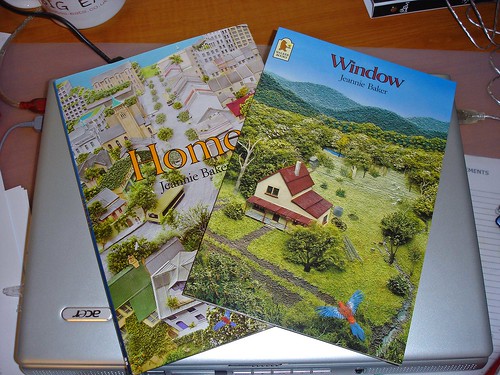
Cross Curricular Connections: This is really a book with an environmental twist. This fantasy picture book would make a nice pair with Home or Window by Jeannie Baker.

Purchase

The Sweetest Fig by Chris Van Allsberg


Summary: Grade 3 Up-Another quietly bizarre and stunning picture book from Van Allsburg. In this modern fairy tale, a Parisian dentist (a prissy and sadistic man who even hates his own dog) is given two magic figs by an old woman who tells him, "'They can make your dreams come true.'" Bibot scoffs. However, after the first fig proves to do exactly that (in a scene in which the dentist walks down the street in his underwear, and then the Eiffel Tower droops over), he realizes how precious they are. Night after night, he hypnotizes himself into dreaming that he is the richest man on earth. Finally, he prepares to eat the second fig. But his dog, Marcel, beats him to it, and the following morning, the dentist wakes up as the helpless pup under a bed, with his own face calling to him, "'Time for your walk. Come to Marcel.'" The Sweetest Fig is a superb blend of theme, language, and illustration, with a very grabbing plot as well. The writing is formal yet direct, using simple, deliberate vocabulary to match the elegant setting and mood. The shades of gray, cream, and brown and the calm, stable design enhance this mood. The angle at which readers view scenes is always intriguing and heightens their involvement. Most children old enough to read this complex book on their own will be fascinated and will return to it again and again. Van Allsburg at his best.
Lauralyn Persson, Wilmette Public Library, IL
Copyright 1993 Reed Business Information, Inc.

Classroom Implications: This text is great to teach point of view and perspective due to the sudden shift at the end of the book. It also lends itself well to characterization and cause and effect concepts.

Purchase

The Mysteries of Harris Burdick by Chris Van Allsberg

Summary: This book is a collection of illustrations that resemble old photographs of surreal events and images. Each illustration has an accompanying title and quote that entice the reader to image a plot for the picture. The premise of the book is that a man named Harris Burdick dropped off a sample of his work to a publisher to consider publishing. The sample only includes illustrations with these enticing titles and quotes. The publisher discloses that the artist never returned again. The publisher finds this so compelling, he ends up making a book out of this mystery.

Classroom Implications: The book is set up with a long author's note to the reader, thereby creating a very "real" feeling for this fictitious book. I've used this book over and over when teaching short stories and have ALWAYS led on that the story is "real" with my middle schoolers. They instantly become intrigued with the mystery and look forward to writing stories that accompany the illustration and the quotes. This text is a fantastic wordless fantasy book that serves as inspiration for writing projects in the classroom!

Purchase

Text Excerpts:

Home by Jeannie Baker

Summary: K-Gr. 3. This wordless picture book with exquisitely detailed collage illustrations speaks eloquently about urban conservation. Every double-page spread is a view through the same window, a view that changes over a generation, beginning with a couple expecting a baby and continuing as the baby grows up, is courted, and is married in the neighborhood street. At first the sprawl and smog nearly smother the view, but gradually the place changes. The community brings back a variety of local plants, and by the time the young woman's own baby is born, trees block the billboards, there are birds on the roof and in the sky, and cyclists and a bus can be seen on the roadway. Suddenly, there's a glimpse of the river in the distance, a dragonfly on the windowsill, and the full moon shines at night. Unlike some collage art, the technique here never gets in the way. The details show and tell a story about the small things in one neighborhood--their fragility, strength, and connection--and their power to make a difference. With each look at the pictures, there's more to see in the crowded neighborhood that is transformed into a wild and beautiful place. Hazel Rochman Copyright © American Library Association. All rights reserved

Classroom Implications
: This is a great companion piece with Baker's other book, Window. It takes the opposite look at development and the environment. It starts with an urban decay of a scene. With time, care, and community effort, the city-scape transforms into something beautiful. It would also be a picture book to support Paul Fleishman's book Seedfolks, which is based on social action, community and gardening.

Purchase

Zoom by Istvan Banyai

Summary: From Booklist:Grades 3-8. Beginning with a close-up of a rooster's comb, each picture zooms out to give a more distant perspective; for example, the "camera" zooms out to show increasingly distant figures of children watching the rooster. Then, a large hand appears, showing that the scene was not depicting a real farm, but a toy farm set. But zoom out a few more times, and the scene reveals that the picture of the girl playing with the farm set is really on the magazine held by a boy, who's sleeping in a chair, which is by a pool, which is on an ocean liner, which is out at sea--no, wait--that picture is on a cruise-line poster on the side of a city bus, but that picture is on a television screen in the Arizona desert . . . and so on until the earth is shown from above, growing smaller with each turn of the page. The final scene is one white dot on a black page. Clear-cut paintings outlined in ink appear on each right-hand page; the left-hand pages are black. Not a story, but an "idea" book, it makes the viewer ask, "What am I really seeing here?" This clever picture book could be intriguing..., depending on the viewer's frame of mind, but children will find it worth a look. Once, anyway. Carolyn Phelan

Sequel Information: Re-Zoom
Summary: From Publishers Weekly:Re-Zoom resumes, or more accurately, reprises, the layout and nothing-is-as-it-seems perspective of last season's Zoom. Featuring detailed drawings backpainted on animation cels, this text-free volume opens with a red-on-blue cave painting that, with the turn of a page, becomes a detail on a wristwatch. The next spread reveals that the watch belongs to a young man doing a rubbing of carved hieroglyphs... and so on. To surprise his audience, which may already expect the sequence of pictures to expand to infinity, as in Zoom, Banyai toys not only with spatial relations but with time and with cultural referents: people in 19th-century garb, admiring an image of Napoleon, turn out to be on a movie set; a woman in traditional Japanese dress sports a yellow Walkman. There are nods to the arts as well. A black-and-white Alfred Hitchcock and a blue bodhisattva sit astride a thundering elephant, and a dejected-looking Picasso rides the New York City subway. The finale-which leaves readers in a subway tunnel as the train's red taillights recede-may not be as mindbending as Zoom's outer-space flight, but is nonetheless a clever solution. All ages. Copyright 1995 Reed Business Information, Inc. --This text refers to an out of print or unavailable edition of this title.

Purchase

The Other Side by Istvan Banyai

Summary: Grade 6 and Up–There's nothing mundane or predictable about Banyai's wordless picture book. As in Zoom and Re-Zoom (both Viking, 1995), the illustrator takes his audience on a visual journey that begins with a nearly blank page that, when turned, reveals instructions for folding a paper airplane. On the next page, a girl in her high-rise apartment practices her cello and a paper airplane can be seen outside her window. Readers flip the page to see the girl's building from the outside looking in. Paper airplanes are everywhere, thanks to a young neighbor one floor up who has been practicing his folding skills. Each pair of pages, front and back, presents inside and outside views, and although the scenes are not obviously linked to a larger plotline, they are connected through reoccurring images, colors, and themes. This is a challenging book, one that allows for creative speculation. The graphite-rendered artwork is quirky as well as infinitely interesting. Not everyone will get the sly humor, or be prepared to indulge in a book that demands such work. However, those who give it a try will be drawn into a thought-provoking, whimsical world. It's a book that begs to be talked about, and teachers will find it a useful tool for discussions about point-of-view and perspective.–Carol L. MacKay, Camrose Public Library, Alberta, Canada Copyright © Reed Business Information, a division of Reed Elsevier Inc. All rights reserved.

Notable Information: This text would be most efficiently used in an upper grade classroom. The way the story builds off of the perspective shifts is highly complex. It is a highly usable text to teach perspective, point of view and symbolism. The Other Side would also pair nicely with a writing activity based around the perspectives of the text. Students could also develop complex conceptual ideas that could become literary essays.

Text Excerpt:

Purchase

The Red Book by Barbara Lehman


Summary: Kindergarten and Up: In this wordless mind trip for tots, Lehman develops a satisfying fantasy in a series of panels framed with thick white borders. The effect is of peering through portals, an experience shared by the characters as they independently stumble across enchanted red books that provide them with a videophone-like connection. Though wordless picture books often seem to be the province of fine artists indulging in high-concept braggadocio (as in Istvan Banyai's 1995 Zoom), Lehman's effort ensures child appeal with an unaffected drawing style and a simple, easy-to-follow story line about a friendship forged between a city girl and a faraway island boy. The message about the transporting power of story will moisten the eyes of many adult readers, but children will most appreciate the thought-provoking visuals, in which characters' actions influence the course of their own storybook narratives--likewise affecting the larger "red book," cleverly packaged to mimic the shape and color of its fictional counterpart. Ideal for fueling creative-writing exercises. Jennifer Mattson Copyright © American Library Association. All rights reserved

Classroom Implications: This post-modern, book within a book, plays with perspective like Flotsam or Zoom. The Red Book deconstructs the common picture book motif, where the characters seem to affect and create the story as the pages turn. The wonderful teaching point this book carries is that character's actions influence the course of the story. This is an essential element of reading and writing to expose students to in the classroom. Kids in the upper grades can take advantage of this wordless text and use the pictures to create their own story.

Purchase

Window by Jeannie Baker

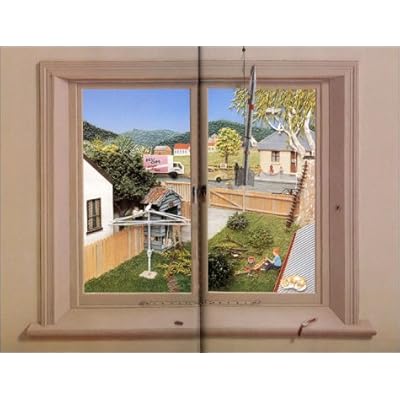
Summary: Grade 1 Up-- A mother, holding her newborn son, gazes out the window of his room at lush vegetation, tropical birds, a pond, a kangaroo. Ten double-page illustrations following show the development--during a 20-year period--of the area outside the window. As Sam (the baby) grows older, the land is cleared, a road is built, then a farm. A housing development goes up, then takes over a hill that was once green with lush growth. Development becomes suburb, then city, complete with billboards, high-rises, noise pollution, litter, and overpopulation. Sam marries and moves to a new house in the country, where the final window scene shows him, holding his baby, staring at a sign announcing, "House Blocks For Sale". Words are unnecessary, as Baker's carefully rendered collage scenes explicitly detail the situation. Varying symbolic objects on Sam's windowsill (and the cracking and peeling of paint on the wall) add to the book's message. Baker's meticulous collages, formed from natural materials, clay, fabric, and real hair, are so detailed that they require many viewings. A final, short author's note explains the inspiration for the book: ". . .by understanding and changing the way we personally affect the environment, we can make a difference." This unusual, exceptionally well-crafted picture book might be a good way to begin. --Susan Scheps, Shaker Heights Public Library, OH Copyright 1991 Reed Business Information, Inc. --This text refers to an out of print or unavailable edition of this title.

Curricular Connections: This text can be used in a science classroom where students study the effect of development on indigenous ecosystems. It is a crucial outlook and environmental perspective that should be support with today's youth.

Purchase

Maus a Survivors Tale: My Father Bleeds History by Art Spiegelman


Summary: Some historical events simply beggar any attempt at description--the Holocaust is one of these. Therefore, as it recedes and the people able to bear witness die, it becomes more and more essential that novel, vigorous methods are used to describe the indescribable. Examined in these terms, Art Spiegelman's Maus is a tremendous achievement, from a historical perspective as well as an artistic one.

Spiegelman, a stalwart of the underground comics scene of the 1960s and '70s, interviewed his father, Vladek, a Holocaust survivor living outside New York City, about his experiences. The artist then deftly translated that story into a graphic novel. By portraying a true story of the Holocaust in comic form--the Jews are mice, the Germans cats, the Poles pigs, the French frogs, and the Americans dogs--Spiegelman compels the reader to imagine the action, to fill in the blanks that are so often shied away from. Reading Maus, you are forced to examine the Holocaust anew.

This is neither easy nor pleasant. However, Vladek Spiegelman and his wife Anna are resourceful heroes, and enough acts of kindness and decency appear in the tale to spur the reader onward (we also know that the protagonists survive, else reading would be too painful). This first volume introduces Vladek as a happy young man on the make in pre-war Poland. With outside events growing ever more ominous, we watch his marriage to Anna, his enlistment in the Polish army after the outbreak of hostilities, his and Anna's life in the ghetto, and then their flight into hiding as the Final Solution is put into effect. The ending is stark and terrible, but the worst is yet to come--in the second volume of this Pulitzer Prize-winning set. --Michael Gerber
Classroom Implications: This book adds a new dimension to a Holocaust study. The graphic novel provides a different angle, a new lens, for students to examine a subject that they may already know a lot about.

Persepolis by Marijane Satripi

Summary: Satrapi's autobiography is a timely and timeless story of a young girl's life under the Islamic Revolution. Descended from the last Emperor of Iran, Satrapi is nine when fundamentalist rebels overthrow the Shah. While Satrapi's radical parents and their community initially welcome the ouster, they soon learn a new brand of totalitarianism is taking over. Satrapi's art is minimal and stark yet often charming and humorous as it depicts the madness around her. She idolizes those who were imprisoned by the Shah, fascinated by their tales of torture, and bonds with her Uncle Anoosh, only to see the new regime imprison and eventually kill him. Thanks to the Iran-Iraq war, neighbors' homes are bombed, playmates are killed and parties are forbidden. Satrapi's parents, who once lived in luxury despite their politics, struggle to educate their daughter. Her father briefly considers fleeing to America, only to realize the price would be too great. "I can become a taxi driver and you a cleaning lady?" he asks his wife. Iron Maiden, Nikes and Michael Jackson become precious symbols of freedom, and eventually Satrapi's rebellious streak puts her in danger, as even educated women are threatened with beatings for improper attire. Despite the grimness, Satrapi never lapses into sensationalism or sentimentality. Skillfully presenting a child's view of war and her own shifting ideals, she also shows quotidian life in Tehran and her family's pride and love for their country despite the tumultuous times. Powerfully understated, this work joins other memoirs-Spiegelman's Maus and Sacco's Safe Area Goradze-that use comics to make the unthinkable familiar. Copyright 2003 Reed Business Information, Inc.

Notable Information: This text has the power to convert the non-reader of graphic novels to an avid one! Reviewer after reviewer will testify that he or she sat down to begin the book and didn't get up until they finished. Middle and high school students can experience this, too. By starting them off with reading American Born Chinese, some will be ready to move onto this heavier, more mature text. The text is highly political while still managing to focus on the individual growth and development of the narrator. The reader has to rely heavily on reading between the lines of this text, as well as the illustrations in order to gain the full understanding of the story. Therefore, graphic novels, such as this one, create a rich environment to work on the tough reading and thinking skills of inference and interpretation.

Text Excerpt:

Sequel: Perspepolis II
This sequel begins where the first left off and chronicles the older years of Marji's life. This sequel presents a different subset of issues and best suits high school readers. Be advised: if this book sits next to the first one, the reader will immediately pick it up to find out what happened where the first left off!

Purchase


Monsters Are Afraid of the Moon by Marjane Satrapi


Book Preview: From the Publisher: Poor Marie! Every night as she climbed into bed, she got a visit from three monsters. They only came out in darkness, so she knew they must be afraid of the light. Marie took a huge pair of scissors, and cutting the moon out of the sky, hung it right in her bedroom. No darkness, no monsters!
Her plan worked perfectly, or so she thought . . . but without a moon in the sky, the village cats were in total darkness! They began bumping into everything, and winding up in the hospital. With no cats to chase them, the mice ran amuck. Finally the king found Marie: "You must return the moon to the sky!" he said. But Marie wouldn't agree--not until she was sure those monsters were gone. How could the king make things right for everyone? A delightful tall tale for bedtime or anytime.

Book Review: Children's Literature :Marie has fun all day, but the nights are another story. For then, "three of the scariest monsters who ever lived would come out from the shadows" to torture her. One night, Marie decides that the night monsters must be afraid of the light. She decides to bring the moon, which lights up the night, into her room. After she cuts it out of the sky and puts it in a cage over her bed, the monsters no longer bother her. But with the moon missing, cats all over the village have accidents in the dark, while the rascally rats begin to ruin the town. The Cat King negotiates with Marie. For the release of the moon, Marie receives a cat to guard her bed every night. The charming, imaginative story finds appropriate accompaniment in the very simple illustrations that need few details. Black outlines amusingly depict Marie, the melancholy felines, and the happily cavorting rats. The Cat King is properly regal; the three monsters are a multicolored trio of grimacing bullies whose sharply pointed shadows are menacing. The final picture is a peaceful view of a sleeping Marie and a cat with a watching eye open, and the moon back in the sky.

Notable Information: This protagonist is reminiscent of Marji's voice in Satrapi's graphic memoir, Persepolis. Both are scared of the dark as little girls. This may be an interesting component to read across the two texts, imagining what the monsters might symbolize for the author after reading her memoir.

Purchase

One Grain of Rice by Demi


Summary: Grades 5-8 In artwork inspired by Indian miniatures, Demi fashions a folktale with far-reaching effects. The raja of a rice-growing village orders his subjects to deliver to him the bulk of their harvest; he will keep it safe should a famine occur. A few years later the harvest fails, and so does the raja: "Promise or no promise, a raja must not go hungry,'' he intones. When a young village girl, Rani, returns to the raja some rice that had fallen from baskets laden for his consumption, he offers her a reward. Her request is seemingly modest: a grain of rice on the first day, two grains the next, four grains on the third; each day double the rice of the day before, for 30 days. The raja, though, doesn't grasp the power of doubling. Day 21 garners 1,048,576 grains of rice; on the last day it takes fold-out flaps to show the herd of elephants necessary to convey the rice to Rani, who feeds the masses and extracts from the raja a promise to be more generous. This gratifying story of the disarming of greed provides an amazing look at the doubling process, and a calendar at the end shows how the reward simply grew and grew. (Picture book/folklore.) -- Copyright ©1997, Kirkus Associates, LP. All rights reserved.

Cross-Curricular Connections: Math is obvious counterpart to the instruction or reading of this book. Kids become captivated by the story, therefore captivated with the concept of doubling. Students can hypothesize around other aspects of their lives that my benefit from doubling, such as reading or writing.

Purchase

Buddha by Demi


Summary: Grade 4 U: A graceful account of Buddha's life, from the prophecies preceding his birth to his death at age 80. Demi is attentive to historical information, legends, and the long and dearly held beliefs about Buddha. She describes his protected royal youth, his search for a way to end suffering, his enlightenment, and his compassionate teaching of the basic tenets of Buddhist faith, the Four Noble Truths and the Eightfold Path. The book also includes several parables, such as the well-known "The Blind Men and the Elephant." In characteristic vibrant colors and shimmering gold, Demi has painted visually engaging illustrations rich in Buddhist symbolism and artistic conventions. The pictures often overflow their gold borders or are set entirely outside their frames, as if floating beyond the confines of this life. The blended, gentle-hued watercolor backgrounds contrast with both the stark white of the pages and with the precise, detailed figures and scenes. The lovely, simple, descriptive language, together with the design and illustrations, combine dynamically so that the whole book is much more than the sum of its parts. Some readers will treasure this title, some will ponder on it, and all will learn from it. Susan Middleton, LaJolla Country Day School, CACopyright 1996 Reed Business Information, Inc.
Notable Information: This piece of narrative nonfiction blends the effect of narrative writing with the information content of nonfiction. The illustrations and language adapt a complex subject into something accessible for younger readers. This nonfiction selection would pair nicely with other stories by Demi or Zen Shorts.

The Greatest Power by Demi


Summary: K-Gr. 3. This companion to The Empty Pot (1990) continues the story of the life of Ping, the young emperor who wants to bring harmony to his kingdom. Ping sends all the children in the kingdom on a year-long quest to find the greatest power in the world, telling them, "A wise person must be able to see the unseen and know the unknown." The boys believe the power is great weapons; the girls, great beauty; the students, great technology; and the practical children, great amounts of money. When the children come to show the emperor what they have discovered, the last child in line, a little girl named Sing, remembers Ping's words. She presents a lotus seed as the powerful force of eternal life, and Ping names her the new prime minister. The text and the handsomely designed, richly colored artwork, which is touched with gold leaf, are set within a circular motif that reinforces the idea of eternity. As usual, Demi ably combines striking artwork and a meaningful story, with quiet dignity and wisdom. Julie Cummins Copyright © American Library Association. All rights reserved

Classroom Application: This book has been critiqued by some reviewers to be too conceptually heavy for young readers. The book can be modified and presented in a more concrete way by using it as an instructional read aloud: the teacher focusing on heavy inferring and interpretation as the story unfolds. Students can use their prior knowledge of The Empty Pot to uncover the meaning of this text.

This book is great to be read critically because gender and other classification stereotypes are used to create the story (i.e. the girls saying that beauty is the greatest power).

Purchase

The Empty Pot by Demi


Summary: Grade 1-3-- When the Chinese emperor proclaims that his successor will be the child who grows the most beautiful flowers from the seeds the emperor distributes, Ping is overjoyed. Like the emperor, he loves flowers and anything he plants bursts into bloom. But the emperor's seed will not grow, despite months of loving care, and Ping goes before the emperor carrying only his empty pot. The emperor ignores the beautiful blossoms brought by the other children and chooses Ping, revealing that the seeds he handed out had been cooked and could not grow. This simple story with its clear moral is illustrated with beautiful paintings.

Each page contains a single picture, shaped like a stiff, rounded, paper fan and framed in celadon brocade that subtly changes pattern from one spread to the next. Isometric perspective, traditional Chinese architecture, and landscape motifs are combined with Demi's fine line and lively children and animals. While all the landscapes featuring the emperor and the other children are in brilliant red, gold, and purple, the scenes involving Ping alone are predominantly beige and delicate green. Ping is almost always shown as a solitary figure in contrast to the busy groups of running, smiling children, reinforcing the portrait of him as a quieter, more contemplative person whose values make him a worthy heir to the emperor. A beautifully crafted book that will be enjoyed as much for the richness of its illustrations as for the simplicity of its story. --Eleanor K. MacDonald, Beverly Hills Public Library Copyright 1990 Reed Business Information, Inc

Notable Information: This is a beautiful book to teach theme and the moral of stories. In this story, Ping stays true to himself and in the end, is rewarded. IT is a remarkable story that children and adults will latch onto and want to read again and again.

Purchase

Shh! The Whale is Smiling by Josephine Nobisso

Summary: From Amazon.com: C. Penn "WordWeaving" (Greenville, SC) - Author Josephine Nobisso and illustrator Maureen Hyde bring enchantment to the play of shadows and wind deep in the night in SHH! THE WHALE IS SMILING. As a fierce wind blows outside their home, a sister comforts her brother turning fear of the cold dark into a warm, safe place of imagination. Flying in their bed to the sea, they join a whale swimming among bubbles in a world of their marvelous creation.

The fear of the dark, wind and storms is gently confronted in this imaginative story for children. The dark becomes deep water, movement the swimming of a whale, and wind a part of the mystery of the sea, thereby replacing the fearful with the imaginative. A delightful tale, with fabulously realized illustrations, SHH! THE WHALE IS SMILING comes very highly recommended.
Text Excerpts:


Moonflute by Audrey Wood


Summary: Grades 3-6 In this long bedtime mood-piece, a little girl, Firen, accuses the moon of taking her sleep; she resolves to "go out in the night and find it.'' Outside, a moonbeam lands in her hands and becomes a magic flute with which she flies through the night. She encounters creatures of town, sea, and jungle in a dreamlike sequence illustrated in deep greens, blues, and violet. Firen herself has a pixie-ish, flower-fairy look, and is silvery-shiny with moonlight. Susan Patron, Los Angeles Public LibraryCopyright 1987 Reed Business Information, Inc.

Notable Information: This is another dream-like fantasy text that can open the doors into the genre of fantasy. The text is long and more like a short story with illustrations. With this in mind, it makes a stronger text to use in the upper elementary grade classrooms.

Purchase

When the Sun Rose by Barbara Berger


Summary: As in her earlier Grandfather Twilight, Berger has created a picture book dreamscape, full of radiant colors and intriguing possibilities. Alone with her doll in a playhouse, the young narrator receives an unusual visitor who comes calling "in a carriage bright as the sun." The visitor's consort is a lemon-yellow lion who dines on blueberries and cream as the two girls play dolls and paint a rainbow. At day's end, the visitor departs into a glowing sunset, promising to return. Berger's skillful blending of the metaphysical and a child's inner life make this an inspired work of art. Copyright 1986 Reed Business Information, Inc.

Notable Information: This makes a good book to deeply talk about the lasting effects that friendship can have on people.

Purchase