Showing posts with label Social Issues Book Club. Show all posts

Persepolis by Marijane Satripi

Summary: Satrapi's autobiography is a timely and timeless story of a young girl's life under the Islamic Revolution. Descended from the last Emperor of Iran, Satrapi is nine when fundamentalist rebels overthrow the Shah. While Satrapi's radical parents and their community initially welcome the ouster, they soon learn a new brand of totalitarianism is taking over. Satrapi's art is minimal and stark yet often charming and humorous as it depicts the madness around her. She idolizes those who were imprisoned by the Shah, fascinated by their tales of torture, and bonds with her Uncle Anoosh, only to see the new regime imprison and eventually kill him. Thanks to the Iran-Iraq war, neighbors' homes are bombed, playmates are killed and parties are forbidden. Satrapi's parents, who once lived in luxury despite their politics, struggle to educate their daughter. Her father briefly considers fleeing to America, only to realize the price would be too great. "I can become a taxi driver and you a cleaning lady?" he asks his wife. Iron Maiden, Nikes and Michael Jackson become precious symbols of freedom, and eventually Satrapi's rebellious streak puts her in danger, as even educated women are threatened with beatings for improper attire. Despite the grimness, Satrapi never lapses into sensationalism or sentimentality. Skillfully presenting a child's view of war and her own shifting ideals, she also shows quotidian life in Tehran and her family's pride and love for their country despite the tumultuous times. Powerfully understated, this work joins other memoirs-Spiegelman's Maus and Sacco's Safe Area Goradze-that use comics to make the unthinkable familiar. Copyright 2003 Reed Business Information, Inc.

Notable Information: This text has the power to convert the non-reader of graphic novels to an avid one! Reviewer after reviewer will testify that he or she sat down to begin the book and didn't get up until they finished. Middle and high school students can experience this, too. By starting them off with reading American Born Chinese, some will be ready to move onto this heavier, more mature text. The text is highly political while still managing to focus on the individual growth and development of the narrator. The reader has to rely heavily on reading between the lines of this text, as well as the illustrations in order to gain the full understanding of the story. Therefore, graphic novels, such as this one, create a rich environment to work on the tough reading and thinking skills of inference and interpretation.

Text Excerpt:

Sequel: Perspepolis II
This sequel begins where the first left off and chronicles the older years of Marji's life. This sequel presents a different subset of issues and best suits high school readers. Be advised: if this book sits next to the first one, the reader will immediately pick it up to find out what happened where the first left off!

Purchase


Who Am I Without Him?: Short Stories About Girls and the Boys in Their Lives by Sharon Flake


Summary: Gr. 6-12. Hilarious and anguished, these 10 short stories about growing up black today speak with rare truth about family, friends, school, and especially about finding a boyfriend. Erika is a "ghetto girl" who likes white boys; she can't help it, and the other black kids in school can't stand her, because they know. Class is a big issue for Erin, who steals clothes so he can take a suburban girl to the homecoming dance. The church girls are forbidden to date, and they get hurt when they go hunting for boys. But their well-meaning parents don't have it right, and the girls won't stop looking. As with Janet MacDonald's fiction, the talk here is wild, angry, and outrageous, but there's no overt sex or obscenity. Yes, there are messages, but the narrative is never preachy or uplifting; it's honest about the pain. When one girl's boyfriend hits her, she apologizes "just like my momma does when daddy slaps her." The best advice comes from a dad who abandoned his family, who now tells his teenage daughter how to avoid getting stuck with someone like him ("you is so much more than a pretty face and a tight pair of jeans, some boy's girlfriend or some man's wife"). Not everyone makes it. The stories work because Flake never denies the truths of poverty, prejudice, and failure. Hazel Rochman Copyright © American Library Association. All rights reserved --This text refers to the Hardcover edition. Purchase

An Island Like You: Stories of the Barrio by Judith Ortiz Cofer

Summary: Gr. 7-12. "Dating is not a concept adults in our barrio really get." The contemporary teenage voices are candid, funny, weary, and irreverent in these stories about immigrant kids caught between their Puerto Rican families and the pull and push of the American dream. The young people hang out on the street in front of the tenement El Building in Paterson, New Jersey, where the radios are always turned full blast to the Spanish station and the thin walls can't hold the dramas of the real-life telenovelas. As in her autobiographical adult collection Silent Dancing (1990), Cofer depicts a diverse neighborhood that's warm, vital, and nurturing, and that can be hell if you don't fit in. Some of the best stories are about those who try to leave. Each piece stands alone with its own inner structure, but the stories also gain from each other, and characters reappear in major and minor roles. The teen narrators sometimes sound too articulate, their metaphors overexplained, but no neat resolutions are offered, and the metaphor can get it just right (the people next door "could be either fighting or dancing"). Between the generations, there is tenderness and anger, sometimes shame. In one story, a teenage girl despises the newcomer just arrived from the island, but to her widowed mother, the hick (jibaro) represents all she's homesick for. Raul Colon's glowing cover captures what's best about this collection: the sense of the individual in the pulsing, crowded street. Hazel Rochman

Themes: Culture, Hybrid Identities, Generational Differences, Individuality, Community

First Sentence:

When I was sent to spend the summer at my grandparents' house in Puerto Rico, I knew it was going to be strange, I just didn't know how strange.

Classroom Implications: Many classrooms have and use W.D.Myer's 145th Street Stories or G. Soto's Baseball in April collection of stories. Ortiz adds to this base of literature and gives a voice to the Puerto Rican communities that she reflects in her writing.

Purchase

Call Me Maria by Judith Ortiz Cofer


Summary: Ages 9-12 Maria is a girl caught between two worlds: Puerto Rico, where she was born, and New York, where she now lives in a basement apartment in the barrio. While her mother remains on the island, Maria lives with her father, the super of their building. As she struggles to lose her island accent, Maria does her best to find her place within the unfamiliar culture of the barrio. Finally, with the Spanglish of the barrio people ringing in her ears, she finds the poet within herself. In lush prose and spare, evocative poetry, Cofer weaves a powerful novel, bursting with life and hope.

Themes: Identity, Family, Community, Clashing Cultures

Classroom Implications: Poetic novels are a wonderful addition to classroom libraries. They build off of the alluring nature of poetry and reframe it in the context of a novel. Judith Ortiz Cofer is a must-have author in the classroom and speaks to the Puerto-Rican/American experience.

Judith Ortiz Cofer has an interesting outlook on language and identity. This excerpt may be an enriching addition to use with students while reading her works:

"People ask me: If I am a Puerto Rican writer, why don't I write in Spanish?" noted poet, essayist, and author Judith Ortiz Cofer in the online publication, The Global Education Project. "Isn't writing in English a sellout? I respond that English is my literary language. The language of the country my parents brought me to. Spanish is my familial language, that lies between the lines of my English language. Because I am a daughter of the Puerto Rican diaspora, English gives life to my writing." (http://www.answers.com)

Purchase

Before We Were Free by Julia Alvarez

Summary: (Ages 12+) What would life be like for a teen living under a dictatorship? Afraid to go to school or to talk freely? Knowing that, at the least suspicion, the secret police could invade your house, even search and destroy your private treasures? Or worse, that your father or uncles or brothers could be suddenly taken away to be jailed or tortured or killed? Such experiences have been all too common in the many Latin American dictatorships of the last 50 years. Author Julia Alvarez (How the Garcia Girls Lost Their Accents) and her family escaped from the Trujillo regime in the Dominican Republic when she was 10, but in Before We Were Free she imagines, through the stories of her cousins and friends, how it was for those who stayed behind.

Twelve-year-old Anita de la Torre is too involved with her own life to be more than dimly aware of the growing menace all around her, until her last cousins and uncles and aunts have fled to America and a fleet of black Volkswagens comes up the drive, bringing the secret police to the family compound to search their houses. Gradually, through overheard conversations and the explanations of her older sister, Lucinda, she comes to understand that her father and uncles are involved in a plot to kill El Jefe, the dictator, and that they are all in deadly peril. Anita's story is universal in its implications--she even keeps an Anne Frank-like diary when she and her mother must hide in a friend's house--and a tribute to those brave souls who feel, like Anita's father, that "life without freedom is no life at all." --Patty Campbell

Themes: Oppression, Activism, Family, Membership, Identity, Resistance

Classroom Implications: This book takes a different spin on identity and immigration by telling the story of those left behind. This novel is to be appreciated for its honest look at Latin American dictatorships and the impact they have on families, advocacy and identity. This book can move through different themed book clubs: realistic fiction, social issues, and even possibly historical fiction. Lower level readers can help access this text by listening to the audio version.

Purchase

The First Part Last by Angela Johnson

Summary: Ages 11+. Rarely do we see teen pregnancy from the father's perspective. Narrator Khalipa Oldjohn gives realistic insight into the consequences of unexpected parenthood on one teenaged father. Alternating between "then," when Nia told him on his sixteenth birthday that he was going to be a father, and "now," as he struggles to raise his daughter alone, we witness Bobby coming to grips with responsibility as he struggles to do the right thing. The back-and-forth between past and present requires close attention to the narration to understand why Bobby gave up the adoption option in favor of fatherhood. N.E.M. 2005 YALSA Selection © AudioFile 2005, Portland, Maine-- Copyright © AudioFile, Portland, Maine

Themes:
Responsibility, Parenting, Choices

Classroom Implications: This novel includes a crucial voice for the male YA audience. It positions the male in a position that is normally not documented and explored in YA literature. There is also an audio version available that may be helpful for lower level readers, sp.ed. and e.l.l. students.


Purchase

If You Come Softly by Jacqueline Woodson

Summary: Ages 10-up. Once again, Woodson (I Hadn't Meant to Tell You This) handles delicate, even explosive subject matter with exceptional clarity, surety and depth. In this contemporary story about an interracial romance, she seems to slip effortlessly into the skins of both her main characters, Ellie, an upper-middle-class white girl who has just transferred to Percy, an elite New York City prep school, and Jeremiah, one of her few African American classmates, whose parents (a movie producer and a famous writer) have just separated. A prologue intimates heartbreak to come; thereafter, sequences alternate between Ellie's first-person narration and a third-person telling that focuses on Jeremiah. Both voices convincingly describe the couple's love-at-first-sight meeting and the gradual building of their trust. The intensity of their emotions will make hearts flutter, then ache as evidence mounts that Ellie's and Jeremiah's "perfect" love exists in a deeply flawed society. Even as Woodson's lyrical prose draws the audience into the tenderness of young love, her perceptive comments about race and racism will strike a chord with black readers and open the eyes of white readers ("Thing about white people," Jeremiah's father tells him, "they know what everybody else is, but they don't know they're white"). Knowing from the beginning that tragedy lies just around the corner doesn't soften the sharp impact of this wrenching book. Copyright 1998 Reed Business Information, Inc.

Themes:
Inter-racial dating, Families, Membership, Prejudice

Classroom Implications:
If a classroom was focusing on author study book clubs, this would be an excellent book to start with in a J. Woodson group. There are several of her books posted on this blog. This book is great for teaching first- and third-person narration, membership, prejudice, and descriptive language.

Purchase

Define "Normal" by Julie Anne Peters

Summary: Grade 7-10-When Antonia is assigned to Jazz as a peer counselor, she figures there is no way she can help this tattooed, pierced, incorrigible girl. They are complete opposites. Antonia is a straight-A student whose parents are divorced and she is struggling to keep what's left of her family together as her mother battles depression. Jazz's family is wealthy and seemingly perfect. As they continue through the 15 hours of peer counseling, it becomes clear that both girls have issues they need to work through. They go from wary classmates to friends who support and help one another. As Antonia's mother is hospitalized for her depression, Jazz battles her own mother's need to control by quitting the one thing she loves most-playing classical piano. Both girls deal with their losses by finding new ways to look at their problems and to resume life as "normally" as possible. This believable book is well written and readers will feel that they know both Jazz and Antonia, and they will want to see them triumph over the frustrations in their lives. Kimberly A. Ault, Lewisburg Area High School, PA Copyright 2000 Reed Business Information, Inc

Themes:
Identity, Inclusion/Exclusion, Stereotypes, Membership

Classroom Implications:
This is a wonderful book to begin a conversation on what is considered "normal" in different communities. Middle school students can latch onto this tough subject using this novel. It is also a great novel to reach out to marginalized youth that sit on the peripheries of normalized school student bodies. Julie Anne Peters has a variety of books that touch on this issue and uses her literature to advocate for marginalized youth. In Luna, she features and advocates for a transgendered character. Another book that reaches out to LGBTQ youth is What Happened to Lani Garver? This text is recommended for high school and carries some controversial images, language and content, but can be used as an excellent tool to inspire students to question identity and labels.

Purchase

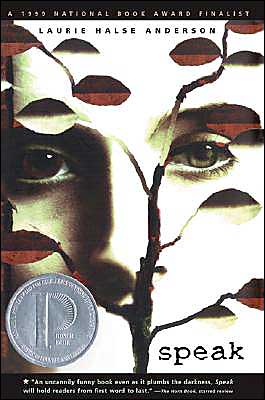
Speak by Laurie Halse Anderson

Summary: Ages 12-up. In a stunning first novel, Anderson uses keen observations and vivid imagery to pull readers into the head of an isolated teenager. Divided into the four marking periods of an academic year, the novel, narrated by Melinda Sordino, begins on her first day as a high school freshman. No one will sit with Melinda on the bus. At school, students call her names and harass her; her best friends from junior high scatter to different cliques and abandon her. Yet Anderson infuses the narrative with a wit that sustains the heroine through her pain and holds readers' empathy. A girl at a school pep rally offers an explanation of the heroine's pariah status when she confronts Melinda about calling the police at a summer party, resulting in several arrests. But readers do not learn why Melinda made the call until much later: a popular senior raped her that night and, because of her trauma, she barely speaks at all. Only through her work in art class, and with the support of a compassionate teacher there, does she begin to reach out to others and eventually find her voice. Through the first-person narration, the author makes Melinda's pain palpable: "I stand in the center aisle of the auditorium, a wounded zebra in a National Geographic special." Though the symbolism is sometimes heavy-handed, it is effective. The ending, in which her attacker comes after her once more, is the only part of the plot that feels forced. But the book's overall gritty realism and Melinda's hard-won metamorphosis will leave readers touched and inspired. Copyright 1999 Reed Business Information, Inc.

Themes:
Identity, Inclusion/Exclusion, Teenage/Female Violence

Classroom Implications: This novel pulls the reader into the world of an isolated teenager. This novel would be matched well with The Misfits, The Perks of Being a Wallflower, The Pinballs, The Outsiders, or Define Normal--all books that address identities and lives on the periphery. This is an excellent novel to study first person narration, symbolism, internal/external conflict and point of view.

Purchase

American Born Chinese by Gene Luen Yang

Summary: Indie graphic novelist Gene Yang's intelligent and emotionally challenging American Born Chinese is made up of three individual plotlines: the determined efforts of the Chinese folk hero Monkey King to shed his humble roots and be revered as a god; the struggles faced by Jin Wang, a lonely Asian American middle school student who would do anything to fit in with his white classmates; and the sitcom plight of Danny, an All-American teen so shamed by his Chinese cousin Chin-Kee (a purposefully painful ethnic stereotype) that he is forced to change schools. Each story works well on its own, but Yang engineers a clever convergence of these parallel tales into a powerful climax that destroys the hateful stereotype of Chin-Kee, while leaving both Jin Wang and the Monkey King satisfied and happy to be who they are. Yang skillfully weaves these affecting, often humorous stories together to create a masterful commentary about race, identity, and self-acceptance that has earned him a spot as a finalist for the National Book Award for Young People. The artwork, rendered in a chromatically cool palette, is crisp and clear, with clean white space around center panels that sharply focuses the reader's attention in on Yang's achingly familiar characters. There isn't an adolescent alive who won't be able to relate to Jin's wish to be someone other than who he is, and his gradual realization that there is no better feeling than being comfortable in your own skin.--Jennifer Hubert

Themes:
Identity, Inclusion/Exclusion, Ethnicity

Classroom Implications: This graphic novel could combine with other graphic novels, like Maus and Persepolis, to create a social issue book club of graphic novels. It also has a strong identity theme and could be matched with similarly themed books, like The Skin I'm In and Becoming Naomi Leon.

Purchase