 Summary: Gr. 7-12. "Dating is not a concept adults in our barrio really get." The contemporary teenage voices are candid, funny, weary, and irreverent in these stories about immigrant kids caught between their Puerto Rican families and the pull and push of the American dream. The young people hang out on the street in front of the tenement El Building in Paterson, New Jersey, where the radios are always turned full blast to the Spanish station and the thin walls can't hold the dramas of the real-life telenovelas. As in her autobiographical adult collection Silent Dancing (1990), Cofer depicts a diverse neighborhood that's warm, vital, and nurturing, and that can be hell if you don't fit in. Some of the best stories are about those who try to leave. Each piece stands alone with its own inner structure, but the stories also gain from each other, and characters reappear in major and minor roles. The teen narrators sometimes sound too articulate, their metaphors overexplained, but no neat resolutions are offered, and the metaphor can get it just right (the people next door "could be either fighting or dancing"). Between the generations, there is tenderness and anger, sometimes shame. In one story, a teenage girl despises the newcomer just arrived from the island, but to her widowed mother, the hick (jibaro) represents all she's homesick for. Raul Colon's glowing cover captures what's best about this collection: the sense of the individual in the pulsing, crowded street. Hazel Rochman
Themes: Culture, Hybrid Identities, Generational Differences, Individuality, Community
First Sentence:
When I was sent to spend the summer at my grandparents' house in Puerto Rico, I knew it was going to be strange, I just didn't know how strange.
Classroom Implications: Many classrooms have and use W.D.Myer's 145th Street Stories or G. Soto's Baseball in April collection of stories. Ortiz adds to this base of literature and gives a voice to the Puerto Rican communities that she reflects in her writing.
Purchase
 Summary: Grade 2-4 - An exuberant picture-book biography of the Cuban-born salsa singer. From its rhythmic opening, the first-person narrative dances readers through Cruz's youth in Havana, a childhood bounded by scents of nature and home, the sweet taste of sugar, and the sound of music. A singer from an early age, Cruz sang so continually that one of her teachers finally urged her to share her voice with the world. Thus encouraged, she entered competitions, undeterred when her racial heritage prevented her from competing - undeterred, even, when the advent of Castro's communist regime forced her to leave Cuba as a refugee. Positive even in exile, Cruz made New York City her own and took Miami by storm. The salsa-influenced prose presented in English and in Spanish is followed by a straightforward vita of the singer, noting her death in July 2003. Lopez's distinguished, luminous acrylic paintings are alive with motion, lush with brilliantly layered colors, and informed with verve and symbolism. This is a brilliant introduction to a significant woman and her music. The only enhancement required is the music itself. Copyright © Reed Business Information, a division of Reed Elsevier Inc. All rights reserved.
Parallel Texts: When Marian Sang by Pam Munoz Ryan matches the content of this picture book biography. Both stories tell of singers that battled society forces, whether they be racism or regimes, in order to share their gift of music with the world. These stories are especially important in the classroom due to the diminished time celebrating and exploring the music arts.
Other texts that celebrate the music arts include...
John Coltrane's Giant StepsElla Fitzgerald: The Tale of a Vocal Virtuoso
Duke Ellington: The Piano Prince and His Orchestra (Caldecott Honor Book)
Charlie Parker Played Be Bop
Purchase
 Summary: Grade 4-8-The dramatic story of Chavez's 340-mile march to protest the working conditions of migrant farmworkers in California is the centerpiece of this well-told biography. Readers meet Chavez at his grandparents' home in Arizona where he lived happily amid a large extended family. His childhood was cut short when, due to financial difficulties, the family was forced to move to California to seek employment. After years of laboring in the fields, Chavez became increasingly disturbed by the inhuman living conditions imposed by the growers. The historic 1965 strike against grape growers and the subsequent march for "La Causa" are vividly recounted, and Chavez's victory-the agreement by the growers granting the workers better conditions and higher pay-is palpable. While sufficient background information is provided to support the story and encourage further research, focusing on one event makes the story appealing to younger readers. The text is largely limited to one side of a spread; beautifully rendered earth-toned illustrations flow out from behind the words and onto the facing page. A fine addition to any collection.Sue Morgan, Tom Kitayama Elementary School, Union City, CA Copyright 2003 Reed Business Information, Inc.
Themes: Activism, Peace, Social Activism, Hope, Prejudice, Perseverance
Classroom Implications: A must to match with Cesar: Si, Se Puede!/ Yes, We Can! by Carmen Bernier-Grand. This picture book is an excellent piece of nonfiction/biography that will reach and inspire students. Cesar's life is an accessible venue by which to teach fairness, activism, peace and perseverance.
Teacher's Guide to Book
Purchase
 Summary: Grade 2-6–The life and times of César Chávez are vividly re-created in this collection of poems. Where most biographies stick to the facts of what a person did, this one also touches on the man's character and values. Children will learn about Chávez, but, more importantly, they will learn the important lessons he taught, and they will be able to apply them to their own lives. The lyrical language describes events and paints evocative pictures to which children will relate. Diaz's stylized, computer-drawn, folk-art illustrations capture the subject's private and public life, from the images of picking fruit to peaceful demonstrations. A glossary and translation of the Spanish words used, a concise well-written biographical essay, and famous Chávez quotes are appended. An excellent choice for most libraries.–Scott La Counte, Anaheim Public Library, CA Copyright © Reed Business Information, a division of Reed Elsevier Inc. All rights reserved.
Themes: Activism, Peace, Social Activism, Hope, Prejudice,
Classroom Implications: This books makes a perfect compliment iwth Harvesting Hope: The Story of Cesar Chavez by Kathleen Krull. Whereas Krull's book is a biographical picture book, Bernier-Grand's book offers a more poetic, minimalistic tribute to Chavez's life's work.
Note: A glossary and translation of the Spanish words used, a concise well-written biographical essay, and famous Chávez quotes are appended. (amazon.com)
Purchase
 Summary: PreS-Gr. 3. The creators of Tomas and the Library Lady (1997) offer another glowing picture book set in the American Southwest, but this time, the story is a magical tall tale. In a cozy village, Dona Flor grows from an unusual child, who can speak the language of plants and animals, into a giant, whose heart is as large as her enormous hands and feet. After ferocious animal cries terrorize the villagers, Flor sets out to find their source. The culprit--a tiny, mischievous puma, who ingeniously amplifies his kittenish growl into a beastly roar--is an amusing surprise, and Flor soothes the cat in its own language, returning peace to her village. Mora strengthens her economical, poetic text with vivid, fanciful touches: the villagers use Flor's colossal homemade tortillas as roofs, for example. Colon's signature scratchboard art extends the whimsy and gentle humor in lovely scenes of the serene heroine sweet-talking the animals or plucking a star from the sky. A winning read-aloud, particularly for children who can recognize the intermittent Spanish phrases. Gillian Engberg Copyright © American Library Association. All rights reserved
Themes: Peace, Fear, Leadership, Compassion
Classroom Implications: An American Southwest myth is an excellent addition to a study on myths and folktales in a classroom. This picture book includes Spanish phrases, which always benefit native and emerging Spanish speakers. The author uses descriptive, poetic language that is sure to bring students into the story.
Purchase
 Summary: Gr. 6-9. From an early age, Sofia has watched the comadres in her close-knit barrio community, in a small Texas town, and she dreams of becoming "someone who makes people into a family," as the comadres do. The secret, her young self observes, seems to lie in telling stories and "being brave enough to eat a whole tequila worm." In this warm, entertaining debut novel, Canales follows Sofia from early childhood through her teen years, when she receives a scholarship to attend an exclusive boarding school. Each chapter centers on the vivid particulars of Mexican American traditions--celebrating the Day of the Dead, preparing for a cousin's quinceanera. The explanations of cultural traditions never feel too purposeful; they are always rooted in immediate, authentic family emotions, and in Canales' exuberant storytelling, which, like a good anecdote shared between friends, finds both humor and absurdity in sharply observed, painful situations--from weathering slurs and other blatant harassment to learning what it means to leave her community for a privileged, predominately white school. Readers of all backgrounds will easily connect with Sofia as she grows up, becomes a comadre, and helps rebuild the powerful, affectionate community that raised her. Gillian Engberg Copyright © American Library Association. All rights reserved
Themes: Leadership, Family, Traditions, Identity, Community, Privilege, Prejudice
Classroom Implications: This book speaks to the development of a child's identity within her Mexican-American heritage. Many traditions are interwoven through the text that help celebrate and educate around Mexican-American traditions. The book is entertaining, but also delicately tackles white privilege and prejudice. This notion of white privilege is also covered in Woodson's If You Come Softly and would make an interesting parallel text for this piece.
Purchase
 Summary: (Ages 12+) What would life be like for a teen living under a dictatorship? Afraid to go to school or to talk freely? Knowing that, at the least suspicion, the secret police could invade your house, even search and destroy your private treasures? Or worse, that your father or uncles or brothers could be suddenly taken away to be jailed or tortured or killed? Such experiences have been all too common in the many Latin American dictatorships of the last 50 years. Author Julia Alvarez (How the Garcia Girls Lost Their Accents) and her family escaped from the Trujillo regime in the Dominican Republic when she was 10, but in Before We Were Free she imagines, through the stories of her cousins and friends, how it was for those who stayed behind.
Twelve-year-old Anita de la Torre is too involved with her own life to be more than dimly aware of the growing menace all around her, until her last cousins and uncles and aunts have fled to America and a fleet of black Volkswagens comes up the drive, bringing the secret police to the family compound to search their houses. Gradually, through overheard conversations and the explanations of her older sister, Lucinda, she comes to understand that her father and uncles are involved in a plot to kill El Jefe, the dictator, and that they are all in deadly peril. Anita's story is universal in its implications--she even keeps an Anne Frank-like diary when she and her mother must hide in a friend's house--and a tribute to those brave souls who feel, like Anita's father, that "life without freedom is no life at all." --Patty Campbell
Themes: Oppression, Activism, Family, Membership, Identity, Resistance
Classroom Implications: This book takes a different spin on identity and immigration by telling the story of those left behind. This novel is to be appreciated for its honest look at Latin American dictatorships and the impact they have on families, advocacy and identity. This book can move through different themed book clubs: realistic fiction, social issues, and even possibly historical fiction. Lower level readers can help access this text by listening to the audio version.
Purchase
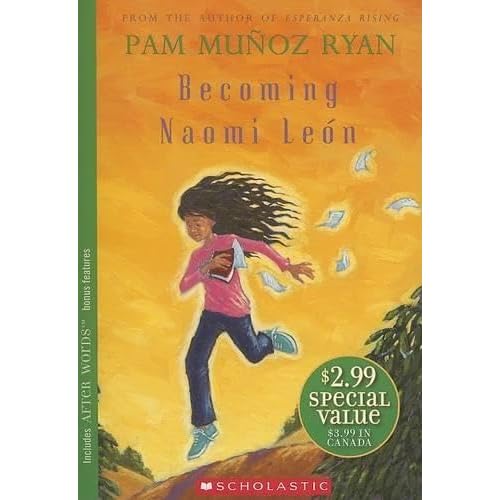 Summary: Grade 4-7–Naomi Soledad Leon Outlaw lives with younger brother Owen and her fiercely practical Gram in a trailer park in California in this novel by Pam Munoz (Scholastic, 2004). An unpopular fifth grader, she spends lots of time in the library with the other outcasts and the kind librarian. Naomi's talent is carving objects out of soap. After being gone for seven years, her mother shows up one day with a scary boyfriend, Clive. Gram lets the children know that their mother, Terri Lynn, has always been wild and irresponsible. They're worried that she will assert her parental rights and take the children away. Naomi is insecure and particularly susceptible to her mother's attention. Owen is essentially ignored by Terri Lynn because he has some physical deformities, but Clive thinks he could use Owen's deformities to make money gambling. Gram, the neighbors, and the children go to Oaxaca to find the children's father and get him to sign papers making Gram their guardian. Their dad is thrilled to see them, and Naomi learns that her talent for soap carving is inherited from her father. This deeply moving story is expressively and sympathetically narrated by Annie Kozuch. Characterization is excellent and listeners will be happy that Naomi finds confidence, love, and security.–B. Allison Gray, John Jermain Memorial Library, Sag Harbor, NY
Themes: Identity, Family, Overcoming Adversity, Belonging
Classroom Implications: This novel carries a strong Latina voice of a female protagonist throughout the novel. Students are able to relate to the character's journey to discover her family history and her identity. This book makes a good choice for lower level readers ins 6th and 7th grade, as well as provides help to sp. ed. students in a full inclusion setting.
Purchase

